A Philadelphia shipyard enters Navy construction
Hanwha Defense USA has secured a $269 million contract to build a U.S. Navy medium landing ship in Philadelphia, giving the South Korean group its first Navy shipbuilding order and bringing naval vessel construction back to a city where the former Philadelphia Naval Shipyard closed in 1995.
Contents
- A Philadelphia shipyard enters Navy construction
- One firm order, with three possible additions
- How the new purchasing system works
- A smaller ship for islands and shallow shores
- The dates that shape delivery
- Expansion reaches beyond one landing ship
- Previous government work provides a starting point
- A Korean investment inside American construction rules
- What changes for workers and the fleet
- Key Points
The agreement, signed with TOTE Services on October 29, 2026, and announced on October 30, covers one ship at Hanwha Philly Shipyard, with options for three more. Construction is expected to begin in the fourth quarter of 2027. TOTE puts the program's first delivery in 2030, a year later than the Navy's previously stated 2029 schedule.
The award joins two changes in American shipbuilding: a Korean company is using a shipyard it bought in the United States to enter naval construction, while the Navy is putting a private construction manager between itself and the shipbuilders to coordinate delivery.
Hanwha acquired Philly Shipyard in December 2024 for about $100 million. Since then, it says it has spent about $350 million on equipment, technology and workforce preparation. Employment has risen from roughly 1,800 to 2,300, with ambitions to reach 4,000 or more.
The ship will carry Marines, military vehicles, equipment and supplies between coastal locations, including islands in the Indo-Pacific. Its ability to reach shallow shores is central to a military approach that spreads smaller groups across several locations instead of concentrating them at a few large bases.
One firm order, with three possible additions
TOTE Services selected Hanwha after inviting qualified American shipyards to submit proposals in July 2026. The company cited competitive pricing and Hanwha's acceptance of its subcontract terms. The selection process also considered safety, quality and delivery performance.
The $269 million award purchases one vessel. The options give TOTE the ability to order three more at Philadelphia if it chooses to exercise them. TOTE President Jeff Dixon has linked those additional ships to successful execution of the initial work.
Hanwha's order sits inside TOTE's $2.2 billion vessel construction manager contract, awarded by the Navy in July. That base arrangement covers up to eight ships, while the Navy and Marine Corps plan a fleet of 35.
The Navy directed work toward one ship at Bollinger Shipyards and four at Fincantieri Marinette Marine. Fincantieri's April 2026 contract covered materials requiring early purchase and production preparation for four vessels. TOTE says contract discussions with both companies are continuing. Hanwha is the first builder selected through TOTE's competitive process.
The practical picture is therefore an initial program involving three domestic builders, with different contracting steps still being completed. The latest delivery schedule begins in 2030; the wider ambition is a fleet of 35 ships.
How the new purchasing system works
TOTE Services serves as the prime contractor, meaning it holds the main agreement with the Navy and has direct contractual responsibility for overseeing construction and delivery. Shipyards such as Hanwha perform the building work under subcontracts.
The vessel construction manager model is familiar in commercial shipbuilding but new to Navy ship procurement. Instead of leaving each yard to manage a largely separate production effort, TOTE is intended to connect government requirements with construction across the participating yards.
TOTE plans to standardize the ships' configuration and buy materials in groups, known as block buys. Ordering the same components for several vessels can give suppliers more predictable demand and help secure better prices. Keeping designs consistent also reduces the number of different parts and arrangements builders must manage.
Jeff Dixon, president of TOTE Services, described the timing and competitive process in announcing the award:
Through a competitive process, we secured strong terms that benefit the government, along with build positions that allow construction to start in the fourth quarter of 2027.
The Navy's Portfolio Acquisition Executive for Maritime office approved the arrangement. A central goal is to limit unnecessary changes after construction begins. Navy officials have identified repeated changes to ship plans as one contributor to delays and rising costs.
A smaller ship for islands and shallow shores
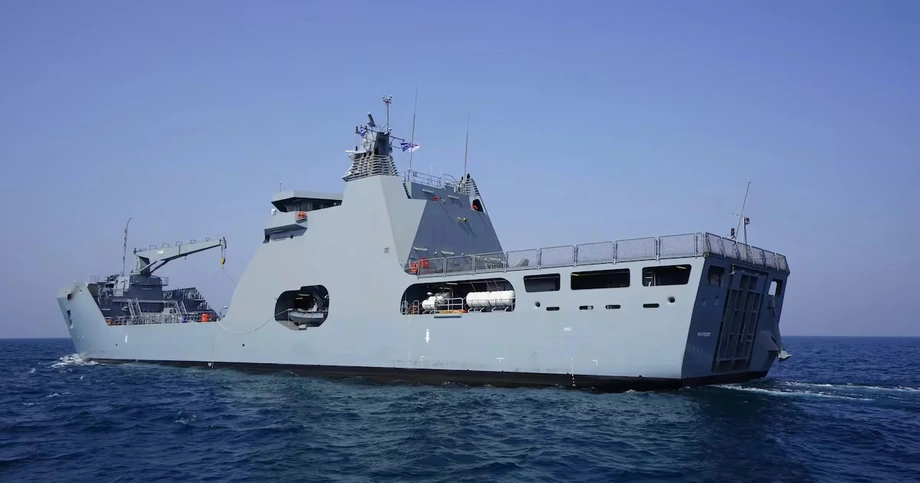
The medium landing ship, abbreviated LSM, is intended to transport up to about 100 Marines and their vehicles to shore, including during combat operations. At roughly 100 meters long and 16 meters wide, it offers a smaller means of moving forces and supplies through island chains.
The Navy and Marine Corps disclosed in December 2025 that the design's foundation came from Dutch shipbuilder Damen. The baseline derives from Damen's LST 100, a landing ship designed for shallow water and direct access to beaches through bow doors and a ramp.
The vessel is described as having a lightship displacement of approximately 2,687 tons. Lightship displacement means the ship's weight without its operational load of fuel, cargo and personnel. The Damen parent design is described at roughly 4,000 tonnes in a loaded configuration, explaining why descriptions using different loading conditions give different weights.
Published specifications describe a range of about 7,400 kilometers. Program requirements include a minimum range of 3,400 nautical miles, about 6,300 kilometers, a sustained speed of 15 knots and the ability to carry more than 500 tonnes of Marines and equipment. A stern flight deck is intended to support helicopters and aircraft that can take off and land vertically.
For Marines operating across the Indo-Pacific, beach access means supplies and vehicles can reach places without a large port. The ship supports Expeditionary Advanced Base Operations, a Marine Corps approach in which smaller forces operate from dispersed coastal positions and move between them.
The dates that shape delivery
Hanwha's award follows nearly two years of investment and preparation at Philadelphia. Defense USA personnel began working at the yard earlier in 2026 to prepare it for naval construction.
The principal milestones are:
- December 2024: Hanwha acquired Philly Shipyard for about $100 million.
- December 2025: The Navy and Marine Corps disclosed the landing ship design's Damen foundation.
- April 2026: Fincantieri Marinette Marine received an initial contract for materials and production preparation.
- July 2026: The Navy awarded TOTE its $2.2 billion management contract, and TOTE invited shipyard proposals.
- October 29, 2026: Hanwha Defense USA signed the $269 million agreement.
- Fourth quarter of 2027: Construction at Philadelphia is expected to begin.
- 2030: TOTE expects the program's first vessel to be delivered.
The Navy had previously stated a first delivery in 2029, and a Philadelphia account also placed it in late 2029. TOTE's October announcement gives the later date of 2030. The announcement did not explain the change.
The schedule leaves roughly a year between contract signing and the expected start of construction. During that period, the yard must prepare production space, workers and equipment while continuing other government and commercial projects.
Expansion reaches beyond one landing ship
Hanwha operates on 110 acres at the former naval shipyard and agreed in September to lease another 47 acres. The additional land would expand its footprint by about 43 percent, providing room for facilities needed to build more ships at the same time.
The company plans a further $400 million investment in a dry dock, a larger training center and production sites. A dry dock is a basin that can be emptied of water so workers can build or repair the lower part of a ship.
Hanwha's broader ambition is to invest up to $5 billion over time and increase annual capacity from about 1.5 ships to as many as 20. Those figures imply more than a thirteenfold increase in output. The yard currently produces roughly one vessel every eight months; reaching 20 a year would mean an average of one every few weeks.
The company is introducing updated welding and painting equipment, training systems and collaborative robots, which work alongside people on production tasks. It also aims to obtain facility certification for combatant construction by 2028.
The workforce has already grown by about 500 people, or roughly 28 percent, from the approximately 1,800 employed before the purchase. Reaching 4,000 employees would require at least another 1,700 positions beyond the current workforce of about 2,300.
Previous government work provides a starting point
Hanwha Philly Shipyard and TOTE already have experience working together on the U.S. Maritime Administration's National Security Multi-Mission Vessel program. Four of the five vessels have been delivered, with the fifth, Golden State, expected in 2027.
Under that program, TOTE has overseen shipyard selection, design, construction, testing, delivery and support planning. The existing relationship gives both companies experience with the yard's workforce and supply chain before the landing ship begins production.
The Philadelphia yard is also completing the first of three cargo ships for Matson. Hanwha has pursued other federal work, including conceptual design for the Navy's next generation logistics ship and a missile range instrumentation vessel for the Maritime Administration and Missile Defense Agency. Such a vessel carries equipment used to monitor missile tests.
Michael Coulter, president and chief executive officer of Hanwha Defense USA, described the company's preparation:
Since acquiring Philly Shipyard in 2024, Hanwha has made significant investments in its workforce and technology to pave the way to build for the U.S. Navy and other federal customers.
The landing ship adds a naval construction role to a yard sustained in recent decades by civilian government vessels and commercial cargo ships. Its ability to manage those overlapping orders will matter as it expands.
A Korean investment inside American construction rules
Hanwha's entry depends on building in Philadelphia. The Burns-Tollefson restrictions generally bar construction of Navy ships and major hull components in foreign shipyards. Acquiring an American yard gave the Korean group a domestic production base from which to compete for the work.
The contract is Hanwha's first warship order under the U.S.-Korea shipbuilding cooperation initiative known as MASGA. Its immediate effect is American construction work supported by Korean ownership, investment and production experience.
Hanwha Defense USA has also announced plans to take a controlling stake in the Philadelphia yard. Before that proposed restructuring, Hanwha Systems held 60 percent and Hanwha Ocean held 40 percent. Retired U.S. Navy Rear Adm. Tom Anderson is to oversee the yard as its operations move under the defense business.
Another Korean shipbuilder, HD Hyundai, has announced plans with American construction company Kiewit for a joint venture and a U.S. shipyard targeted to begin operating in 2029. Both efforts respond to a Navy seeking more construction capacity amid competition with China.
What changes for workers and the fleet
Philadelphia stands to gain naval construction work for the first time since the former Navy yard closed in 1995. The privately operated yard continued building ships after the site passed to the Philadelphia Industrial Development Corp. and its tenants in 1996, but those orders centered on commercial and civilian government vessels.
Representative Mary Gay Scanlon, whose district includes the yard, pointed to its union workforce and investment as reasons the selection matters. Welders, operating engineers and other skilled trades would be central to the expansion.
The Navy gains another potential production line for a ship designed around a specific operational need: moving relatively small Marine units and their equipment between shores. Using several yards gives the program more building locations at a time when American shipbuilding faces capacity limits and labor shortages.
The next concrete tests are the expected 2027 construction start, completion of the wider contracting arrangements and delivery beginning in 2030. For Philadelphia, those milestones will determine how quickly the investment plans become sustained production and additional employment.
Key Points
- Hanwha Defense USA won a $269 million contract for one Navy medium landing ship at Hanwha Philly Shipyard, with options for three more.
- Construction is expected to start in the fourth quarter of 2027; TOTE expects the program's first delivery in 2030.
- TOTE's $2.2 billion base contract covers up to eight ships within a planned fleet of 35.
- The ships will move Marines, vehicles and supplies between coastal locations, including shallow shores in the Indo-Pacific.
- Hanwha says it has invested about $350 million since acquiring the yard and plans further expansion of facilities and employment.
- The award combines Korean investment in an American yard with a new Navy construction management approach.