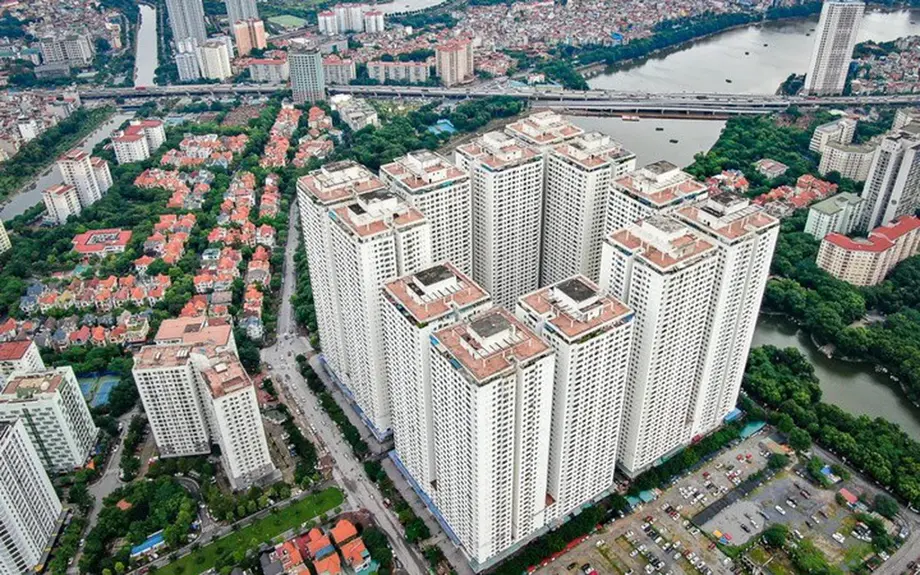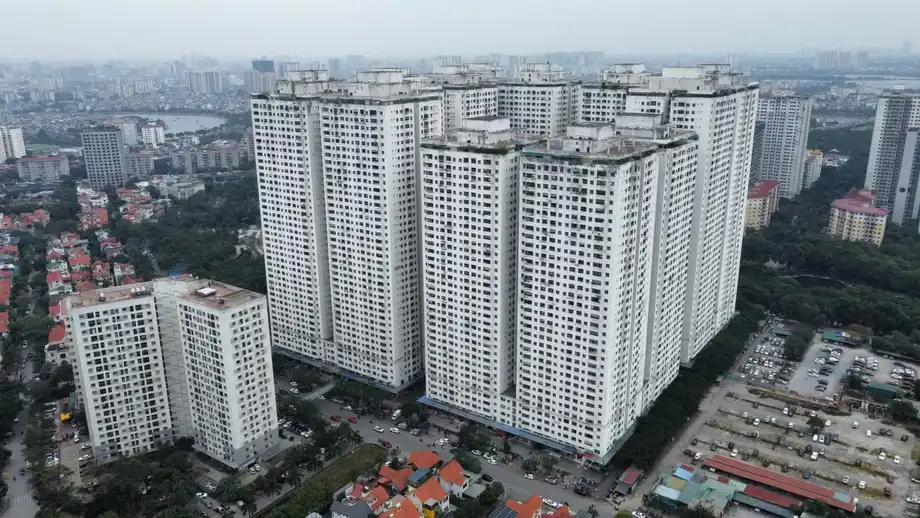
Nearly 25,000 apartments built against approval for 6,759
Hanoi has approved a special framework to address construction and land violations at 12 projects linked to Muong Thanh Group, requiring developers to prepare safe demolition arrangements within 30 days of an effective demolition order and allowing local authorities to enforce compliance at the developers' expense.
Contents
- Nearly 25,000 apartments built against approval for 6,759
- Which developments are covered?
- What allows a building to remain?
- Why residents may move from buildings that stay
- Extra floors and converted space increased density
- Safety concerns already affect daily life
- Who must organise demolition and pay?
- Replacement housing and compensation options
- Ownership papers remain tied to corrective work
- The timetable and the work still required
- Key Points
The Hanoi People's Council adopted the resolution on October 28, 2026. City figures show that the projects contain 24,943 apartments against 6,759 approved through planning documents or construction permits, an excess of 18,184. The actual total is about 3.69 times the approved number.
The first concrete indication of how the policy could affect households came at a November 5 meeting in Dinh Cong Ward. An initial review identified 246 apartments, measuring 43 to 74 square metres, whose occupants are expected to move from four buildings at Kim Van-Kim Lu.
Hanoi will assess buildings and individual sections separately. Some may remain after safety checks, infrastructure improvements and other corrective work. Others face demolition or the restoration of space originally intended for shops, technical equipment, nurseries or community activities.
Developers must fund compensation, relocation, demolition and repairs. The city has also adopted the principle that lawful buyers who were not responsible for the violations should not bear the resulting losses. For residents, the practical outcome will depend on detailed decisions about their own apartments, compensation and replacement accommodation.
Which developments are covered?
The resolution covers businesses associated with Le Thanh Than through legal representation, management, ownership, capital contributions or investment cooperation. Hanoi plans to prepare 12 corrective schemes, one for each project entry, rather than impose an identical solution across every development.
The list comprises Bemes, also known as CT6 Kien Hung; Dai Thanh; CT5 Tan Trieu; Xa La; the combined CT11 and CT12 housing project at Kim Van-Kim Lu; VP3, VP5 and VP6; and HH1, HH2, HH3 and HH4 at Linh Dam. A project entry can contain several buildings, explaining why the number of individual towers exceeds 12.
The decision follows the earlier proposed remedies for the same 18,184 excess apartments. The process has now moved from drafting a citywide mechanism to examining which structures can stay, which spaces must change use and which households require compensation or relocation.
Standing Vice Chairman of the Hanoi People's Committee Duong Duc Tuan told the council that the violations were extensive and had continued for years. He said ordinary legal procedures could not resolve the situation adequately while protecting residents and maintaining public order.
What allows a building to remain?
Hanoi's framework divides structures into two categories: those permitted to remain subject to conditions and those requiring demolition. Technical assessments and city decisions will determine the treatment of each building, component or area.
For occupied towers to remain, they must meet requirements for structural strength, fire prevention, firefighting, rescue and the safety of neighbouring buildings. Structural strength means that a building's foundations, columns and other supporting parts can safely carry its loads.
Water, electricity, parking, schools and community facilities must also meet requirements or have an approved, workable improvement plan. Towers must satisfy rules governing the distance between buildings and respect road boundaries, transport safety areas and corridors protecting infrastructure.
A building with an infrastructure shortfall may still be considered for retention if the other conditions are met and authorities approve a feasible remedy. Structures with inadequate load capacity, fire safety problems that cannot be corrected or violations of mandatory boundaries fall into the demolition category.
Low buildings permitted to remain must undergo approved renovation. Essential facilities such as kindergartens and schools must also be improved to meet operating requirements and local needs.
Why residents may move from buildings that stay
A tower approved to remain can still contain apartments whose occupants must leave. Hanoi requires the clearance of residential space created in areas intended for other functions, including podiums, technical floors and community facilities.
A podium is the broad base beneath a tower, often designed for shops, services or shared amenities. Turning such space into apartments increases the number of households while removing facilities intended to serve them. Under the resolution, cleared areas must return to their approved use or become suitable public facilities under a city decision.
Dinh Cong Ward Chairman Nguyen Tuan Anh said the review of CT11, CT12A, CT12B and CT12C had identified misuse of ground floor space and conversions on floors two to four. Areas intended for commercial services, nurseries and community activities had become apartments. The developer had also changed the approved distribution of apartment floor areas from the fourth floor upwards.
The initial list contains 246 apartments expected to require relocation. Ward authorities plan to publish the list and implementation schedule, continue inspections and determine future uses for the vacated space. At HH Linh Dam, specific apartments and floors requiring relocation have yet to be identified through the project review.
Nguyen Tuan Anh, the ward chairman, described the authorities' approach at the November 5 meeting:
The city's and the ward's position is to deal strictly with the violations while ensuring, to the greatest extent possible, the rights and social welfare of affected residents,
Extra floors and converted space increased density
Inspection findings at HH Linh Dam show how far construction departed from approved plans. The development was permitted to reach 27 floors, but HH4 rose to 36, while HH1, HH2 and HH3 reached 41. The excess ranges from nine to 14 floors.
HH Linh Dam began operating in 2015 and contains about 10,000 apartments, with an estimated population of 40,000. Its size makes decisions about demolition, repairs and relocation especially difficult because residents share lifts, electricity, water and fire protection systems.
Nearby VP6 grew from an approved 25 floors to 37, while its apartment count increased from 138 to 840, about 6.1 times the planned total. VP3 reached 32 floors instead of 29, with apartments rising from 192 to 451. VP5 reached 33 floors, four above approval, and increased from 216 apartments to 805.
At CT6 Kien Hung, the ward's review counted 1,584 apartments against 231 planned; the project has also been listed as containing 1,602 apartments. The ward identified three towers instead of two, 32 floors instead of 31, and one basement instead of two. It also recorded the replacement of a planned hotel component with housing.
CT6's podium expanded from 5,586 to 6,071 square metres. Its low housing area increased from 15 homes of three floors each to 38 homes of five floors each. At Dai Thanh, towers approved for 29 floors reached 31, with an additional attic level sold to residents.
Safety concerns already affect daily life
Residents have experienced failures that make the safety assessments more than a paperwork exercise. A fire on the 36th floor of CT12A at Kim Van-Kim Lu in late December 2024 stopped all four lifts serving floors 25 to 45. Less than half a month later, residents reported two further lift breakdowns.
At CT8A Dai Thanh in early 2025, about 20 people were trapped in the PL5 goods lift for roughly 45 minutes. Xa La experienced fires at CT5B and CT4A in September and October 2015. The CT4A basement fire forced hundreds of people to evacuate.
Tran Hoa, an HH Linh Dam resident since 2015, described having to walk 30 floors with young children when lifts stopped. Nguyen Hung, who lives at CT12A, called for prompt official notices so households facing relocation could arrange their work and family lives.
Architect Tran Tuan Anh of the Vietnam Urban Planning and Development Association said assessments should examine actual building quality alongside legal records. He identified lifts, water pumps, electrical systems, alarms, automatic firefighting equipment and escape stairs as facilities central to everyday safety and emergency response.
Bui Trung Dung, former director of the Construction Activities Management Agency, suggested examining whether some floors could become emergency refuge areas or communal spaces if technical conditions allow. His proposal would reduce residential density while seeking to keep more households in their established neighbourhoods.
Who must organise demolition and pay?
Ward and commune chairpersons will issue demolition orders and supervise implementation. Within 30 days after an order takes effect, the developer must select consultants, arrange funding and make relocation and demolition plans public.
Developers must also organise the required design checks and approvals, construction methods, supervision and acceptance procedures. Demolition must protect people, belongings, neighbouring buildings and the environment. Residents and their property must leave the affected area before work begins.
Local authorities can enforce demolition if developers fail to comply, with the developers responsible for the full cost. Where removing an entire structure or part of it would be unsafe or technically unworkable, local authorities must coordinate an assessment and submit an alternative to the city for decision.
Developers must pay for compensation, assistance, relocation, infrastructure improvements and restoration of the intended uses of space. They must also settle land obligations and surrender unlawful construction gains. Compensation and resettlement assistance are to take priority over payments of unlawful gains and land obligations.
Hanoi can use resources securing a developer's obligations or order enforcement against assets when responsibilities are not met. Public funds are not intended to cover costs belonging to developers, subject to any exception required by law.
Replacement housing and compensation options
Hanoi's implementation plan identifies Thanh Ha A, Thanh Ha B and My Hung as important locations for relocation and resettlement housing. Proposed solutions include moving residents to social or commercial housing at Thanh Ha, or arranging compensation so households can find another home.
For projects already subject to criminal proceedings, the plan envisages developers negotiating purchases of affected apartments after authorities establish compensation values based on market prices. Developers are also expected to negotiate rental assistance while residents await replacement homes.
The council presentation described compensation payment within 90 days for residents required to move. Household decisions and notices will need to specify the applicable payment schedule. Eligible households may receive priority to buy or enter a lease purchase arrangement for social housing without a lottery. A lease purchase arrangement allows occupants to pay towards ownership over time.
The earlier implementation plan described broader access to replacement housing without a lottery or beneficiary screening, while the council presentation and later policy descriptions tie social housing priority to eligibility under housing law. Individual relocation decisions will therefore matter for families assessing their options.
Residents may remain temporarily until authorities issue formal notices concerning demolition or a change of use. People whose only income comes from business activities in podium areas being converted may also receive assistance to stabilise their livelihoods.
Do Duc Nam, an HH Linh Dam resident, questioned whether Thanh Ha would have enough homes for affected households and whether compensation would buy an equivalent apartment at current prices. Fellow resident Trieu Quang Xuan highlighted the disruption that moving could cause children already attending local schools.
Ownership papers remain tied to corrective work
Some apartments at VP3, VP5, CT6 Kien Hung and CT5 Tan Trieu have received certificates recording land use rights and ownership of attached property. VP6 and HH1 to HH4 have not received them.
Under Hanoi's framework, eligible apartments allowed to remain have a route towards certificates after the required financial obligations and corrective measures are completed. Residents staying in their homes can continue their contracts without paying the developer's remediation costs.
Economic adviser Phan Chanh Duong has argued for separating the protection of innocent buyers from the resolution of developer violations, including finding ways to issue ownership documents sooner. The adopted approach in Hanoi still requires the relevant obligations and remedies to be completed.
Aqua City in Dong Nai offers a comparison involving delayed documentation. More than 1,100 townhouses and villas had been handed over by April 2026, and the first residents received ownership certificates on July 23. A plan announced in April envisaged around 752 certificates during 2026 in the Sun Harbor 2 and EverGreen 1 subdivisions.
Lawyer Hoang Ha of the Ho Chi Minh City Bar Association called for compensation based on contracts, applicable law and demonstrable losses. He also urged scrutiny of the agencies responsible for inspections and oversight when violations arose. National Assembly member Trinh Xuan An proposed stronger protections in housing legislation and financial security backing compensation obligations, including arrangements for developer insolvency.
The timetable and the work still required
Hanoi's earlier plan targeted submission of the special resolution before September 30, 2026. The documented approval process instead ran through October, followed by local meetings and inspections. The principal steps and targets are:
- October 22, 2026: The Justice Department appraised the draft through Report No. 547/BC-STP.
- October 23: City leadership agreed on the policy direction.
- October 25: The People's Committee submitted Proposal No. 428/TTr-UBND.
- October 28: The People's Council approved the resolution.
- October 30: The Construction Department's deadline for local apartment reviews.
- November 5: Dinh Cong Ward discussed the initial 246 apartments expected to require relocation.
- October and November 2026: Inspections and classification were scheduled.
- 2027: The city targets completion of relocation.
- 2027 to 2028: Designated demolition work is planned, with the city targeting completion in 2028.
Missing records remain a practical obstacle. Council member Can Thi Viet Ha sought solutions for unavailable land documents, drawings showing completed construction and contracts. Duong Duc Tuan said authorities would assess current conditions, search for original files and clarify the responsibilities of developers and public agencies for keeping and supplying them.
The Construction Department will lead reviews of construction and planning violations. The Agriculture and Environment Department will examine land matters, certificates and related obligations, while the Finance Department will assess investment procedures and financial liabilities.
Architect Luu Quang Huy, director of the Hanoi Institute of Construction Planning, said specific solutions must address livelihoods and schooling at replacement locations. At Dinh Cong's meeting, residential representative Tran Lan Phuong sought careful assessment and consultation, while CT12C management board head Uong Van Cuong said many residents wanted to stay and expected fair arrangements if moving became unavoidable.
Key Points
- Hanoi approved the special framework on October 28, 2026, covering 12 Muong Thanh related projects.
- The projects contain 24,943 apartments against 6,759 approved, an excess of 18,184.
- Buildings and individual areas will be assessed for conditional retention, demolition or restoration of their intended use.
- An initial Dinh Cong Ward review identified 246 apartments expected to require relocation.
- Developers must fund compensation, relocation, demolition and corrective work, with enforcement available if they fail to comply.
- Hanoi targets relocation in 2027 and completion of demolition in 2028.