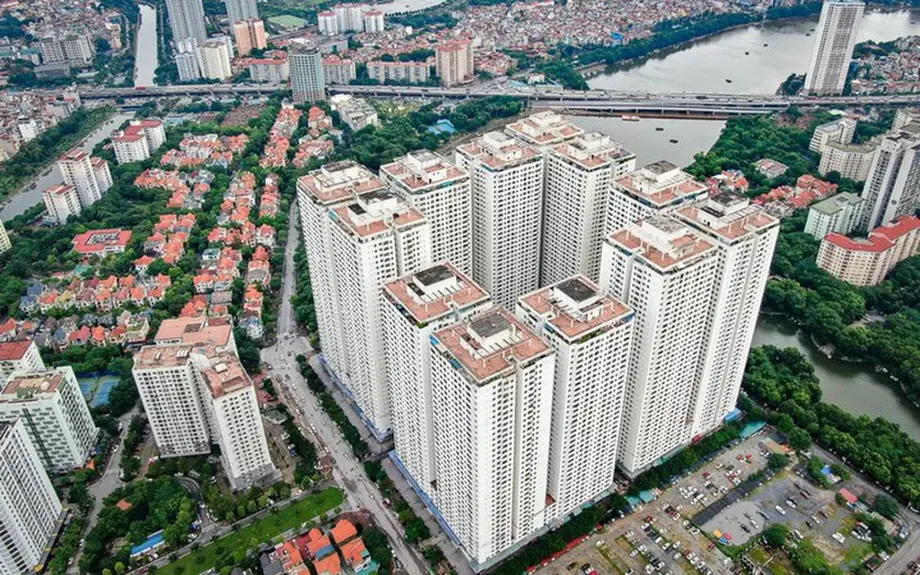
Nearly 25,000 apartments built where 6,759 were approved
Twelve housing projects linked to businesses associated with Mường Thanh Group contain 24,943 apartments despite approval for just 6,759, according to Hanoi's Department of Construction. The difference of 18,184 apartments is now central to a proposed city resolution that would determine which buildings can remain, which require changes and which must be demolished.
Contents
- Nearly 25,000 apartments built where 6,759 were approved
- Which projects are covered?
- How the dispute developed
- Three categories would determine what can stay
- Permission to remain may still require residents to move
- Developers would fund relocation and compensation
- What developers would have to pay
- Ownership certificates depend on more than an application
- Linh Đàm shows the scale of the decisions
- A proposed remedy, not the cancellation of violations
- Key Points
The figures mean the projects contain about 3.69 times the approved number of apartments. The excess alone is approximately 2.69 times the authorized total, equivalent to an increase of about 269%. That distinction matters: the nearly 2.7 figure describes the additional apartments, not the total number built.
The draft resolution of the Hanoi People's Council would combine financial obligations for developers with building assessments, possible relocation and a route to ownership certificates for eligible buyers. It would not automatically allow all 24,943 apartments to remain or guarantee certificates for every household.
Inspection findings issued between 2015 and 2017 identified violations involving investment, land use, planning and construction. Developers built contrary to approved plans, increased floor space and building heights, divided apartments into smaller units and changed the intended use of some areas.
The construction department says the resulting increase in population has strained local infrastructure and reduced residents' quality of life. Yet many homes have already been handed over, and families have lived in them for years. Hanoi now faces the task of enforcing the rules while addressing the housing rights and practical needs of those residents.
Which projects are covered?
The proposal covers projects belonging to businesses in which Lê Thanh Thản is a legal representative, owner or manager, or has participated through capital contributions or investment cooperation. The list stretches across several residential areas in Hanoi, with a large concentration in Linh Đàm.
The 12 entries are CT6 Kiến Hưng, also known as the Bemes residential and commercial complex; Đại Thanh, including CT8 and CT10; CT5 Tân Triều; the Xa La housing area; the combined CT11 and CT12 project at Kim Văn–Kim Lũ; VP3, VP5 and VP6; and the four HH1, HH2, HH3 and HH4 projects at Linh Đàm.
The distinction between a project and an individual tower helps explain the count. CT11 and CT12 form one project entry, while the HH Linh Đàm complex consists of four blocks, each containing three towers. The HH complex therefore has 12 towers within four of the projects covered by the draft.
Certificate status also varies. The construction department's assessment identifies some apartments at VP3, VP5, CT6 Kiến Hưng and CT5 Tân Triều as having received certificates of land use rights and ownership of assets attached to the land. VP6 and the HH1 to HH4 developments have not received them. The existence of certificates at some projects does not establish that every apartment there has one.
How the dispute developed
The inspection findings are years old, but the proposed remedy addresses buildings that are already occupied. At HH Linh Đàm, operations began in 2015, and residents have faced a prolonged wait for ownership documentation.
The main milestones are:
- 2015: The HH Linh Đàm complex began operating.
- 2015 to 2017: Inspectors issued findings on investment, land use, planning and construction violations at the projects.
- October 10: Hanoi began seeking public comments on the draft resolution. The consultation account does not specify the year.
- After technical review: The Hanoi People's Committee would decide which buildings or building portions fall into each proposed treatment category.
The proposal remains a draft, rather than a final decision for individual buildings. No confirmed adoption date, consultation closing date or timetable for completing the building classifications has been specified. Residents therefore cannot yet treat its proposed certificate and compensation procedures as settled entitlements.
Three categories would determine what can stay
The draft divides the affected structures into three groups. The first could remain in their current form, provided they are completed and in use, have no disputes, meet structural and fire safety requirements and do not adversely affect neighboring buildings.
Buildings in this group would also need adequate infrastructure or a plan to provide it. They must meet requirements concerning the surrounding landscape, road boundaries, protected corridors, transport safety zones and height clearance restrictions. These tests go beyond the question of whether residents already occupy the apartments.
The second group could remain subject to conditions. These buildings do not yet satisfy certain requirements, but their shortcomings could be corrected through technical work, additional infrastructure, relocation or a change of use. Permission to remain would therefore depend on remedial action rather than payment alone.
The third group would require demolition where safety problems, landscape conflicts or encroachment on protected boundaries cannot be corrected. It would also include certain low rise homes built on land designated for technical infrastructure, public facilities, defense, security or protected corridors where planning adjustments are not possible.
The Hanoi People's Committee would establish the specific lists after specialist agencies complete their assessments. If demolition of a structure in the third group cannot be carried out, the draft allows consideration of a change of use, provided it does not increase pressure on infrastructure. That possibility is not a promise that the structure could continue as housing.
Permission to remain may still require residents to move
A building's placement in the first group would not mean every occupied space inside it could remain an apartment. Residents would have to leave unauthorized homes or areas in the building base, technical floors and community rooms so those spaces could return to their planned function or serve the community.
Technical floors contain equipment and services needed for the building to operate. Community rooms are intended for shared use. Restoring these areas would address changes in function, even where the wider building meets the conditions for continued use.
For the second group, relocation would be required if additional infrastructure still could not support the resident population. The proposed sequence starts with unauthorized residential areas in building bases, technical floors and community rooms, followed by apartments on floors built above the approved height.
All residents and their property would have to leave structures in the third group. The practical consequence is that decisions must identify the affected portions of each building, not simply label an entire project. A development could continue operating while some households still face relocation.
Developers would fund relocation and compensation
Before residents move, developers would have to compile apartment lists, establish the lawful rights and interests involved in each case, disclose their proposed arrangements and seek residents' views on compensation, support and temporary accommodation.
The draft assigns developers responsibility for relocation funding and temporary housing. It also states that the costs of remedying violations would be paid by developers, not from the state budget. This separates the city's role in deciding and overseeing the remedy from the businesses' responsibility to pay for it.
Buyers required to relocate could negotiate one of three options: monetary compensation; equivalent housing in an eligible commercial project belonging to the developer; or the purchase or lease purchase of social housing without a lottery, if they meet the legal eligibility requirements.
Lease purchase allows a household to pay toward ownership over time. The social housing option would still be conditional on eligibility, so it is not an automatic replacement home for every affected buyer.
The draft does not establish individual compensation amounts or identify replacement apartments for particular families. Those details would depend on the assessment of rights and the arrangements made before relocation. The construction department also says implementation needs to take account of developers' ability to carry out their obligations.
What developers would have to pay
Developers whose buildings are allowed to remain would still have to surrender an amount defined in the draft as unlawful gains from the unauthorized construction. The proposed calculation is:
Additional unauthorized floor area × construction cost per square meter at the time the building entered actual use × 50%.
The construction cost would be drawn from the investment cost benchmark applicable when the building was brought into use. This is an area based calculation, not a fixed charge for each excess apartment. The total of 18,184 additional apartments therefore cannot, by itself, establish the amount payable.
Calculating a sum would require the unauthorized floor area and the relevant construction benchmark for each affected building. Neither a combined financial total nor the full inputs needed to calculate one have been specified. The formula also does not simply recover half the proceeds from apartment sales, because it uses construction cost rather than sale prices.
A separate obligation would cover land related payments. The draft bases that calculation on the official land price schedule multiplied by a coefficient set by the Hanoi People's Committee at the time permission is granted for the building or building portion to remain in its existing form.
The two obligations use different reference dates. The construction calculation looks back to when the building entered use, while the land calculation uses the point at which continued existence is approved. Developers would pay the required amounts into the city budget through the Hanoi State Treasury within the deadline stated in the relevant enforcement decision.
Ownership certificates depend on more than an application
For eligible apartments allowed to remain, the proposed sequence begins with the developer completing its financial obligations for unauthorized construction and land use. The business would then have to complete and submit the documents needed for buyers to obtain certificates.
These certificates, commonly called pink books in Vietnam, record land use rights and ownership of assets attached to the land, including apartments. Their absence is one of the central unresolved problems for residents at VP6 and HH Linh Đàm.
The draft includes a route for buyers to apply directly if the developer has completed its financial obligations but fails to submit the paperwork. The competent authority would then receive and process the buyer's application under the applicable rules.
That provision addresses developer inaction after payment. It does not remove the payment requirement or bypass the decision on whether an apartment may remain. The proposed route therefore depends on both the building assessment and the developer fulfilling its financial responsibilities.
Linh Đàm shows the scale of the decisions
At HH Linh Đàm in Hoàng Liệt ward, the approved height was 27 floors. The HH4 towers were built to 36 floors, nine above that limit, while HH1, HH2 and HH3 reached 41 floors, fourteen above it. Across its 12 towers, the complex contains approximately 9,000 apartments and 40,000 residents.
Those approximate 9,000 homes represent about 36% of the 24,943 apartments recorded across all 12 projects. The comparison shows why decisions affecting this single complex could have a substantial impact on the wider remediation effort.
VP6 presents another large departure from approval. It rose from an authorized 25 floors to 37, while apartment numbers increased from 138 to 840. The additional 702 homes mean its apartment count is about 6.1 times the approved figure.
Nguyễn Trọng, a resident of HH4C, said residents did not know which category the HH complex would fall into and wanted authorities to classify it and issue a final decision. His concern captures the uncertainty that the draft alone does not resolve.
Phạm Văn Đức, a member of the HH4B residents' representative body, called for enforcement against the developer while protecting people who had bought homes and settled there. Describing residents' wishes, he said:
The legitimate and sole wish of people who bought homes at HH is for the city authorities to create conditions for residents to live peacefully at HH Linh Đàm and issue pink books to homebuyers.
Đức also called for the developer to complete its financial obligations to the state and address infrastructure shortcomings. His position places secure housing, documentation and infrastructure repairs alongside accountability, rather than treating them as competing demands.
A proposed remedy, not the cancellation of violations
The construction department describes a separate resolution as necessary and urgent. Its assessment says existing special mechanisms for land violations committed before the 2024 Land Law took effect cannot be applied to these projects. It does not say the violations lack legal sanctions; instead, it identifies the difficulty of enforcing those sanctions where large numbers of homes are occupied.
Hanoi's assessment warns that extensive demolition and relocation could disrupt public order, affect residents' welfare and lead to large collective complaints. It also recognizes that implementing a remedy could temporarily disrupt families' employment, schooling and health, even if the policy improves living conditions over time.
The draft expressly preserves the effect of existing inspection findings, judgments and enforcement decisions. Allowing an unauthorized building or part of one to remain would be treated as a measure to address the consequences of the violation, not as a declaration that the original construction was lawful.
The next decisive steps are the technical assessments, decisions on building categories and any adoption of the resolution. Until those occur, the number of households requiring relocation, the total developer payments and the timetable for issuing certificates remain unresolved.
Key Points
- The 12 projects contain 24,943 apartments against approval for 6,759, an excess of 18,184.
- The draft proposes three categories: buildings that may remain, those that may remain with conditions and those requiring demolition.
- Some residents could have to move even where the wider building is allowed to stay.
- Developers would pay remediation costs, relocation expenses and specified construction and land obligations.
- Eligible buyers could apply directly for certificates if developers complete their financial obligations but fail to submit documents.
- HH Linh Đàm contains approximately 9,000 apartments and 40,000 residents, with its final classification still unresolved.
- The proposal would not cancel existing inspection findings, judgments or enforcement decisions.