A sales freeze ends as public debt heads toward 1,000 trillion won
South Korea has removed a requirement for the prime minister to approve public institution asset sales in advance, reopening a route to cash for heavily indebted companies including Korea Electric Power Corporation (KEPCO). The Prime Minister's Office notified ministries and public institutions of the change in October 2026, about 11 months after President Lee Jae-myung ordered a halt to government asset sales amid concerns about low prices.
Contents
- A sales freeze ends as public debt heads toward 1,000 trillion won
- What changed, and which safeguards remain?
- How the policy reached this point
- KEPCO reopens its overseas asset review
- Why KEPCO needs cash before 2027 ends
- The electricity network competes for the same money
- Housing, gas and rail face different pressures
- Some transactions have already restarted
- Removing one signature may not make sales quick
- Key Points
The financial pressure is substantial. The Ministry of Finance and Economy's financial management plan for 2026 to 2030 projects that debt at 37 major public institutions will rise from 778.3 trillion won in 2026 to 997.4 trillion won in 2030. That is an increase of 219.1 trillion won, or about 28%, in four years.
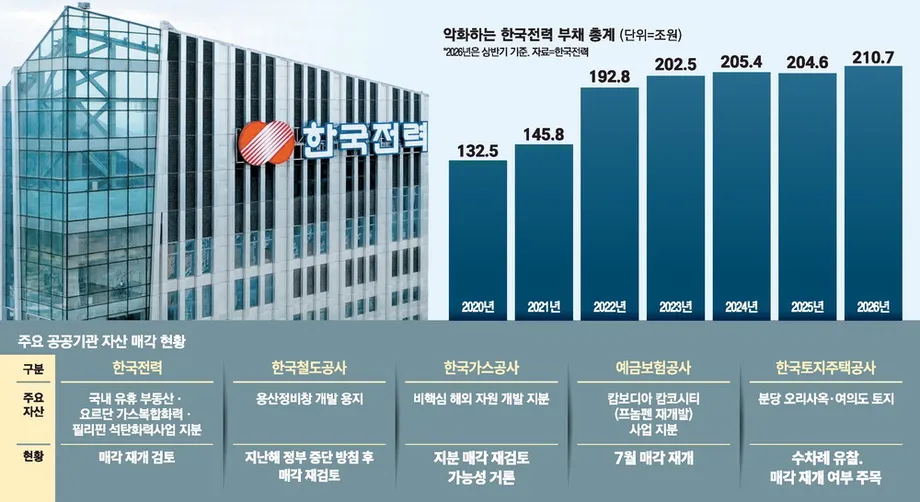
KEPCO, whose total debt exceeds 200 trillion won, is reconsidering sales of stakes in power projects in Jordan and the Philippines. Other possible disposals include unused land, office properties and interests in overseas resource projects. Public institutions need money both to manage existing debts and to keep investing in electricity networks, housing and other services.
The government is removing one approval stage while retaining controls intended to protect public property from being sold too cheaply. Advance reporting to lawmakers remains part of the framework for large transactions, and legislation requiring parliamentary approval for sales of public institution equity is still under review. The practical question for these companies is how quickly they can turn potential sales into cash while meeting the remaining requirements.
What changed, and which safeguards remain?
The prime minister's approval requirement was an emergency response to controversy over public assets being sold at low prices. Although sales could proceed with that approval, the need for a decision at the top of government, together with stronger internal checks and concern about subsequent audits, sharply restricted disposals.
The government says its revised system now provides other protections. A reform plan announced in December 2025 included advance reporting to the relevant National Assembly standing committee for asset sales worth at least 30 billion won. The framework also provides for Cabinet consideration of government asset sales at that threshold and review bodies drawing on outside experts.
Discounted sales below appraised value are, in principle, prohibited. An appraisal is an assessment of what an asset is worth. Requirements for renewed valuations and limits on reductions in auction prices are intended to prevent repeated unsuccessful auctions from leading to steep discounts.
A Prime Minister's Office official said no sales below appraised value had occurred and explained that the emergency approval requirement was ending as the reform process reached its final stage. The official also committed the office to continuing oversight:
We will regularly inspect the status of asset sales and manage them thoroughly.
How the policy reached this point
President Lee's intervention followed controversy during a National Assembly audit over prices in the Korea Asset Management Corporation's asset disposal process. The policy then moved from a broad halt toward a system combining financial valuations, ministry reviews and parliamentary scrutiny.
- November 3, 2025: Lee ordered a complete halt to government asset sales and a fresh examination of transactions underway or under consideration. Sales considered unavoidable subsequently required the prime minister's advance approval.
- December 2025: The government announced reforms including advance reporting to the relevant parliamentary committee for sales worth at least 30 billion won.
- October 2026: The Prime Minister's Office notified ministries and public institutions that sales could proceed without the prime minister's advance approval. KEPCO received the related government notice around the middle of the month.
- End of 2027: A temporary provision allowing KEPCO to issue bonds up to an expanded statutory limit is scheduled to expire.
A proposed amendment to the Act on the Management of Public Institutions would require National Assembly approval before public institution equity is sold. That proposal remains under parliamentary review. For companies considering the sale of ownership stakes, its progress matters alongside the rules already governing valuations and reporting.
KEPCO reopens its overseas asset review
KEPCO began reviewing asset sales after receiving the October government notice. Stakes in a gas combined cycle power project in Jordan and a coal power project in Cebu, in the Philippines, are among the assets being reconsidered. A combined cycle plant uses a gas turbine and captures its hot exhaust to generate additional electricity through a steam turbine.
The utility had left asset sales out of the financial recovery plan it prepared earlier in 2026 under government guidance. The latest policy change allows that work to resume. KEPCO has said it must examine market conditions and profitability and consult the government; it has set no sale timetable or method.
Domestic property may also return to consideration. Assets included in earlier recovery measures encompassed approximately 640,000 square metres at KEPCO's training centre in Gongneung, Seoul, land at its southern Seoul headquarters in Yeouido, and properties connected with office consolidation and unused substation sites.
A stake sale in KEPCO KDN, however, has been left out of the current discussions. Its board put that proposal on hold in 2024 after lawmakers and the electricity workers' union objected to transferring an interest in a company responsible for important power network information systems to private ownership.
Why KEPCO needs cash before 2027 ends
KEPCO's debt exceeds 200 trillion won, and its ratio of debt to equity is above 400%. In simple terms, it owes more than four times the accounting value of its equity, the amount left after liabilities are subtracted from assets. Annual net interest costs are around 4 trillion won, equivalent to roughly 11 billion won a day.
Its outstanding bonds are approaching 80 trillion won. Bonds are loans provided by investors that must be repaid or replaced when they mature. KEPCO currently benefits from a temporary rule allowing bond issuance up to six times the combined value of its capital and reserves.
That exception is due to end in December 2027. Without an extension or other measures, the lower legal borrowing limit could constrain both new borrowing and refinancing, the process of taking out new debt to repay debt falling due.
Electricity price increases are also constrained by concerns about household and business costs. Asset sales offer another source of money, but they exchange property or ownership stakes for cash. Selling an overseas power investment also means giving up whatever future income would have come from the stake sold, making the sale price and the investment's expected earnings central to each decision.
The electricity network competes for the same money
KEPCO needs more than 56 trillion won through 2036 to expand transmission and substation infrastructure. Those facilities carry electricity over long distances and adjust voltage so power can move safely between generators, factories, businesses and homes.
The investment is tied to demand from developments including the semiconductor cluster in Yongin, Gyeonggi province, and artificial intelligence data centres. Financial constraints have already contributed to delays in network construction. In parts of the east coast and Honam region, power plants have been built while the infrastructure needed to carry their electricity remains insufficient.
KEPCO told lawmakers that it could determine its funding arrangements after establishing the total financing shortfall through the following year's budget, prepared at the end of each year. Asset sales therefore sit within a wider budgeting problem: the utility must pay financing costs, replace maturing borrowing and fund construction from the money it can raise.
The overseas power stakes and unused domestic land are attracting attention because they could release money without selling the domestic electricity network itself. The amount available will depend on which assets reach the market, the prices buyers offer and the approvals each transaction requires.
Housing, gas and rail face different pressures
Korea Land and Housing Corporation (LH) is projected to have debt of 372.8 trillion won by 2030 as it advances projects including the third generation of new towns. That would represent about 37% of the 997.4 trillion won projected for the 37 major public institutions, showing how much of the expected debt is concentrated in the housing agency.
LH properties attracting renewed attention include its Ori office building in Bundang, Seongnam, and land held in Yeouido. Previous attempts to sell some properties have encountered unsuccessful auctions. The assets are large, but their size also means finding buyers with enough money and a workable development plan.
Korea Gas Corporation has around 14 trillion won in receivables associated with city gas supplied to residential and other civilian customers. These are costs recorded for recovery through future charges. The company may reconsider disposals of interests in overseas resource projects that sit outside its central operations.
Korea Railroad Corporation, known as Korail, faces persistent losses and the need to refinance debt. Its Yongsan railway maintenance depot development land is among the assets being discussed. Korea Mine Rehabilitation and Mineral Resources Corporation and Korea National Oil Corporation remain in negative equity, meaning their recorded liabilities exceed their assets. Power generation subsidiaries and Korea Expressway Corporation also face pressure to review unused property and ownership stakes.
Some transactions have already restarted
The Korea Deposit Insurance Corporation has resumed efforts in 2026 to sell claims and equity connected with Cambodia's Camko City project after work was halted under the government's earlier policy. Claims are rights to seek repayment; equity represents an ownership interest. Selling them allows an institution to recover money now rather than continue holding them.
Other possible transactions include Industrial Bank of Korea's stake in Korea Financial Security. Alongside overseas energy investments and major development sites, this illustrates how varied the potential disposal programme is. Each asset has a different pool of buyers, valuation process and route to completion.
Public institutions must also decide which properties or investments they can spare. An unused office site presents a different financial choice from a stake in a power plant that earns income. The government's broader opening gives institutions room to examine both, while leaving the commercial decision and the applicable reviews to be completed.
Removing one signature may not make sales quick
A weak property market, unsuccessful auctions and negotiations with local governments over permitted land use can all slow transactions. A buyer's willingness to pay for a large site may depend on what can be built there. Stronger appraisal requirements can protect public value while extending the work needed before an agreement is reached.
Parliamentary scrutiny and the prospect of audits also remain important for managers deciding whether to proceed. A Ministry of Finance and Economy official said the replacement parliamentary controls could be stricter than the prime minister's approval requirement. The official described the change this way:
Although the measure requiring the prime minister's prior approval has ended, it does not mean the sale procedures have been eased,
For KEPCO and other indebted institutions, the policy removes a major administrative obstacle. Their immediate task is to identify assets that can attract acceptable bids, complete the required reviews and fit any proceeds into their financing plans. The pressure is especially acute for KEPCO as its expanded bond issuance allowance approaches its scheduled expiry at the end of 2027.
Key Points
- South Korea ended the prime minister's advance approval requirement for public institution asset sales in October 2026, about 11 months after imposing the emergency restriction.
- Valuation safeguards and advance parliamentary reporting for large sales remain part of the framework. A bill requiring parliamentary approval for equity sales is still under review.
- Debt at 37 major public institutions is projected to rise from 778.3 trillion won in 2026 to 997.4 trillion won in 2030, an increase of about 28%.
- KEPCO is reviewing stakes in power projects in Jordan and the Philippines while facing debt above 200 trillion won and major electricity network investment needs.
- KEPCO's temporary expanded bond issuance allowance expires at the end of 2027.
- Market conditions, valuations, parliamentary scrutiny and land use negotiations will shape how quickly potential asset sales produce cash.