A 200-Minute Interview to Outsmart AI
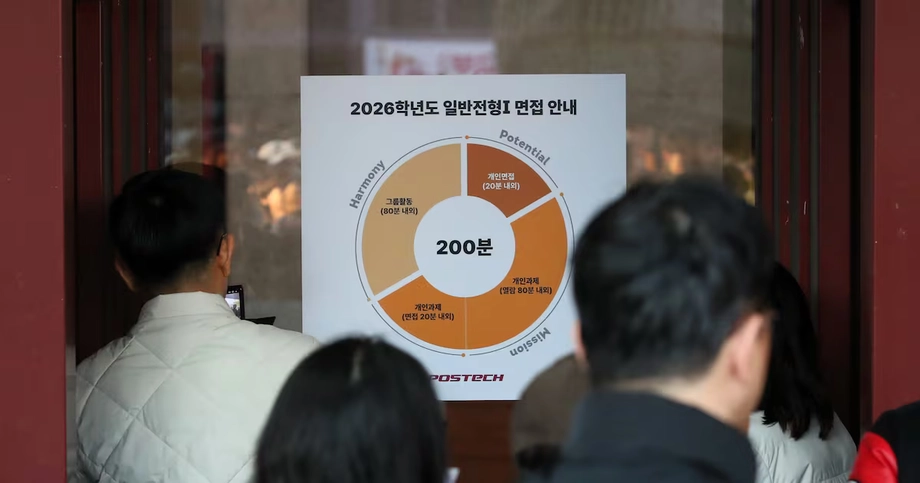
On the morning of November 22, 2026, more than 700 students filled the Grand Auditorium at POSTECH in Pohang, North Gyeongsang Province. They had passed the first document screening for early admissions. Pickets at the entrances read 'Interview Process Guide: 200 Minutes' and showed a circular graph: 20 minutes for individual interviews, 100 minutes for individual tasks, and 80 minutes for group tasks. The total was 3 hours and 20 minutes. Most university interviews in South Korea last 15 to 20 minutes, making POSTECH's evaluation 10 times longer. Students who arrived in the morning left the test site after 5 p.m., when it was already dark.
Contents
- A 200-Minute Interview to Outsmart AI
- Why South Korea's Universities Are Worried
- Inside POSTECH's 200-Minute Evaluation
- What Kind of Questions Take 200 Minutes?
- The Fairness Question: Six Professors for Every Student
- KENTECH's Creativity Interview: 30 Minutes to Prepare, 15 to Explain
- How the Two Approaches Differ from Traditional Exams
- What This Means for Students and Universities
- Key Points
POSTECH, a leading engineering university that admits 370 students each year, introduced the long interview in last year's admissions. This year, it applied the format to its largest admission category, General Admission I, which selects 220 students. The previous interview time was 50 to 60 minutes, so the change quadrupled the duration. The category does not consider College Scholastic Ability Test (CSAT) scores, and school grades are only referenced during the document screening.
The university says the purpose is to find students who can solve problems actively and communicate well, abilities that test scores alone cannot reveal. A POSTECH official explained the approach.
Interview questions have no fixed answers, and we look at why students think a certain way and their reasoning. Using AI is meaningless here.
The official added that professors can judge whether abilities are genuine because they observe students for 200 minutes.
Why South Korea's Universities Are Worried
The urgent interest in interviews follows a series of cheating scandals involving artificial intelligence. On November 15, 2026, Han Won-seok, 34, admitted he cheated his way to the top of the certified tax accountant examination. He scored 397.5 out of 400 in the first round, answering 159 of 160 questions correctly. He used a miniature camera to photograph exam questions, sent the images to generative AI software, and read the answers on his smartphone. The Ministry of Employment and Labour invalidated his passing certificate and barred him from the exam for five years. This was reported in the tax exam confession.
Four days later, on November 19, South Korea held the College Scholastic Ability Test, known as the Suneung, for 2027 university admissions. The education ministry said 551,864 people registered and 497,526 sat the exam at 1,312 centers. The government deployed about 8,400 extra staff, including 1,800 specialists checking for smart devices and 6,600 corridor monitors. Public Wi-Fi near exam halls was shut down, all stationery except black pencils was banned, and stickers were placed over clothing buttons. Three emergency alerts were sent to every mobile phone in the country, even on silent mode, to expose hidden devices. Officials reported 111 suspected cases of electronic device misconduct.
Education Minister Choi Kyo-jin resigned on November 22, taking responsibility for the confusion. President Lee Jae Myung accepted the resignation within an hour and put Prime Minister Han Seong-sook in charge of subsequent measures. Choi said in a statement, 'As the minister in charge, I believe I cannot escape criticism that we failed to prepare in advance.' His resignation was covered in the minister's resignation.
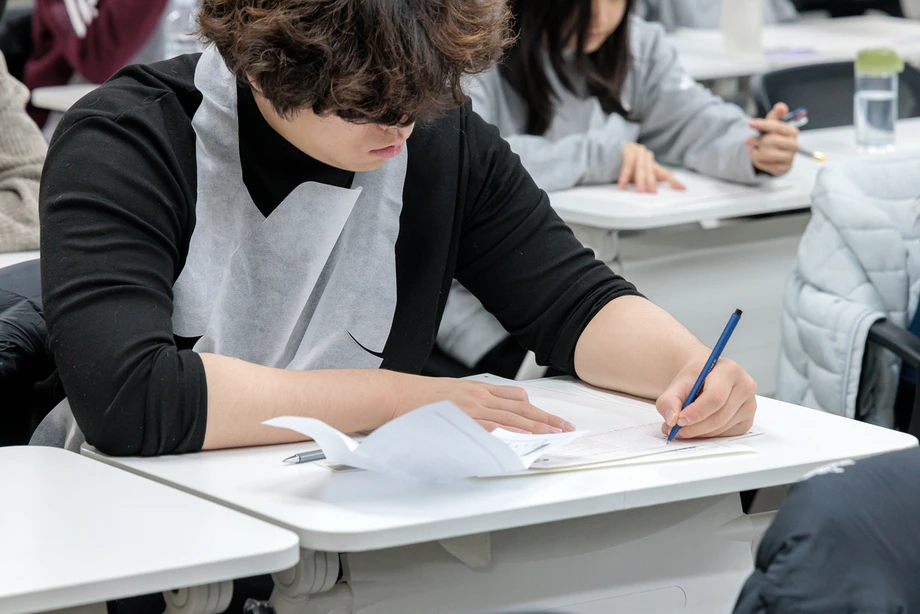
Universities also took physical measures. Kyung Hee University required test takers to wear disposable plastic aprons to prevent hidden cameras, and used handheld metal detectors. Sogang University deployed equipment to detect hidden cameras. Sookmyung Women's University banned earplugs and required hair to be tied back. Sungkyunkwan University provided pens and pencils. These measures followed reports of smart glasses being used in exams at Yonsei University and the University of Seoul. The details were reported in metal detectors and aprons.
Inside POSTECH's 200-Minute Evaluation
The 200 minutes at POSTECH are divided into three parts. Students spend 20 minutes in an individual interview, 100 minutes on individual tasks, and 80 minutes on group tasks. For the group tasks, eight students form a team. The university arranged for each student to be evaluated by six professors. Out of 282 faculty members, 270 participated as evaluators, or 95 percent. Only those unavoidably occupied with academic conferences or overseas schedules were excluded.
Preparing the questions was also intensive. Professors involved in question development held more than 20 meetings since June. The chair of the question development committee said the time spent creating questions was about 10 times longer than in a typical year. The university says the long evaluation allows it to see a student's full capabilities, not a single mistake. One student said, 'In short interviews, one mistake can be hard to recover from, but the extended time allowed us to demonstrate our full capabilities.'
What Kind of Questions Take 200 Minutes?
The questions differ from standard problem-solving items. Applicants were asked to explain the physics principles behind amusement park rides. They were also asked to share their thoughts on balancing profit generation and consideration for vulnerable groups, such as people with disabilities, when operating an amusement park. These questions have no single correct answer.
A new group task added this year presented a scenario: resources had been discovered on the moon. Two countries with different technological strengths, one specialized in mining and the other in transportation, needed to collaborate. Students had to negotiate how the two nations could work together to extract the resources. The goal was to assess mathematical and scientific abilities as well as humanities, social awareness, and communication skills.
POSTECH President Kim Seong-keun explained the philosophy behind the change.
In the AI age, we should not cultivate students who merely follow rigid frameworks but select those with the potential to set broader directions. This admission process is the result of our university's long-term deliberation.
A POSTECH official added that because questions have no fixed answers and professors focus on reasoning, AI use has no meaning.
The Fairness Question: Six Professors for Every Student
To reduce disputes over scoring, POSTECH assigned six professors to evaluate each student. This means one student's performance is judged by multiple people, which the university says improves fairness. A student named Park, 18, who applied to POSTECH, Seoul National University's College of Natural Sciences, and KAIST this early admission season, said, 'I appreciated being evaluated by multiple professors.' Another student, Kim, 17, a soon-to-graduate science high school student from a regional area, said, 'The group task made me realize the exam valued communication skills among students as much as scientific knowledge.'
The university acknowledges that the format requires many resources. With 270 professors involved, POSTECH commits nearly its entire faculty to the admissions process for one day. The investment reflects the university's view that selecting students with creativity and potential is more important than sorting them by one or two points on a test.
KENTECH's Creativity Interview: 30 Minutes to Prepare, 15 to Explain
Another university drawing attention is the Korea Institute of Energy Technology, known as KENTECH, in Naju, Jeollanam-do. Since its founding in 2022, KENTECH has selected new students through a creativity interview. This year, the interview will be held on November 30. The format is 30 minutes of preparation followed by 15 minutes of questioning in person. Applicants analyze material in a preparation room and construct their own line of reasoning. Then they sit with two interviewers to explain the basis for their answers and how they reached their judgment.
The interviewers ask additional questions based on the applicant's responses. This makes memorizing an answer prepared by AI useless. KENTECH assesses divergent thinking, problem-solving ability, and insight grounded in the humanities. The focus is on the process of arriving at an answer. Interviewers look at whether the material presented, the applicant's assumptions, the grounds for judgment, and the final conclusion connect logically. They also watch whether applicants cling to their original thinking when new conditions are introduced or revise and expand it reasonably. Even if conclusions differ, applicants can be rated well as long as their explanation is persuasive.
Past questions show the direction. In the creativity interview for the 2026 academic year, applicants were asked to compare and evaluate four hypothetical technologies. They had to recommend the best one by weighing function and effectiveness, safety, social and ethical impact, environmental and energy considerations, and user experience. There was no single correct answer. KENTECH drew a record 31.14 applicants per seat in this year's early admissions round. This year, it will select 100 out of 110 new students through the creativity interview.
Chang Kwang-jae, head of KENTECH's admissions and student affairs office, said in a statement.
Through the creativity interview, we will build an admissions process in which students who prepare in earnest are evaluated on their own ability.
A KENTECH official added that because questions have no fixed answers, passing the interview through AI cheating is impossible, and students are evaluated solely on their own capabilities. The university plans to tighten management at the site, including controls on bringing in electronic devices.
How the Two Approaches Differ from Traditional Exams
Traditional exams often have fixed answers. Generative AI can read a question and produce an answer within seconds, which makes it a tool for cheating. Extended interviews and creativity interviews change the task. They ask students to explain their reasoning, defend their judgments, and respond to new conditions. The answers are personal and cannot be generated without the student's own thinking.
POSTECH's format is longer, lasting 200 minutes with individual and group tasks. KENTECH's format is shorter, with 30 minutes of preparation and 15 minutes of questioning. Both rely on trained evaluators who ask additional questions and judge the process, not just the conclusion. Both make AI use pointless because there is no fixed answer to copy and because the student must speak for themselves over an extended period.
The shift also changes what students need to prepare. Instead of memorizing facts, applicants must practice forming arguments, listening to others, and explaining their reasoning. For universities, the challenge is scale. POSTECH uses 270 professors for 700 applicants. KENTECH uses two interviewers per applicant for 100 selected students. These models require far more faculty time than a standard written exam.
What This Means for Students and Universities
For students, the message is that test scores alone may not be enough for some selective programs. The General Admission I category at POSTECH does not consider CSAT scores, and school grades are only used in document screening. The interview decides. At KENTECH, the creativity interview selects the vast majority of the incoming class: 100 out of 110 students. Students who can think on their feet and communicate well have an advantage.
For universities, the move is a response to a national crisis. The government has called for a complete overhaul of the exam system. President Lee Jae Myung said cheating with AI threatens fairness and public trust, and called the conduct a serious crime. Prime Minister Han Seong-sook has been put in charge of subsequent measures. The education ministry reported 111 suspected device cases during the Suneung, and the minister resigned. Universities are now experimenting with formats that technology cannot easily break.
What is not yet known: POSTECH and KENTECH have not announced when they will release final admission results for this round. The government has not published a detailed plan for its promised overhaul. The interviews will take place on November 28 for POSTECH and November 30 for KENTECH. The Suneung results are scheduled for release on December 11, 2026.
Key Points
- POSTECH introduced the interview of 200 minutes in last year's admissions and applied it to 220 places in General Admission I this year.
- The interview lasts 3 hours and 20 minutes: 20 minutes for individual interviews, 100 minutes for individual tasks, and 80 minutes for group tasks.
- 700 applicants will be interviewed on November 28, and 270 of 282 professors (95 percent) will serve as evaluators.
- Each student is evaluated by six professors, and question writers held over 20 meetings since June.
- KENTECH will hold its creativity interview on November 30, with 30 minutes of preparation and 15 minutes of questioning.
- KENTECH selects 100 of 110 new students through the interview and drew 31.14 applicants per seat this year.
- The interviews are a response to AI cheating scandals, including the tax exam confession on November 15, 2026, and 111 suspected device cases during the Suneung on November 19.
- Education Minister Choi Kyo-jin resigned on November 22, and President Lee Jae Myung called for an overhaul of the exam system.