A crisis of trust reaches the national entrance exam
South Korean President Lee Jae Myung called on Friday, Nov. 20, for a complete overhaul of the country's national examination system, after cheating scandals involving generative artificial intelligence (AI), miniature cameras and smart glasses shook confidence in tests that can shape students' education and careers.
Contents
- A crisis of trust reaches the national entrance exam
- From miniature cameras to AI glasses
- What happened during the CSAT?
- Past exams are now under scrutiny
- Why the issue carries unusual weight
- Why device checks cannot solve everything
- Universities and educators debate a different kind of test
- What happens next?
- Key Points
The latest wave of concern began when Han Won-seok, the top scorer on the national tax accountant examination, admitted using a miniature camera to photograph questions, sending the images to an AI tool and checking answers on a smartphone. Investigators are also examining alleged cheating involving a perfect scorer on the Legal Education Eligibility Test, or LEET, who was found dead in a Seoul motel on Thursday.
On Friday, Lee said cheating with AI threatens fairness and public trust in a country where examination results can influence access to universities, professions and jobs. He called the conduct a serious crime and said the response must extend to exams that have already taken place.
Speaking at a meeting with senior aides in Seoul, the president described the damage he believes cheating causes. Lee said it "rocks the basic order of our society by undermining fairness and trust." He called for a fundamental rewrite of the rules.
The national examination system should be completely overhauled from A to Z to reflect the changing environment.
Lee also ordered investigations into suspected cheating in past exams and called for strict penalties. His Friday call followed a Nov. 17 online emergency review from the Philippines, where he directed officials to investigate cases in which exam papers may have been photographed and uploaded to AI systems.
The government's immediate concern was the College Scholastic Ability Test (CSAT), commonly called the Suneung. The exam took place on Nov. 19 for university admissions in the 2027 academic year. South Korea's earlier pre exam security plan had added device checks and staff at test sites, but the latest incidents showed how quickly the challenge can spread from one type of device to another.
From miniature cameras to AI glasses
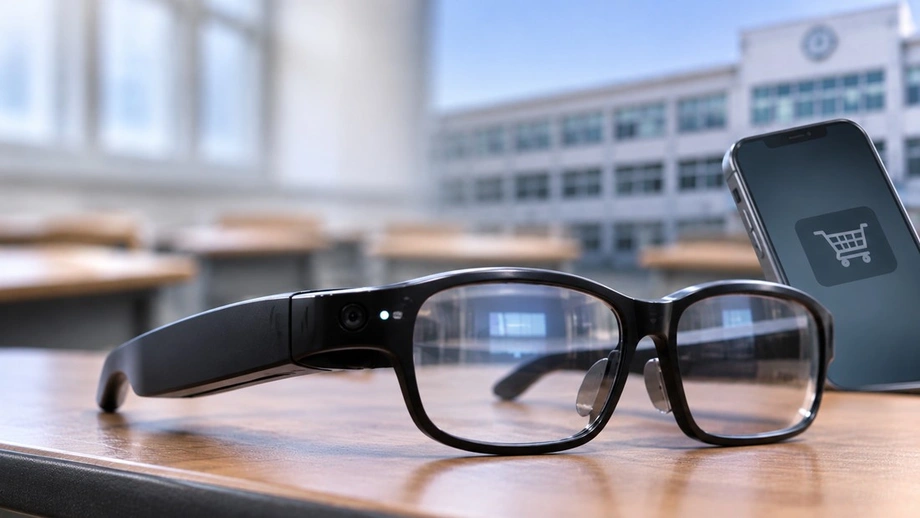
Han's reported method did not require smart glasses. He said he used a small camera to capture questions, then relied on a phone and generative AI, software that can create answers from instructions and, in some systems, interpret text in images. The method matters because it shows why a ban on one kind of wearable device cannot address every way a test taker might transmit a question.
Han admitted using the same approach in a certified public accountant examination. The Ministry of Employment and Labor and the Human Resources Development Service of Korea decided to invalidate his result and bar him from taking the tax accountant examination for five years. The ministry and agency also began reviewing national qualification tests held this year.
Earlier cases show the problem had surfaced before Han's confession. A person who secretly used a phone to ask ChatGPT for answers during a national qualification exam in April 2025 was fined 3 million won by the Incheon District Court in February. In 2023, a candidate who brought a pen camera into a hazardous materials exam was also fined 3 million won, and the device was confiscated.
In May, a man in his 40s was caught using AI powered glasses during a fire protection facilities engineer certification exam in Gwangju. Prosecutors indicted him under the National Technical Qualification Act, the first legal case involving those glasses. Two other men in their 20s were booked after similar allegations at exam sites in Seoul and Mokpo. Separate cases involving AI glasses were also detected in English language tests.
Universities have faced the same challenge. Two applicants were caught switching to smart glasses during entrance examinations in Seoul: one at the University of Seoul on Oct. 3 and another during a mathematics essay test at Yonsei University. The University of Seoul barred its applicant from future entrance exams for three years. Yonsei was reviewing what action to take.
What happened during the CSAT?
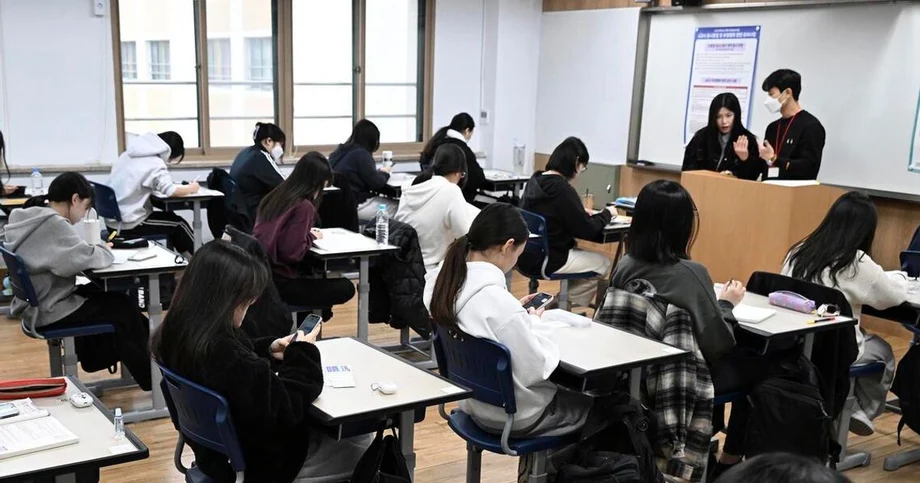
South Korea's Education Ministry said 111 suspected violations involving prohibited electronic devices were detected during the Nov. 19 CSAT. That was higher than the initial count of 98. Some test sites found phones that had not been handed in, while a tiny camera and earphones were found in Yongin and a student wearing smart glasses was caught in Cheonan.
Authorities deployed about 8,400 additional personnel across 1,312 test sites. The staffing included about 75,000 proctors, roughly 1,800 workers assigned to smart device checks and about 6,600 corridor monitors. Proctors checked students' glasses during each exam period and inspected belongings and clothing for devices that could be concealed in ordinary items.
Emergency mobile alerts were used to prompt students to hand in phones. The first alert went out at 8:30 a.m.; 22 smartphones that had not been submitted were found across nine cities and provinces. Lee later directed officials to consider sending at least one additional alert without warning during the exam, alongside other measures such as supplying students with approved stationery.
The government's presidential briefing said Lee also ordered a full review of cases in which test papers had been photographed and uploaded to AI during exam hours. He asked officials to consider a reward of at least 100 million won for people who report cheating with advanced electronic devices and to pursue a law requiring major technology companies to provide information in investigations of national qualification exams.
Before the CSAT, the Education Ministry had found four smart glasses cheating cases in middle and high school exams during the year. Authorities also reviewed reports of hidden devices at university admission tests. Security steps for the CSAT were expanded after Han's confession, but officials have not said how many of the 111 suspected violations involved AI glasses or whether every case led to a confirmed cheating finding.
Past exams are now under scrutiny
The inquiry is widening beyond the latest entrance exam. The Labor Ministry and the Human Resources Development Service plan to examine 528 locations where national qualification tests were held this year. They will look for unusually high scores compared with the previous three year average and large gaps between candidates' rankings, then review answer sheets and refer suspicious cases for investigation.
A government task force is also preparing broader anti cheating measures. Officials are considering more AI inspection systems, checks of all glasses and radio wave detectors, which can identify some electronic transmissions. The Human Resources Development Service has said it will review all national qualification exams for signs of irregularities.
Police are also investigating two suspected cases in which phones were hidden in shoes or clothing during the CSAT. Officials have been asked to preserve last year's exam papers while authorities examine whether earlier tests may also have been compromised. A post exam reporting centre is planned, and investigators may compare scores and communications records when assessing allegations.
In one recent case, prosecutors and police can examine the devices and records Han turned over. The investigation into the LEET allegations faces different difficulties because the 32 year old man accused in that case died on Thursday. Police found him at a motel near Cheonho Station in eastern Seoul. A handwritten note was found in the room, and authorities have not publicly given a conclusion about the allegations or the cause of his death.
Lee Jin-woo had denied cheating allegations and planned to livestream himself solving part of the CSAT to answer questions about his academic ability. He did not appear for the planned broadcast. Attorney Park Eun-sun, who filed a class action lawsuit involving Lee, urged police to continue investigating and examine his devices and whether anyone else may have been involved.
Why the issue carries unusual weight
South Korea's examination system has a direct effect on access to education and careers. The CSAT is a major part of university admissions, and the universities students attend can influence later job opportunities. That pressure helps explain why a cheating scandal involving one test can prompt concern well beyond the exam room.
The National Center on Education and the Economy's Korea profile says almost 80 percent of primary and secondary students received private tutoring in 2023. Families often pay for extra lessons because exam scores and university admissions matter so much. The scale of tutoring also raises concerns about student stress and unequal access to preparation.
That system makes confidence in fair marking and secure testing especially important. When a candidate can use a camera and AI to answer questions without being noticed, honest candidates and families may question whether scores reflect what students know. The concern reaches beyond university admission: national qualifications can determine who enters regulated professions.
Companies have also tightened controls on smart glasses and other wearables. Firms linked to Samsung, SK, Hyundai Motor and LG, as well as shipbuilders and defense contractors, have restricted the devices or required approval before they enter sensitive sites. Some companies inspect devices or ask staff to leave them in lockers. South Korea's National Office of Investigation recorded 179 technology leak cases and apprehended 378 people last year, illustrating why a concealed camera raises concerns in workplaces as well as examination halls.
Why device checks cannot solve everything
Smart glasses may look like ordinary eyewear, while miniature cameras can be built into pens, buttons and other everyday objects. Visual inspections can miss concealed equipment. Radio wave detectors can find some signals, but they may not identify a device that processes AI directly on the device, and detecting a signal does not by itself show that someone used it to cheat.
Human monitoring also has limits when test sites are large and staff must check thousands of people quickly. At the same time, more intensive searches can delay exams and make honest students anxious. During the CSAT preparations, revised rules about permitted writing instruments reached some proctors late, requiring additional explanations and training.
President Lee's Nov. 17 instructions addressed both prevention and investigation. He asked officials to consider legislation requiring major AI companies to supply relevant information in national qualification investigations, and he called for a review of all cases where exam questions may have been uploaded during test hours. The practical questions include what records companies can provide, how quickly investigators can access them and how to protect the privacy of ordinary users.
Penalties are also being debated. Cheating on the tax accountant exam can bring a five year ban. The government is considering extending the current one year restriction for CSAT cheaters to as long as 10 years, while the ruling Democratic Party has said it will pursue a 10 year ban for candidates caught using AI. Those proposals are under discussion, not a single rule already in force across all exams.
Universities and educators debate a different kind of test
Fourteen universities planned stronger device controls for essay admission tests on Nov. 21 and 22. Korea University barred electronic devices and strengthened searches of students' belongings. Kyung Hee University planned to provide disposable aprons and use electronic detectors when students left for the bathroom. The measures show how quickly security changes are reaching tests outside the national exam.
Some educators argue that stronger searches and longer bans will not be enough. They have called for more written answers, essays, oral interviews and assessments designed around particular universities or fields of study. Such tests could ask students to explain their reasoning instead of selecting an answer, although they require more time and staff to grade consistently.
Park Do-soon, the first director of the Korea Institute for Curriculum and Evaluation, has argued that written exams measure only about one tenth of curricular goals. Korea University professor Cho Byeok has called for ending the Suneung. Other educators have cautioned that marking written answers fairly for hundreds of thousands of applicants is difficult, and that university specific tests could increase pressure on families to buy tutoring.
Seoul's education office proposed a roadmap in December 2025 that would begin changes in 2028 and phase out the Suneung by the 2040 academic year, with a greater role for essay assessments. The national government has not adopted that plan, and the Seoul office cannot change the countrywide admissions system on its own. Lee's call for a full overhaul brings that wider debate into the immediate policy agenda, but no national replacement timetable has been announced.
What happens next?
The immediate work is to determine which suspected cases can be substantiated, assess past qualification exams and make sure the rules are applied consistently. Authorities have said they will review this year's national qualification tests and investigate suspicious CSAT cases, including allegations tied to earlier exams. A joint task force is due to prepare comprehensive measures by the end of the year.
For students, the next tests are already approaching. Universities must decide how to keep prohibited devices out of examination rooms without disrupting applicants, while police and ministries work through allegations that may involve devices, AI services and people who are no longer available to question. A longer term decision about what exams should measure will take more time than adding an inspection or a ban.
Key Points
President Lee Jae Myung called on Nov. 20 for a complete overhaul of South Korea's national examination system after AI related cheating scandals.
The Education Ministry counted 111 suspected electronic device violations at the Nov. 19 CSAT, up from an initial count of 98.
Han Won-seok admitted using a miniature camera, AI and a smartphone to cheat on qualification exams; authorities decided to invalidate his tax accountant result and impose a five year ban.
Officials plan to review 528 national qualification exam sites and are investigating suspected cheating at the CSAT and in earlier tests.
Universities are increasing device checks, while educators debate essays, interviews and other changes to what high stakes exams measure.