1,312 Test Sites Prepare for an Exam Under Scrutiny
South Korea will hold its university entrance examination on Thursday, November 19, 2026, despite demands for a postponement after the top scorer in a national tax accountant examination admitted using a miniature camera, a smartphone and artificial intelligence to cheat. At least one official trained to identify smart glasses will be stationed at each of the country's 1,312 testing sites.
Contents
- 1,312 Test Sites Prepare for an Exam Under Scrutiny
- The Confession That Turned Concern Into an Emergency
- How the Response Developed
- What Candidates Must Hand In
- Smart Glasses Can Work Without Spoken Commands
- Why Disabling Wi-Fi Is Only Part of the Plan
- New Detection Equipment Will Come Too Late
- Searches Raise Questions About Privacy and Authority
- Pressure for a Delay Meets a Broader Reform Plan
- Investigations Will Continue After the Examination
- Key Points
Distribution of question papers and answer sheets began Monday across 85 test districts. The College Scholastic Ability Test (CSAT), commonly called the Suneung, is for admission in the 2027 academic year. Its security arrangements are now being expanded with three days remaining before candidates sit down to take it.
Prime Minister Han Seong-sook directed eight ministries and agencies at a November 16 meeting to coordinate safeguards before, during and after the examination. The government is examining whether public Wi-Fi can be disabled at all testing sites, requiring candidates to surrender digital devices and preparing investigations into suspected cheating after results are issued.
Education Minister Choi Kyo-jin rejected a delay when addressing the National Assembly's Education Committee on Monday. He said moving the examination could create greater disruption for candidates.
Postponing the exam could cause even greater confusion, so it would be difficult to consider,
Additional security measures are due to be announced Tuesday morning, November 17. The immediate challenge is to make inspections consistent across the country while protecting honest candidates from unnecessary interruptions and distress.
The Confession That Turned Concern Into an Emergency
Han Won-seok, 34, admitted on November 15 that he had cheated in both rounds of this year's certified tax accountant examination. He also said he had used the same method in a certified public accountant examination. Police received his statement of voluntary surrender and began investigating.
Han described the method during an appearance on a lawyer's YouTube channel.
I cheated by taking pictures of the questions with a miniature camera, sending them to AI, and checking the answers on a smartphone,
His first round score in April was 397.5 out of 400, equivalent to about 99.4 percent of the available points. He reportedly missed just one of 160 questions. He also ranked first overall after the second round in July.
Police said his lawyer submitted a miniature camera, laptop and smartphone on Sunday evening. Investigators are examining whether the phone was used inside or outside the examination site and whether anyone else was involved. Those details remain unresolved.
The Ministry of Finance and Economy planned to suspend the validity of his passing certificate. The prime minister ordered proceedings to invalidate his examination results and bar him from that examination for five years. Cheong Wa Dae, the presidential office, also announced an investigation into suspected AI cheating across national certification tests.
How the Response Developed
November's emergency follows earlier incidents involving smart glasses at university admissions examinations. Two applicants were caught in October at universities in Seoul, while Education Ministry data collected between October 27 and November 3 recorded four cases involving smart glasses at middle and high schools this year.
- October 29: The Education Ministry announced specialist support at every CSAT site and plans to seek criminal investigations into cheating with smart glasses.
- November 2: The Korea Communications Agency issued a tender to develop a handheld detector for signals from AI smart glasses.
- November 15: The tax accountant examination's top scorer publicly admitted cheating and said he had surrendered to police.
- November 16: Test paper distribution began, and the prime minister convened ministries and agencies to coordinate security measures.
- November 17: The education minister is scheduled to announce additional safeguards.
- November 19: The CSAT is due to proceed at 1,312 sites.
The ministry's October smart glasses measures included a proposed increase in the CSAT exclusion period from one year to three. That proposal required a legal change. The latest discussions include still longer penalties, while the current rules remain the immediate basis for Thursday's examination.
What Candidates Must Hand In
All digital devices must be surrendered before the first examination session. The requirement covers smartphones, AI glasses and other electronic equipment, rather than only the most familiar devices. Officials also plan to check during the examination whether candidates still possess prohibited equipment.
Possessing smart glasses will invalidate a candidate's examination this year. Wearing or using them will also bring a ban on taking the CSAT next year. The Education Ministry plans to file criminal complaints against examinees caught cheating.
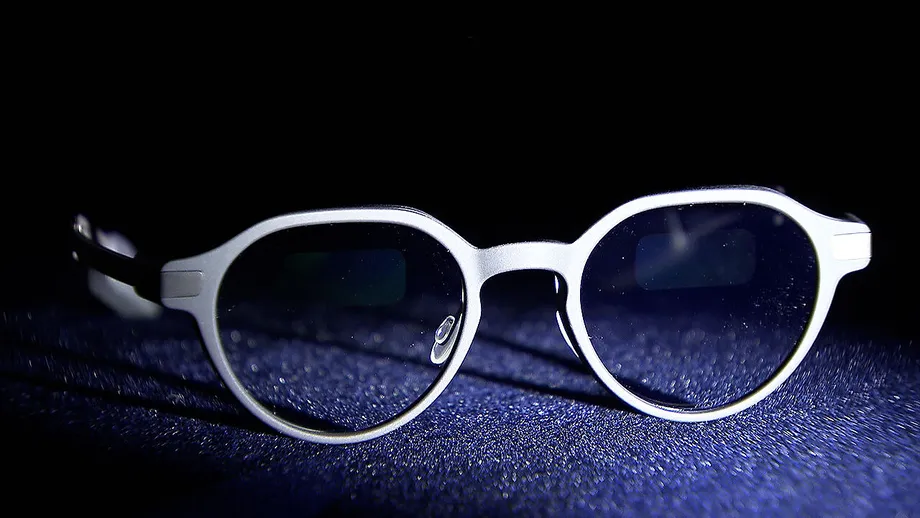
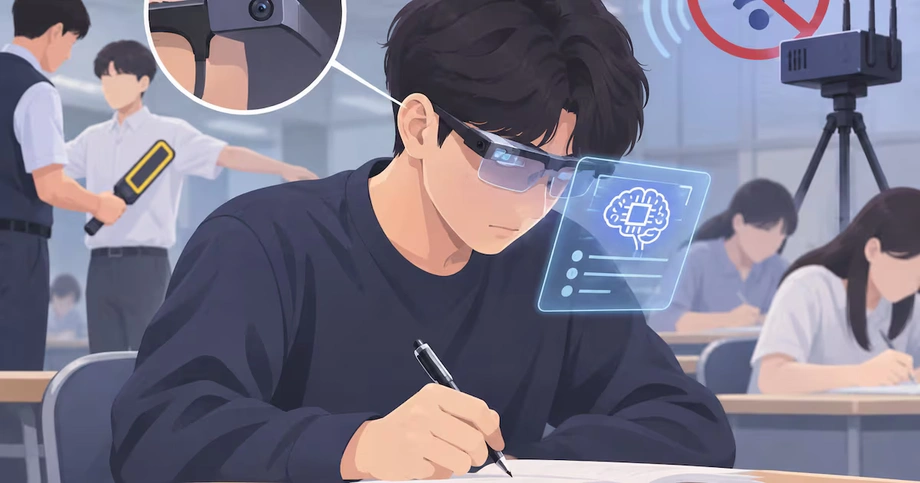
Proctors will inspect glasses when checking candidates' identities at the beginning of each session. Features drawing attention include camera lenses, unusually thick arms, charging contacts, small speakers, power buttons and displays visible inside the lenses.
The ministry says the CSAT already has stricter controls than some qualification examinations, including requirements to submit belongings and limits on what candidates can keep on their desks. Its immediate strategy is to strengthen those existing controls with device recognition training and a support network for uncertain cases.
Smart Glasses Can Work Without Spoken Commands
Education Ministry officials demonstrated Meta and Rokid glasses at the Government Complex Sejong on Monday. An official looked down at a mock examination paper and tapped the side of his glasses, showing how a device could begin processing a question without a spoken request.
Shin Jin-yong, director of the ministry's college admissions policy division, explained how a candidate might prepare the device before entering the room.
If a student intends to misuse the device, they would most likely enter an AI prompt beforehand and activate the AI function with just a tap on the side of their glasses,
Officials pointed to visible cameras, lights and display patterns as identifying features. Some could appear when the wearer lowered their head or when the lenses were viewed from certain angles. The designated specialist at each site will help proctors assess glasses they cannot identify confidently.
Unresolved cases can move through regional education office situation rooms to a joint response center run by the ministry and the Korea Institute for Curriculum and Evaluation, which administers the CSAT. Proctors will also have a hotline for assistance.
Miniature cameras present another problem because they can be concealed in clothing. The ministry is consulting specialists and provincial education offices and preparing guidance on movements that might indicate a candidate is photographing questions.
Why Disabling Wi-Fi Is Only Part of the Plan
The Ministry of Science and ICT is assessing whether public Wi-Fi can be switched off at testing sites during the examination. Public Wi-Fi provides one route for a device to send a photographed question to an outside AI service and receive an answer.
Disabling that network leaves other possible connections, including mobile data. Signal jamming takes a broader approach: it transmits interference to prevent wireless devices from communicating. Education officials said South Korea's Radio Waves Act restricts jamming and that many examination sites stand near homes, where interference could disrupt emergency communications.
Park Chun-sik, an information security professor at Seoul Women's University, proposed considering small jammers designed to limit interference to the testing area. The ministry was consulting the science ministry about communications restrictions, while ruling out general jamming under the current arrangements.
Some AI systems can also operate inside a device without contacting an outside service. A small language model is a compact AI program that can process text locally, although its abilities depend on its design and the equipment running it.
Yeom Heung-yeol, an emeritus information security professor at Soonchunhyang University, described why inspections would still be needed.
Even if outside communications are blocked, cheating is possible if a device carries a small language model (SLM),
The government's response therefore combines possible network restrictions with device collection, visual inspections and monitoring during the examination.
New Detection Equipment Will Come Too Late
The Korea Communications Agency's November 2 tender sought development of a handheld detector capable of picking up Bluetooth and Wi-Fi signals from AI smart glasses. The equipment will not be ready for Thursday's examination.
Radio frequency detectors listen for wireless transmissions. Metal detectors search for metal components, while thermal cameras record heat. Each targets a different physical feature of an electronic device, which helps explain why officials and specialists are discussing several tools rather than a single replacement for proctors.
Lim Jong-in, a professor at Korea University's Graduate School of Information Security, proposed handheld metal detectors and small flashlights. He said a light could make a tiny camera lens reflect reddish or bluish light, while a detector could help locate electronics concealed in a sleeve.
Ryu Dong-kyu, an optometry professor at Shinsung University, suggested having glasses inspected before the examination and marked with stickers. He also proposed involving opticians familiar with products currently on sale.
A Duke University research team tested another approach using light escaping from smart glasses lenses. Its experiment involved three pairs of smart glasses and three ordinary pairs on a mannequin head, filmed from different angles, and identified smart glasses in 80 percent of tests. Education Minister Choi said radio frequency detectors, metal detectors and thermal cameras could be considered as early as next year's CSAT.
Searches Raise Questions About Privacy and Authority
Education officials said there was insufficient legal authority and time to screen every CSAT candidate with metal detectors this year. They also cited the practical difficulty of introducing uniform procedures nationwide with only days remaining.
Blanket body searches or belongings inspections could distress students and require safeguards for candidates wearing medical equipment or assistive devices. The ministry said protecting students' ability to take the examination calmly had to be considered alongside efforts to detect cheating.
Metal detectors are already used for some checks, including checks on candidates returning from restroom visits. Officials had not committed to extending that screening to every candidate.
Teachers' organisations are also seeking clearer rules about responsibility. The Korean Teachers and Education Workers Union and the Teachers Union Federation called for specific response guidelines and protections for proctors expected to identify unfamiliar devices.
The Korean Federation of Teachers' Associations questioned whether one specialist at a site could respond effectively if several examination rooms needed help at the same time. Choi said the ministry and local education superintendents would find ways to take responsibility when proctors acted in the course of their duties.
Pressure for a Delay Meets a Broader Reform Plan
Candidates have posted postponement demands on the Korea Institute for Curriculum and Evaluation website. Korean language instructor Yoo Dae-jong called for a delay unless protections against smart glasses and small cameras were established on November 16. Gongshincam chief executive Kang Sung-tae also argued that traditional proctoring was insufficient.
People Power Party leader Jang Dong-hyeok urged the government to consider postponement unless effective safeguards could be guaranteed. New Reform Party floor leader Chun Ha-ram supported addressing candidates' fairness concerns before the examination. The ministry maintained that the test would proceed.
Beyond Thursday, the government plans two linked efforts: an emergency response team for this CSAT and a separate task force on cheating with smart devices across government examinations. The Ministry of Employment and Labor and the Human Resources Development Service of Korea will review the certification examination system, including approved testing venues and screening stations.
KAIST Graduate School of Culture Technology professor Yoon Sang-ho proposed safeguards at the manufacturing stage. He said devices could be designed to stop working when a camera indicator light is covered or when the equipment has been modified.
The ruling Democratic Party is considering exclusion periods of five to 10 years for cheating. These remain proposals, alongside the ministry's earlier plan for a three year CSAT ban. The five year sanction being pursued in the tax accountant case belongs to that examination's existing rules.
Investigations Will Continue After the Examination
The government plans to operate a CSAT cheating reporting center and work with police to investigate suspicious cases after the examination. Officials will examine irregularities, including unusually high scores, and seek objective evidence when assessing possible misconduct.
Confirmed cheating can lead to revoked results, restrictions on future examination eligibility and criminal investigation. The prime minister also requested a standing system for reporting suspected cheating in other state examinations, both online and offline.
Han Seong-sook framed the response as a duty to protect candidates who had prepared honestly.
Fairness in exams is a basic principle that upholds trust in our society,
South Korea's examination authorities were already facing pressure over exam question trading allegations and proposed penalties for buying questions from serving teachers. The latest case adds another concrete task: detecting tools that can capture a question and seek an answer during the test itself.
For candidates preparing for November 19, the immediate arrangements remain device surrender, repeated checks of suspicious eyewear and specialist support at testing sites. Tuesday's announcement is the next scheduled step in explaining how officials will address miniature cameras and other equipment before the examination begins.
Key Points
- The November 19, 2026, CSAT will proceed at 1,312 testing sites despite demands for postponement.
- All digital devices must be surrendered before the first session, and each site will have at least one official trained to identify smart glasses.
- The government is assessing whether to disable public Wi-Fi and will announce additional safeguards on November 17.
- A tax accountant examination's top scorer admitted cheating with a miniature camera, smartphone and AI; police are investigating.
- New wireless detection equipment will not be ready for this CSAT, while blanket searches face legal and practical constraints.
- Authorities plan investigations after the test and a wider review of security across national certification examinations.