Thirty maths questions answered in 22 minutes
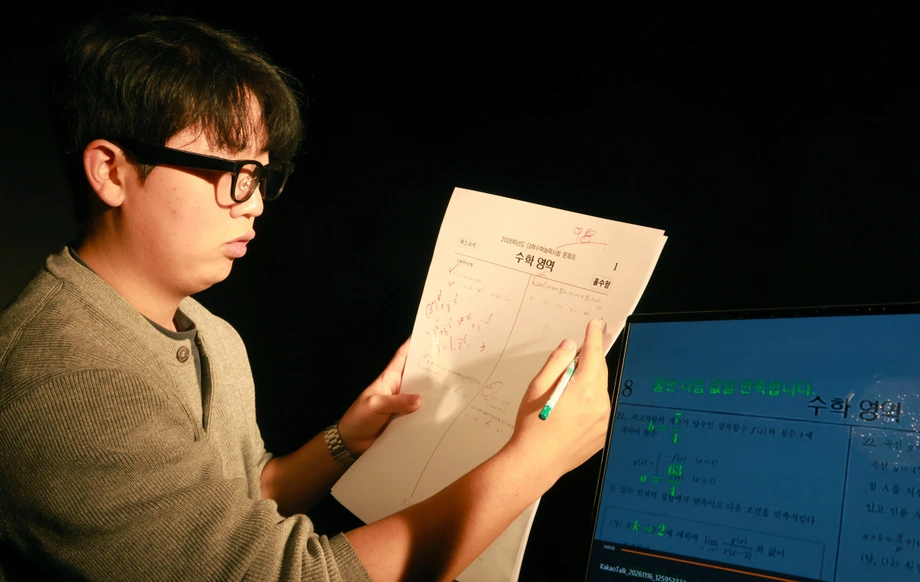
A pair of AI glasses costing about 1 million won produced a score of 98 out of 100 on a past South Korean university entrance maths paper, completing its 30 questions in 22 minutes instead of the official 100 minutes. The demonstration, conducted on November 16, 2026, has sharpened concerns about exam security just before roughly 550,000 candidates take the College Scholastic Ability Test on November 19.
Contents
- Thirty maths questions answered in 22 minutes
- What the glasses could solve, and where they struggled
- The official rules already cover smart glasses
- Longer bans are being announced alongside existing penalties
- How inspections will work across 1,312 sites
- Why switching off Wi-Fi offers limited protection
- Earlier cases show several ways checks can fail
- A confession and a rental market widen the concern
- Students and teachers face the cost of uncertainty
- Can AI help supervisors detect AI cheating?
- Key Points
The trial used Rokid Glasses AI, a device weighing 49 grams that resembles ordinary glasses with thick frames. Its performance placed it 13 points above the reported threshold of 85 for the highest maths grade. It finished with 78 minutes to spare, using just 22 percent of the allotted time.
South Korea is responding with inspections of candidates' glasses, additional staff and warnings of criminal prosecution. On November 17, an 18-year-old student also asked the Constitutional Court to suspend the exam date, arguing that safeguards against AI cheating had not been adequately tested.
The exam, commonly called Suneung, determines admission for the 2027 academic year. The questions used in the demonstration came from the previous examination, held in November 2025 for admission in 2026. The exercise therefore tested AI against an existing paper while officials prepared to protect a new one.
The immediate problem reaches beyond smart glasses. A tax examination cheating confession involved a miniature camera, a smartphone and AI, while earlier incidents show that inspecting glasses before a session can leave gaps once the exam begins.
What the glasses could solve, and where they struggled
The maths demonstration used Google's Gemini AI service to interpret photographed questions and return answers through a display inside the glasses. Preparation took about 20 minutes. Most simple questions took seconds, while difficult questions took one or two minutes.
The device answered 29 of the 30 maths questions correctly, including the difficult questions near the end. Its single error came on the opening question, worth two points and considered among the easiest. The operator attributed that mistake to an initial recognition or settings problem.
A Korean language question produced an even more striking result. Question 12, which 77.7 percent of candidates had answered incorrectly, received a correct answer and explanations within one second. The person conducting the demonstration needed five minutes to solve it without the glasses.
Biology I exposed a different picture. The AI completed 20 questions in 12 minutes and 44 seconds, against an official allowance of 30 minutes, but scored only 34 out of 50, corresponding to the fourth grade. Problems involving family inheritance diagrams and subject specific methods appeared more challenging for the general purpose model.
The hardware also created visible and audible problems. Capturing questions required awkward head movements, touching the frames could attract attention, and the device unexpectedly spoke answers aloud when settings failed. Long Korean passages spread across several pages took longer to capture. During about 20 minutes of maths work, the battery fell from 75 percent to 30 percent, requiring charging before the science paper.
The official rules already cover smart glasses
The Education Ministry's exam conduct guidance bans electronic equipment, including cameras, wireless devices and wearable technology. It identifies consulting unauthorised materials or using wireless equipment as cheating under Article 34 of the Higher Education Act and the ministry's rules for handling CSAT misconduct.
The 2027 prevention notice, distributed through a public high school, explicitly names smart glasses. Candidates who bring prohibited equipment must surrender it before the first session. Failing to do so can invalidate the examination.
The notice goes further for wireless wearables: wearing smart glasses or a smartwatch during the examination after failing to surrender them is treated as use. The stated punishment is cancellation of that year's results and exclusion from the following year's CSAT.
Longer bans are being announced alongside existing penalties
The official notice cites the CSAT Management Regulations, Education Ministry Directive No. 558, as well as the Higher Education Act. It also warns that some conduct may constitute obstruction of official duties by deception under Article 137 of the Criminal Act.
Government statements about stronger sanctions have moved rapidly. Earlier preparations included seeking an increase in the CSAT exclusion period from one year to three. By November 17, officials were warning of a ban lasting 10 years, and Democratic Party leader Kim Min-seok was calling for that increase.
The published 2027 notice specifies a ban covering the following year. Implementing a longer exclusion requires the relevant legal changes, so candidates should distinguish the written rule from the tougher punishment being pursued.
President Lee Jae Myung called for strict enforcement during an emergency readiness meeting on November 17, joining by video from Manila. He described the exam's place in Korean society:
The Suneung is a symbol of fairness and a ladder of opportunity in our society.
Lee subsequently announced plans for rewards exceeding 100 million won for each confirmed report of cheating involving advanced devices. Authorities also said deliberate, organised misconduct could lead to criminal complaints or referrals to investigators.
How inspections will work across 1,312 sites
The Education Ministry plans to assign one member of staff specifically to identify smart glasses at each of the country's 1,312 examination sites. Seoul announced training for 239 personnel serving its 228 sites.
Initial procedures called for suspicious glasses to be removed and placed on a desk before a session, with designated staff examining them and unresolved cases referred to education authorities. Suspicions arising during a session would be checked after it ended. Later announcements expanded the approach to inspections of all candidates' glasses in every session.
Officials also announced stickers covering clothing buttons and closer observation of collars and sleeves, reflecting concern about miniature cameras. Deputy Education Minister Choi Eun-ok discussed these measures with deputy education superintendents from 16 regions on November 16.
The government had already decided to keep the exam scheduled, citing question security and disruption to university admissions if it were delayed. Distribution of papers began on November 16 across 85 examination districts.
Why switching off Wi-Fi offers limited protection
Authorities announced restrictions on Wi-Fi inside and near examination sites after considering whether to disable public networks. Many commercial AI glasses, however, can reach online AI services through a paired smartphone using a mobile network.
Huh Jin-man, a high school teacher with 25 years of experience who was due to supervise the CSAT, pointed out that phones can still use 5G and other mobile connections. A school Wi-Fi shutdown therefore leaves another route to the internet.
Radio jamming, which deliberately disrupts wireless signals, presents broader legal and practical difficulties. Article 29 of the Radio Waves Act generally prohibits interference with other people's use of radio waves, with limited exceptions such as national security and protection of certain facilities. The Education Ministry said it was not considering jamming because of legal and technical limits and the risk of disrupting nearby communications and emergency responses.
Radio signal detectors serve a different purpose: they identify transmissions rather than block them. Devices intended for examination sites were still under development and would not be deployed for this year's CSAT. The ministry was considering them for the following year.
Technology operating directly on a device creates another challenge. A student calling for stronger screening noted that some AI can run on an internal chip without internet access. Effective checks therefore need to address equipment itself as well as its network connections.
Earlier cases show several ways checks can fail
The Human Resources Development Service of Korea recorded five smart glasses cheating cases in national technical qualification examinations during May and June, involving fields including information processing, fire service equipment and electrical engineering. An account covering detections through October also gave a total of five, with Rokid glasses reportedly involved in four.
Supervisors detected devices through suspicious light, electronic sounds and, in one case, a blue display appearing when a candidate pressed a frame button. Those incidents show why staff are being trained to recognise both equipment and behaviour.
A July Law School Eligibility Test case exposed a different weakness. A candidate in their twenties passed an inspection wearing ordinary glasses, then changed to AI glasses during the examination. A supervisor noticed suspicious behaviour during the second session. National Assembly Education Committee chair Kim Hee-jung proposed attaching seals that break when removed to inspected glasses and checking them each session.
The warning signs extended across other examinations:
- May 10 and May 31: Two candidates were detected wearing AI glasses during TOEIC English examinations.
- May and June: Three smart glasses cheating cases were recorded across TOEIC examinations during the broader period.
- July: Police reported arrests of more than 10 suspects accused of supplying answers through advanced equipment during the Korean language TOPIK examination.
- Early October: Smart glasses incidents occurred at university admissions essay examinations, including at the University of Seoul.
- November 15: The top scorer in the certified tax accountant examination admitted cheating with a camera, phone and AI.
- November 19: The 2027 academic year CSAT is scheduled to take place.
The Korea TOEIC Committee imposed score cancellation and bans lasting four years on the two candidates detected in May. Its broader disciplinary framework allows exclusion for up to five years. The committee also uses identity checks, continuous monitoring and analysis of unusually similar answers or testing patterns.
Ha Geum-soo, a Korea TOEIC Committee official, said organised cheating or leaks of examination content could lead to legal action involving copyright infringement and obstruction of business operations.
A confession and a rental market widen the concern
The tax scorer's confession turned a series of warnings into an emergency. The candidate, identified as Han, had scored 397.5 out of 400 in the first stage, answering 159 of 160 questions correctly. Police said the equipment in his case did not include smart glasses; his admission centred on a miniature camera, smartphone and AI.
Online rentals have made access cheaper than buying equipment. More than 10 AI glasses rental listings appeared on the secondhand marketplace Bungaejangter, with prices around 50,000 won per day or 110,000 won for three days. Some sellers openly promoted examination use and claimed their equipment would escape detection.
Several advertisements offered advice about avoiding scrutiny, and one seller promoted an additional controller that reduced the need to touch the frames. An overseas electronics business also marketed miniature earphones explicitly for cheating.
Lawyer Bang Min-woo said simply renting smart glasses would be difficult to punish as aiding misconduct, but knowingly teaching a customer how to evade detection during cheating could create liability. Seoul police said potential punishment of sellers would depend on the circumstances.
The Korea Media and Communications Commission also said blanket restrictions on websites selling miniature cameras would be difficult because cameras and earphones have legitimate security and communication uses.
Students and teachers face the cost of uncertainty
A Korean Teachers and Education Workers Union survey found that 82.3 percent of participating middle and high school teachers considered smart glasses difficult to identify under existing supervision procedures. Teachers described competing risks: missing cheating, disturbing innocent candidates and facing complaints over intrusive checks.
Huh Jin-man explained the pressure on supervisors:
I worry that searching students could unsettle them and disrupt the exam atmosphere, but the hard work of the honest majority must not go to waste.
Kim Tae-hoon, a senior at Donong High School in Namyangju, described why students wanted stronger safeguards:
It would be so unfair for those who studied hard to lose out. They put in the time and effort, but someone with AI could just outscore them.
On November 17, student Ahn Min-jun filed a constitutional complaint and an application for an interim injunction, asking the Constitutional Court to suspend the November 19 designation until the main case was decided. He argued that two days were insufficient to distribute new inspection procedures nationwide and verify staff competence. No court decision was given in the accounts of his filing.
Medical accommodations also require care. The official notice permits necessary devices after prior education office approval and checks by supervisors. This matters for candidates using hearing aids, cochlear implants or continuous glucose monitors, whose equipment needs to remain accessible during the exam.
Can AI help supervisors detect AI cheating?
Commercial examination monitoring systems already use AI to flag possible misconduct. One system uses laptop and smartphone cameras to check for earphones, smartwatches and smart glasses, then alert human supervisors to suspicious changes.
The service was reported to be used by about 600 companies and capable of supervising 20,000 remote candidates simultaneously. Grepp chief technology officer Kim Tae-yang called for systems allowing recorded footage to be reviewed after examinations. Applying that approach to classrooms would require technology suited to monitoring several candidates together, along with rules protecting recordings of their faces.
Other countries face similar choices. China required screening of glasses for its June university entrance examination, taken by more than 10 million candidates. In Taiwan, unusual behaviour led supervisors to inspect a medical school applicant's glasses and discover heat coming from the frames.
Restrictions also extend beyond exams. The British Cinema Association said cinemas were introducing bans or limits on glasses with cameras because of filming and privacy concerns. At the same time, smart glasses can help people with visual impairments. The practical task is to set rules for particular settings while preserving legitimate access.
Key Points
- AI glasses scored 98 out of 100 on a past CSAT maths paper in 22 minutes, against the official 100 minutes.
- The same demonstration produced a weaker biology result and exposed battery, recognition and audio problems.
- South Korea plans glasses inspections and designated detection staff at all 1,312 CSAT sites on November 19.
- The published 2027 notice provides for cancellation of results and exclusion from the following year's exam for wearing undeclared smart glasses.
- Officials are pursuing tougher penalties, while a student has asked the Constitutional Court to suspend the exam date.
- Wi-Fi restrictions leave mobile connections available, and radio signal detectors will not be deployed this year.