A race to stop smoke at the field
Pakistan's Punjab government has deployed 750 pollution officers in 67 rapid response units to tackle crop fires, promising to reach reported burning within 10 to 15 minutes as Lahore struggles with another season of dangerous air. In one period of 24 hours this week, the provincial environment department received 679 field fire reports and said its teams extinguished 650, about 96% of the reported total.
Contents
- A race to stop smoke at the field
- How the new units respond
- Why farmers still burn the straw
- Where the fires are concentrated
- How smoke reaches Lahore
- Cleaner readings still leave patients struggling
- The crackdown extends beyond farms
- Two Punjabs face a shared problem
- What the season's timeline shows
- The Essentials
The operation faces a substantial flow of new fires. Satellite monitoring analysed by the Pakistan Air Quality Initiative (PAQI) identified 18,825 fire detections across Pakistani Punjab from October 1 to November 9, with about 89% classified as likely burning of crop residue. Lahore's average concentration of fine particle pollution during that period was 126 micrograms per cubic metre, 11% below the corresponding period last year but still above Pakistan's daily standard on all 40 days with valid data.
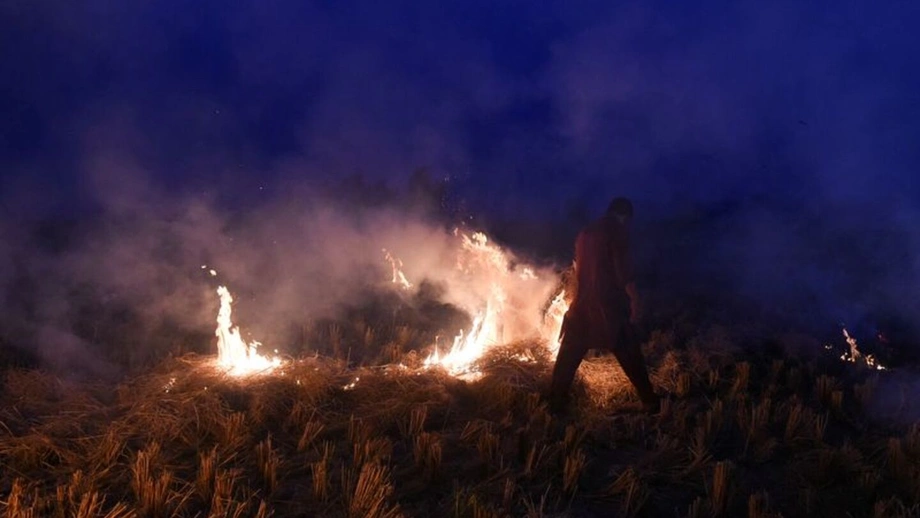
On Thursday, a team brought a fire under control within minutes at a paddy field on Lahore's outskirts. Officials describe the force as Pakistan's first unit dedicated to fighting pollution. Its work brings enforcement directly to fields where farmers burn the straw and stalks left after the rice harvest to prepare land for the next crop.
The government's campaign combines punishment with machinery subsidies. Farmers face fines of 15,000 Pakistani rupees per acre for burning stubble, while the province says it has distributed more than 10,000 subsidised super seeders to help them plant without setting fields alight. For residents breathing the smoke, the immediate test is whether those measures make the air safer, rather than simply cleaner than last year.
How the new units respond
Silwat Saeed, chief of Punjab's Environment Protection and Climate Change Department, said the 67 units operate across major districts producing rice. Officers patrol paddy areas, receive complaints and use information about detected fires to direct their response.
Ashfaq Hussain, a deputy director of the force, described how teams receive alerts:
"We receive complaints through multiple channels and respond to them in the shortest possible time," he said.
Satellite alerts allow authorities to identify burning over a wide area, while patrols and local complaints can help locate fires between satellite passes. Punjab has also deployed drones, special squads working at night and field teams as part of its wider pollution campaign.
The department's figure of 650 fires extinguished out of 679 reports gives a snapshot of activity during one day. Across the season, teams must repeatedly cover agricultural districts where new burning can begin as other fires are put out.
Why farmers still burn the straw
Rice harvesting leaves residue that must be managed before the next crop is planted. Burning clears it quickly, which helps explain why the practice persists despite fines and the health costs borne by nearby communities.
Saleem Abbas, a farmer who has stopped burning stubble, said many farmers still regard fire as the cheapest and fastest option. The government's alternative is to reduce the cost of machinery that can manage residue while sowing the next crop.
Punjab pays 60% of the cost of subsidised super seeders, leaving farmers to pay 40%. A super seeder works crop residue into the soil and sows seed, allowing farmers to prepare for wheat without first burning the field. Muhammad Ismail, who farms 50 acres, said switching to a subsidised super seeder and other equipment had substantially increased his wheat yield per acre.
Muhammad Farooq, an assistant director in the Punjab Agriculture Department, said farmers caught burning face fines of 15,000 rupees, about $54, per acre. Failure to pay can lead to prosecution and a possible prison term of up to six months. The policy therefore changes both sides of the farmer's calculation: machinery becomes cheaper through public support, while burning carries a financial and legal risk.
Where the fires are concentrated
A separate analysis of NASA satellite observations counted 13,241 fire detections in Pakistani Punjab between October 1 and 29, 2026. About 92% were on farmland and considered likely to be associated with crop burning. Roughly half of that period's detections, 6,655, occurred in its final seven days.
Okara recorded 2,144 detections, Gujranwala 1,011 and Nankana Sahib 1,003. Together, those three districts accounted for 4,158, about 31% of the provincial total. Their concentration gives authorities a practical reason to direct patrols and machinery support toward particular agricultural areas rather than spreading resources evenly.
PAQI's assessment through November 9 placed Sheikhupura first with 2,559 suspected crop fires, followed by Jhang with 2,192, Okara with 2,062, Hafizabad with 1,893 and Gujranwala with 1,417. Those five districts accounted for about 54% of its detections. The assessments use different monitoring and classification approaches, producing different district totals even where their observation periods overlap.
Satellite fire detections record heat at locations observed when a satellite passes overhead. Burned area measures the land affected, while smoke output depends on how much material burns and how it burns. Clouds, thick smoke and fires occurring between passes can also leave gaps in the record. These measurement differences help explain why officials can cite burned area below a historical average while other monitoring shows substantial numbers of active fires.
How smoke reaches Lahore
PAQI found that Lahore's average PM2.5 concentration was 175 micrograms per cubic metre when air currents passed over areas affected by fires, compared with 93 micrograms on other days. That is a difference of 82 micrograms, or about 88%, linking much worse city air with winds arriving through burning areas.
PM2.5 means airborne particles no more than 2.5 micrometres across. They are small enough to travel deep into the lungs, and some can enter the bloodstream. A concentration in micrograms per cubic metre describes the mass of those particles in a given volume of air.
Multan and Bahawalpur showed similar patterns between agricultural fires, wind direction and pollution. Cold, stagnant conditions also trap emissions close to the ground, allowing smoke to accumulate alongside vehicle exhaust, industrial emissions and construction dust.
Lahore's average of 126 micrograms per cubic metre was more than eight times the World Health Organization's guideline for an average over 24 hours of 15 micrograms. Pakistan's daily limit is 35 micrograms. The seasonal average and the daily thresholds describe different periods, but PAQI also found that every monitored day exceeded the national daily limit.
Cleaner readings still leave patients struggling
Punjab officials point to improvements in both pollution and health indicators. Environment director general Abdullah Nayyar said health department data showed that hospitalisations for throat problems associated with smog last month were 69% of the level recorded in October 2025, equivalent to a decline of 31%.
Lahore's Sir Ganga Ram Hospital nevertheless had patients crowding benches and corridors in recent days. Ahmed Abubakar, a patient with diabetes who has undergone heart bypass surgery, said smog had brought breathing difficulties and eye infections. For someone already managing serious illness, another period of polluted air adds an immediate health burden.
Mohammad Niaz Butt, another patient, described blockage in his nose and throat and expressed frustration with continuing burning:
They are burning it, and nothing is done about it.
Lahore's disruption has extended beyond hospitals. The Pakistan Cricket Board moved the second Test against Sri Lanka from Lahore to Rawalpindi because of smog, retaining its scheduled dates of November 17 to 21. Spectators, players, officials and broadcast crews consequently lost the planned Lahore fixture.
The crackdown extends beyond farms
Punjab's Environment Protection Agency has also targeted brick kilns, factories, plastic burning and construction dust. Its figures for September 28 to October 27 recorded 11,580 kiln inspections, 197 demolitions of kilns that failed to meet requirements, 163 sealed units, 162 cases and fines totalling 40.7 million rupees.
Industrial enforcement covered 6,650 inspections, with 22 units demolished, 191 sealed and fines of 28 million rupees. Operations against plastic burning included 6,064 inspections, 152 sealed sites and the confiscation of 45,100 kilograms of plastic.
Equipment intended to capture industrial emissions was another focus. Of 4,204 facilities inspected for suction hoods, 1,863 had installed the required equipment, about 44%. Authorities sealed 333 sites that failed to comply. Construction dust operations covered 397 union councils, with mist sprinklers installed at 49 locations.
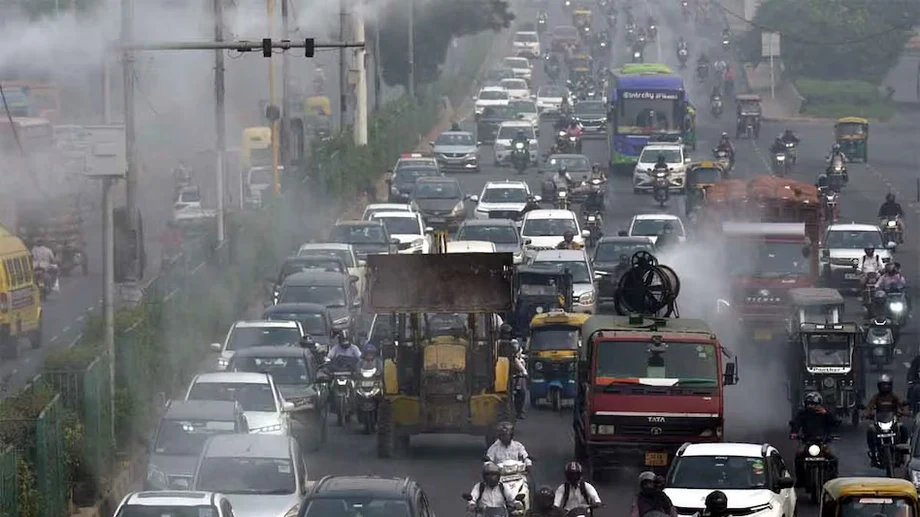
The environment department also reported that Lahore's AQI fell from 489 at 9am to 232 by 3pm on Monday, with all 11 monitoring stations recording declines. Operations included spraying mist along about 640 kilometres of roads. AQI converts pollution measurements into a health risk index; a lower number means improved conditions, although a reading of 232 still falls in the very unhealthy category on the scale used by IQAir.
Two Punjabs face a shared problem
The satellite analysis covering October 1 to 29 counted 3,158 fire detections in Indian Punjab against 13,241 in Pakistani Punjab, a ratio of about 4.2 to one. A comparison restricted to the Suomi NPP satellite recorded 918 and 4,562 respectively. Using a single satellite provides a more consistent basis for comparing different years.
The historical pattern has shifted. In the same October period in 2019, Indian Punjab had 14,002 detections against 2,908 in Pakistani Punjab. The analysis found that Indian Punjab's detections fell 95% between 2021 and 2025, while Pakistani Punjab's rose 33% between 2019 and 2025.
Indian authorities are still confronting substantial burning. The Commission for Air Quality Management recorded more than 5,785 farm fire incidents during the season covered by its inspection, including 150 in one day. Its team met officials in Ludhiana after visiting Sangrur, Patiala and Bathinda, and spoke with farmers using alternatives to burning. Ferozepur had nearly 800 cases, with high counts also in Tarn Taran and Sangrur.
The dispute over responsibility has also intensified around Delhi, following a surge in Punjab fires and arguments over enforcement and access to machinery. Saeed said Pakistan had raised the pollution challenge with Indian officials at international forums. India's foreign ministry did not respond to a request for comment.
What the season's timeline shows
Lahore's pollution has changed sharply within weeks and even within individual days. The sequence shows why a better monthly average can coexist with severe episodes affecting hospitals, travel and outdoor events.
- September 28 to October 27: Punjab recorded thousands of inspections targeting kilns, industry, plastic burning and other pollution sources.
- October 1 to 29: Satellite analysis counted 13,241 fire detections in Pakistani Punjab, with about half recorded during the final seven days.
- November 2: Lahore's hazardous morning pollution reached an AQI of 535, alongside a PM2.5 concentration of 343 micrograms per cubic metre.
- October 1 to November 9: PAQI recorded 18,825 fire detections across Punjab and daily pollution above the national limit throughout Lahore's 40 valid monitoring days.
- November 10: The cricket board announced that Lahore's November 17 to 21 Test would move to Rawalpindi.
PAQI said chemical testing of particles would be needed to separate emissions from fireworks and agricultural smoke when examining pollution around Diwali. Its assessment identified substantial fire activity upwind of Lahore, alongside weather conditions that restricted the movement of polluted air.
Punjab's disaster management authority forecast rain across Lahore and several other districts over the two days following its advisory, potentially bringing temporary relief. Continuing fires, factory emissions and traffic leave the province facing repeated pollution risks whenever conditions again favour the accumulation of smoke and dust.
The Essentials
- Punjab has deployed 750 pollution officers in 67 rapid response units, aiming to reach reported crop fires within 10 to 15 minutes.
- PAQI identified 18,825 fire detections from October 1 to November 9, about 89% likely associated with crop residue.
- Lahore's average PM2.5 fell 11% from the corresponding period last year, but every valid monitoring day exceeded Pakistan's daily limit.
- Farmers face fines of 15,000 rupees per acre, while the government covers 60% of the cost of subsidised super seeders.
- Smoke from agricultural areas combines with industrial emissions, vehicle exhaust, dust and stagnant weather to worsen the city's air.