Two early goals put India one win from a 10th title
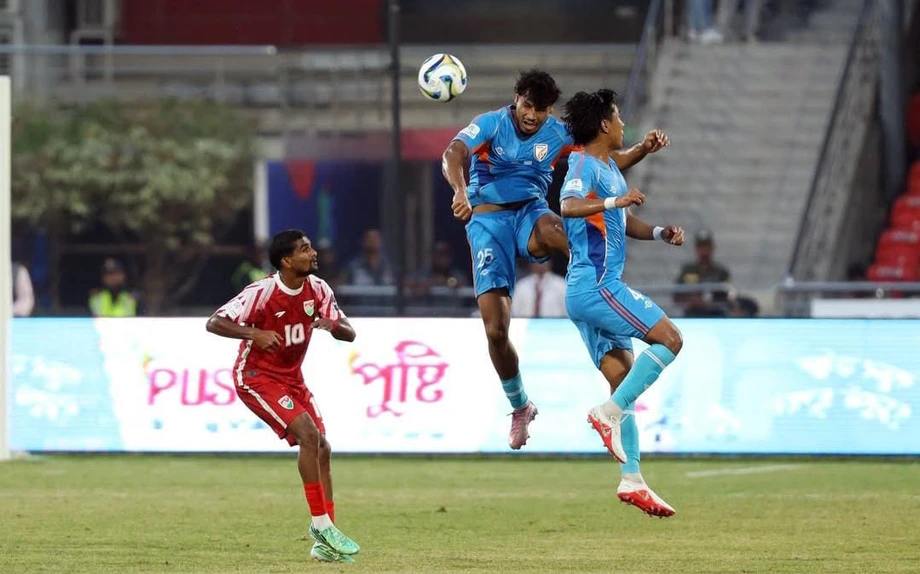
India reached the SAFF Championship final with a 2-1 victory over Bhutan at Dhaka's National Stadium on Saturday, November 14, 2026, surviving a difficult second half in a match that introduced video refereeing to the regional tournament.
Contents
- Two early goals put India one win from a 10th title
- Vishnu's control opens up Bhutan
- Chinglensana turns pressure into a second goal
- Bhutan return with a more direct threat
- How remote VAR changed the semi-final
- Bhat hits the bar as Bhutan press until the end
- Three victories reveal the same challenge for India
- Bhutan's long wait ends with another narrow defeat
- The dates leading to Tuesday's final
- Key Points
Vishnu PV and captain Chinglensana Singh Konsham scored before the interval. Kinzang Tashi Tobden answered in the 48th minute, bringing Bhutan within one goal and giving the competition its first goal awarded after a Video Assistant Referee review.
India will play either hosts Bangladesh or Pakistan at the same stadium on Tuesday, November 17. The final is scheduled for 7:30 p.m. Indian Standard Time. Their opponent had not been decided when India completed their semi-final, with Bangladesh and Pakistan scheduled to meet later on Saturday.
The victory took the defending champions into their 14th SAFF final and kept a record 10th title within reach. Bhutan, appearing in their first semi-final in 18 years, fell short of a first appearance in the championship match despite creating chances until the closing seconds.
For India coach Naushad Moosa, the result continued a successful but demanding campaign with a largely young reserve squad while senior national team players were in New Zealand for friendlies. His side has won all three matches in Dhaka, each by a single goal.
Vishnu's control opens up Bhutan
Bhutan began by working hard in midfield, interrupting India's passing and preventing the defending champions from immediately finding a comfortable rhythm. A long diagonal delivery nevertheless gave Vishnu the opening he needed inside the first 10 minutes.
The East Bengal attacker controlled the ball on the left, moved it onto his right foot and beat a defender before finishing past goalkeeper Gyeltshen Zangpo. His first touch was central to the move: it allowed him to attack the defender rather than pause to recover possession.
India then began creating opportunities through several routes. In the 17th minute, Brison Fernandes found Suhail Ahmad Bhat running into the left side of the penalty area, and Zangpo pushed away the forward's immediate attempt.
Ricky Shabong provided another opening four minutes later, winning possession and advancing into the box before pulling the ball back towards Bhat. Tenzin Norbu blocked the resulting shot. Abhishek Suryavanshi then crossed for Fernandes, whose volley travelled narrowly outside the left post.
Chinglensana turns pressure into a second goal
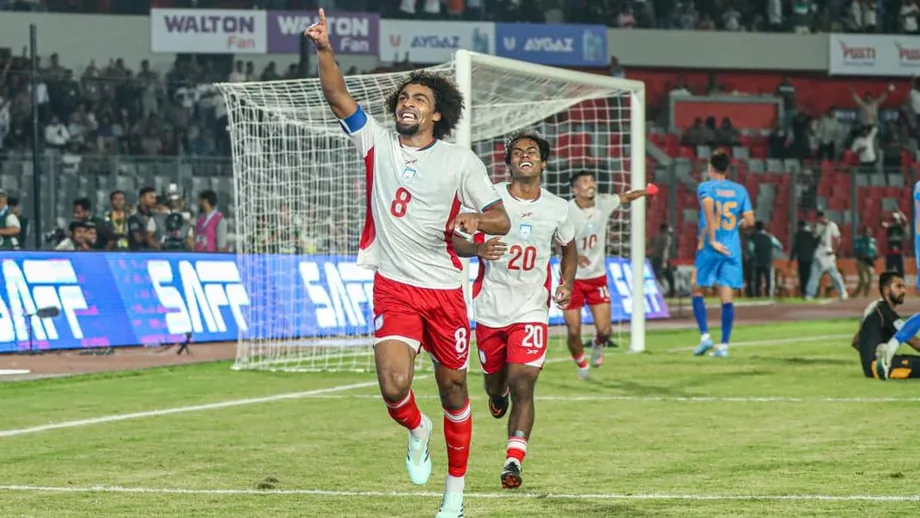
Chinglensana doubled India's lead before the half hour. Manglenthang Kipgen delivered a corner from the right, Bhutan failed to clear, and the captain reacted to the loose ball in front of goal to finish from close range.
The goal rewarded a period in which India repeatedly reached dangerous positions. Bhutan occasionally moved forward with promise, but their attacks lacked the final pass or finish needed to put sustained pressure on goalkeeper Arsh Anwer Shaikh.
Chencho Gyeltshen showed why he remained Bhutan's main attacking threat when he beat Indian players near the edge of the penalty area in the 19th minute. India crowded him out before he could turn that movement into a decisive opportunity.
India reached the interval with a 2-0 advantage. Both goals had come from different kinds of pressure: Vishnu exploited space behind and around a defender, while Chinglensana punished Bhutan's failure to deal with a corner.
Bhutan return with a more direct threat
Bhutan changed the contest almost immediately after the restart. A free kick into India's penalty area was not cleared effectively, allowing captain Chencho Gyeltshen to send the ball towards the far post. Tobden met it with his head and directed it into an unguarded net.
The assistant referee initially raised the flag for offside. A video review reversed that decision, allowing the goal and cutting India's lead to 2-1 in the 48th minute.
Bhutan now had most of the second half to pursue an equaliser. Their quicker, more direct approach forced India to defend deliveries into the box and react to balls that remained loose after the first attempted clearance.
Arsh made an important save in the 53rd minute. Shabong's attempted clearance from a cross fell to Chencho, whose shot threatened to dip beneath the crossbar. The Indian goalkeeper reacted quickly and tipped it over, preserving the narrow lead.
How remote VAR changed the semi-final
The South Asian Football Federation introduced Remote VAR from the semi-final stage, making the technology available for both semi-finals and the final. Tobden's goal was the first awarded following a video review since the championship began in 1993.
VAR allows designated video officials to examine match footage and help the referee review major incidents. In Dhaka, the system operated remotely: live pictures from the National Stadium were transmitted to an operations hub in Thailand, where video officials reviewed the action.
SAFF introduced the arrangement with the Asian Football Confederation and the ASEAN Football Federation. Spain based technology company Quality handled its operation, with officials working under International Football Association Board protocols.
The second major intervention came around the 65th minute. Substitute Irfan Yadwad crossed from the left, the ball made contact with Nima Wangdi's arm, and the referee awarded India a penalty. Bhat prepared to take it before the referee went to the pitchside monitor and cancelled the award after reviewing the footage.
Both reviews helped Bhutan stay in the contest. The first gave them a goal that had initially been disallowed; the second removed India's opportunity to restore a lead of two goals from the penalty spot.
Bhat hits the bar as Bhutan press until the end
Moosa made two changes in the 64th minute, introducing Macarton Nickson for Kipgen and Yadwad for Vishnu. India continued to find attacking opportunities, even as Bhutan committed more effort to searching for an equaliser.
Bhat came closest to settling the match with about five minutes of normal time remaining. He carried the ball into the penalty area, deceived a defender with a feint onto his left foot and then shot with his right. The attempt struck the crossbar.
Bhutan kept creating openings at the other end. A delivery from Chencho was just beyond substitute Kinzang Tenzin's reach, while Norbu sent a volley off target during added time. Arsh also made a late save as India protected their advantage.
A final ball headed across the goalmouth offered Tenzin another chance, but he could not make contact from close range. Bhutan's opportunity to force extra time passed, and India held on.
Three victories reveal the same challenge for India
India's path to the final has followed a consistent pattern: score before the interval, then withstand pressure after it. All six of their goals in the tournament have come in the first half, while all three goals they have conceded have come after the break.
The campaign began with a 3-2 win over Pakistan on November 5. Bhat scored twice and India led 3-0 at half-time, but two goals in stoppage time brought Pakistan close to recovering a point.
India then secured a 1-0 victory over Maldives on November 11. Bhat converted a penalty in the 38th minute, and goalkeeper Priyansh Dubey made important late saves to preserve the lead. India finished top of Group B with six points, ahead of Pakistan on three and Maldives on none.
Bhat supplied three of India's four group stage goals. Against Bhutan, Vishnu and Chinglensana shared the scoring responsibility, but India again needed their goalkeeper and late defensive work to protect an advantage established before half-time.
The final gives Moosa a concrete problem to address: how to keep possession and maintain an attacking threat after taking the lead. Another goal would have given India breathing room against Bhutan; instead, the contest stayed within reach of a single late finish.
Bhutan's long wait ends with another narrow defeat
Bhutan had reached the last four through a much narrower route. They began with a 1-0 defeat against Bangladesh, then drew 2-2 with Sri Lanka after trailing 2-1 at the interval.
Bangladesh's subsequent 4-0 victory over Sri Lanka left Bhutan and Sri Lanka level on one point. Bhutan advanced on goal difference, the total number of goals scored minus goals conceded, to claim second place in Group A.
Their semi-final brought a painful historical echo. In 2008, Bhutan also lost 2-1 to India in a SAFF semi-final, that time in Male. Eighteen years later, they returned to the same stage and finished with the same score.
Bhutan's second half in Dhaka nevertheless made this a close contest. Chencho created the goal and tested Arsh, while Tobden's header gave the side a realistic opportunity to reach its first final. Their late chances kept India under pressure until the whistle.
The dates leading to Tuesday's final
India now have a short turnaround before the title match. Chinglensana has taken the captain's armband after Bijoy Varghese left for the New Zealand camp, adding leadership duties to his role in central defence.
India won their ninth SAFF crown in 2023 by defeating Kuwait in the final in Bengaluru. Their current campaign also recalls 2009, when an Indian Olympic team won the championship in Bangladesh. Moosa's squad has now earned its own opportunity to win the trophy in Dhaka.
- November 5: India beat Pakistan 3-2 in their opening Group B match.
- November 11: Bhat's penalty secured a 1-0 win over Maldives and first place in the group.
- November 14: India defeated Bhutan 2-1 in the semi-final as Remote VAR made its tournament debut.
- November 17: India face Bangladesh or Pakistan in the final at the National Stadium, with kick-off scheduled for 7:30 p.m. IST.
Key Points
- Vishnu PV and Chinglensana Singh Konsham scored as India beat Bhutan 2-1 in Dhaka.
- Kinzang Tashi Tobden's goal stood after VAR overturned an offside decision.
- A second video review cancelled a penalty awarded to India.
- India reached their 14th SAFF final and remain one victory from a record 10th title.
- Bhutan's first semi-final appearance since 2008 ended in another narrow loss to India.
- The final is scheduled for November 17 against Bangladesh or Pakistan.