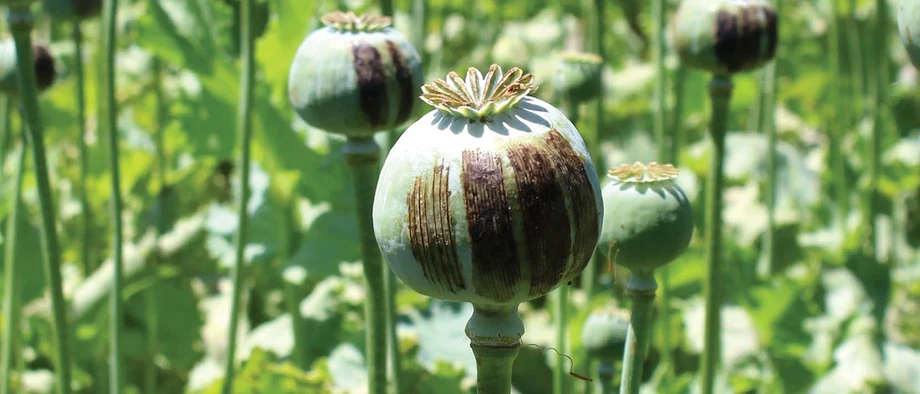
Badakhshan becomes the centre of a sharply larger harvest
Afghanistan produced an estimated 1,466 tons of opium in 2026, almost five times the 296 tons harvested in 2025, with the northeastern province of Badakhshan accounting for more than two thirds of the land planted with poppies. The shift brings the centre of production closer to Central Asia, where authorities face concerns about trafficking, online drug markets and drug use among young people.
Contents
- Badakhshan becomes the centre of a sharply larger harvest
- How large is the recovery?
- Why the northeast matters to Central Asia
- Concealed fields complicate enforcement
- Kabul challenges the survey's measurements
- Lower prices still leave a powerful financial incentive
- Stockpiles and European demand connect distant markets
- Uzbekistan combines border work with prevention
- Farm incomes will shape the next growing season
- Key Points
The United Nations Office on Drugs and Crime (UNODC), in its Afghanistan Opium Survey 2026, estimates that cultivation reached 43,300 hectares, up from 10,200 hectares a year earlier. That is an increase of about 325%. Better growing conditions also raised the amount harvested from each hectare, pushing production up by approximately 395%.
At a briefing in Tashkent, UNODC warned that the rebound increases the need for regional cooperation. The Balkan route through Iran and Türkiye remains the main corridor toward European markets, while Russia remains an important destination. A larger harvest near Central Asian borders could put greater pressure on the northern trafficking route, although UNODC has not confirmed a fundamental change in established routes.
The Taliban's Interior Ministry disputes the UN findings and says eradication has left almost no surviving cultivation. UNODC says farmers have adapted to enforcement, hiding poppies among cereal crops and behind compound walls while spreading planting and harvesting across different dates.
For Afghanistan's neighbours, the challenge extends beyond intercepting shipments. The rebound connects rural poverty, the finances of international trafficking networks and the capacity of health services to prevent and treat drug use.
How large is the recovery?
UNODC released the survey on October 29, 2026, describing the first significant increase since enforcement of the Taliban's April 2022 narcotics ban. Cultivation remains far below the 232,000 hectares recorded in 2022: the latest estimate is about 81% smaller.
The intervening years show an uneven pattern rather than a continuous decline. Cultivation stood at 10,800 hectares in 2023, rose to 12,800 in 2024 and fell to 10,200 in 2025 before the latest surge. Production followed a similar pattern, reaching 333 tons, 433 tons and 296 tons respectively.
- April 2022: The Taliban announced its ban on narcotics cultivation.
- 2025: UNODC estimated 10,200 hectares of poppies and 296 tons of opium.
- May and June 2026: Eradication operations in Badakhshan were accompanied by protests, deaths and injuries.
- October 29, 2026: UNODC published estimates of 43,300 hectares and 1,466 tons for the latest harvest.
UNODC gives a 95% confidence interval of 32,000 to 61,000 hectares for cultivation and 805 to 2,439 tons for production. These ranges express the uncertainty around estimates assembled from monitoring and yield measurements.
The average national yield rose from 29 kilograms per hectare in 2025 to 33.8 kilograms in 2026, an increase of about 17%. More favourable rainfall, improved water availability and suitable temperatures helped explain why production grew faster than the cultivated area.
Why the northeast matters to Central Asia
Badakhshan contained 29,482 hectares of poppies in 2026, about 68% of Afghanistan's total. Neighbouring Takhar had approximately 3,400 hectares. Together, the two provinces accounted for roughly three quarters of national cultivation, replacing the southwest as the dominant growing area.
Badakhshan's expansion has been especially sharp. Its cultivated area rose from 6,639 hectares in 2025 to 29,482 hectares in 2026. In 2021, it had 3,561 hectares, making the latest area more than eight times that earlier figure. Takhar, classified as poppy free in 2021, has also become a substantial producer.
The northeastern region produced an estimated 1,090 tons of opium, approximately three quarters of the national harvest. Badakhshan borders Tajikistan, placing a large concentration of supply beside a Central Asian frontier. The earlier cultivation surge also brought a dispute over how UNODC measured crops and accounted for eradication.
Afghanistan's southwest is recovering too. Regional production rose from 35 tons in 2025 to 225 tons in 2026, increasing its share of the national harvest from 12% to 15%. Helmand, identified as Hilmand in the survey, had about 3,500 hectares under cultivation.
UNODC estimates that the entire 2026 crop could be converted into 107 to 168 tons of heroin at purity levels of 50% to 70%. The conversion depends on processing methods and the strength of the finished drug.
Concealed fields complicate enforcement
Farmers in several provinces planted small poppy plots inside larger fields of wheat and barley or within traditional walled compounds. More than 90% of identified poppy fields in Helmand used one of those concealment methods in 2026.
More than half of Helmand's fields were concealed among cereal crops, compared with 6% in 2025. With the total number of fields also increasing, UNODC estimated that the province had fifty times as many fields using this method as a year earlier. More than 40% were inside walled areas.
Staggered planting creates another challenge for eradication teams. Crops in the same area reach different stages at different times, potentially requiring repeated visits to destroy them. Farmers also spread the risk of losing an entire harvest to frost, hail or other adverse weather.
UNODC identified these practices across provinces including Helmand, Kandahar, Herat, Daykundi and Takhar. Cultivation was detected in 16 of Afghanistan's 34 provinces, five more than in 2025. Six provinces entered the growing category while Zabul became poppy free, producing the net increase of five.
Kabul challenges the survey's measurements
The Taliban's Interior Ministry rejects UNODC's conclusions and argues that satellite observations failed to account adequately for crops destroyed before harvest. Ministry spokesperson Mufti Abdul Mateen Qani requested disclosure of image dates, field coordinates, data sources, methods and margins of error.
The authorities also gave different eradication totals. UNODC's launch statement cited 22,000 hectares, a ministry response reproduced in the survey cited approximately 23,000 hectares, and Qani said more than 26,000 hectares had been cleared before crops matured. The ministry response put cultivation at 24,000 hectares, compared with UNODC's 43,300.
UNODC said technical problems with the authorities' eradication records prevented a full assessment of their effects. Its analysis nevertheless found that more than 85% of reported eradication occurred before the satellite images used for the survey were acquired, meaning nearly all of that destruction was already reflected in its estimates.
The disagreement centres on how much poppy survived eradication and when fields were observed. Adding destroyed hectares to UNODC's surviving cultivation estimate would count land using different measures and observation dates. The agency reviews around 1,000 satellite images each year, covering more than 30,000 square kilometres.
Lower prices still leave a powerful financial incentive
Dried opium sold for just over $500 per kilogram in 2026, compared with $570 in 2025 and a seasonal average peak of $780 in 2024. UNODC puts the latest decline at 12% from 2025 and 36% from the 2024 peak. Prices remain far above the levels below $100 per kilogram recorded before the ban.
The much larger harvest outweighed the price decline. UNODC estimated the gross value of sales by the first traders buying and selling the crop at $525 million, up from $134 million in 2025, almost a fourfold increase.
The $525 million figure measures sales at the first trader level. UNODC has not obtained prices paid directly to farmers since 2023, so the share reaching farming households is unknown. Processing, exporting and later trafficking transactions generate further value beyond this estimate.
The northeast accounted for more than $352 million of those sales, about two thirds of the national total. At a national level, the $525 million estimate was equivalent to roughly 2.7% of Afghanistan's 2025 gross domestic product of $19.66 billion. The comparison shows the size of the trade relative to an economy with few opportunities for paid work.
Regional price gaps may also encourage movement within Afghanistan. UNODC said prices in the southwest could be twice those in the northeast, creating an incentive for traders to buy near the main growing areas and sell farther away.
Stockpiles and European demand connect distant markets
UNODC estimates that opium accumulated before the ban could have lasted through 2025 or 2026. Those reserves helped trafficking continue while Afghan harvests were much smaller, and recent seizure patterns suggest stocks may now be increasingly depleted.
European market data show the pressure on supply. Across 20 transit and destination countries, mostly in Europe, the average retail price per pure gram of heroin rose from about $250 in 2022 to $470 in 2025, after adjustment for inflation. Measuring a pure gram accounts for differences in how heavily heroin is diluted before sale.
UNODC's 2026 World Drug Report also identified early signs of falling heroin supplies in Europe. Shrinking reserves, continued demand and prices that remain attractive to growers help explain why production incentives can persist despite a cultivation ban.
The agency's regional seizure analysis also tracks methamphetamine, a synthetic stimulant. Average methamphetamine seizure weights were more than twice their baseline level in the third quarter of 2021. UNODC says the share originating in Afghanistan remains uncertain, adding another challenge for regional monitoring and forensic laboratories.
Pressure can extend into neighbouring growing areas. Earlier findings on cultivation across the borders described expansion in parts of Pakistan and Iran. Official eradication figures cited by UNODC rose in Pakistan from 337 hectares in 2023 to 745 in 2024. Comprehensive cultivation estimates are needed to measure the full extent of that expansion.
Uzbekistan combines border work with prevention
Uzbekistan is cooperating with UNODC on border controls, prevention, coordination between agencies and recovery of criminal proceeds. It chairs the Central Asia Regional Information and Coordination Center, which supports intelligence exchange and joint action against trafficking.
UNODC has supported nearly 50 border and airport control units across the region with training, equipment and technical assistance. Its work includes the European Union funded Central Asia Drug Action Program and Border Management Program in Central Asia, alongside the CHAMPS prevention initiative.
Uzbekistan's cooperation also covers gaps in legislation for confiscating proceeds of crime. Taking money and assets from trafficking networks targets the people financing and profiting from the trade, extending enforcement beyond farmers and couriers.
Young people's drug use adds a public health concern. In Uzbekistan, 3% to 4% of young people surveyed reported illicit drug use or nonmedical use of pharmaceuticals during the preceding year, a relatively stable finding between 2025 and 2026. Across Central Asia, the share reporting such use nearly doubled over the same period.
UNODC cautioned that these survey results are not definitive estimates of use across the population. Household surveys planned through an EU funded regional programme are intended to provide a firmer basis for prevention and treatment. Regional priorities also include online drug markets, links with cybercrime, stronger forensic services and early warning systems.
Farm incomes will shape the next growing season
Afghan farmers face poverty, limited employment and few reliable alternatives to poppies. UNODC research found that many cultivate the crop out of economic necessity. Reduced support for alternative livelihoods and returning refugees from Pakistan and Iran have added pressure on household income and local resources.
UNODC's Alternative Development Program has supported legal activities including orchards and poultry production. Sustaining those alternatives requires farming infrastructure, reliable income and access to buyers. Monica Juma, UNODC's executive director, addressed that need in the agency's October 29 statement:
The DFA and the international community need to work together to support farming communities by investing in livelihoods, farming infrastructure and access to markets,
Juma also called for international cooperation to investigate and dismantle trafficking networks. UNODC recommends action across the chain, including the diversion of chemicals used in drug processing, criminal finances and trafficking operations.
The size of Afghanistan's 2027 harvest will depend on enforcement, household finances and access to viable legal livelihoods. For Central Asia, preparations involve both stronger cooperation at borders and better prevention and treatment at home, while monitoring whether the northeastern concentration of production changes the movement of drugs.
Key Points
- UNODC estimates Afghanistan produced 1,466 tons of opium in 2026, compared with 296 tons in 2025.
- Cultivation reached 43,300 hectares, with Badakhshan accounting for about 68% of the total.
- The Taliban's Interior Ministry disputes the estimates; UNODC says most reported eradication preceded its satellite observations.
- Gross sales at the first trader level reached an estimated $525 million, up from $134 million in 2025.
- A larger northeastern harvest could increase pressure on Central Asian trafficking routes.
- Regional priorities include border cooperation, criminal asset recovery, prevention, treatment and better drug use data.