A sharp rebound, with Badakhshan at its centre
Afghanistan produced an estimated 1,466 tonnes of opium in 2026, almost five times the 296 tonnes recorded in 2025, according to the United Nations Office on Drugs and Crime (UNODC). Its Afghanistan Opium Survey 2026, published on October 29, puts the area planted with poppies at 43,300 hectares, up from 10,200 hectares a year earlier.
Contents
- A sharp rebound, with Badakhshan at its centre
- What changed after the 2022 ban?
- Why the northeast now dominates
- Farmers conceal crops and change planting schedules
- Why the Taliban disputes the survey
- High prices keep poppies attractive
- Eradication has brought violence in Badakhshan
- Trafficking pressure reaches beyond Afghanistan
- Replacing the crop requires more than seeds
- Key Points
Badakhshan, bordering Tajikistan, accounted for 29,482 hectares, more than two thirds of the national total. The northeastern province has become the centre of a crop once concentrated in Afghanistan's southwest, changing where farmers earn money, where authorities conduct eradication campaigns and where traffickers can obtain supplies.
The cultivated area increased by about 325%, while production rose by approximately 395%. More land was planted, and better rainfall and water availability helped farmers obtain more opium from each hectare.
The Taliban's Interior Ministry rejected the findings, saying its own field information and destruction of crops showed a much smaller surviving harvest. UNODC said it could not independently verify the authorities' eradication figures.
Afghanistan's crop remains far below the 232,000 hectares recorded in 2022, the year the Taliban announced its narcotics ban. The 2026 area is about 81% smaller than that benchmark. Nevertheless, the rebound challenges the durability of restrictions that initially brought a dramatic contraction in cultivation.
What changed after the 2022 ban?
The Taliban prohibited narcotics cultivation in April 2022, following its return to power in August 2021. UNODC now says the ban appears to be weakening, with poppies detected in 16 of Afghanistan's 34 provinces in 2026, five more than in 2025. Thirteen provinces recorded substantial increases in cultivated area.
The main developments span several growing seasons:
- April 2022: The Taliban announced its nationwide narcotics ban. Cultivation that year reached 232,000 hectares.
- 2025: Poppy cultivation stood at 10,200 hectares, producing an estimated 296 tonnes of opium.
- May and June 2026: Eradication campaigns prompted protests and clashes in Badakhshan.
- September 2026: Japan signed an agreement worth $9.4 million with UNODC to support counter narcotics work over two years.
- October 29, 2026: UNODC published its survey estimating a sharp recovery in cultivation and production.
The latest increase reflects both a larger planted area and a stronger harvest. Average yields rose from 29 kilograms per hectare in 2025 to 33.8 kilograms in 2026, an increase of about 17%. Yield means the amount harvested from a given area of land.
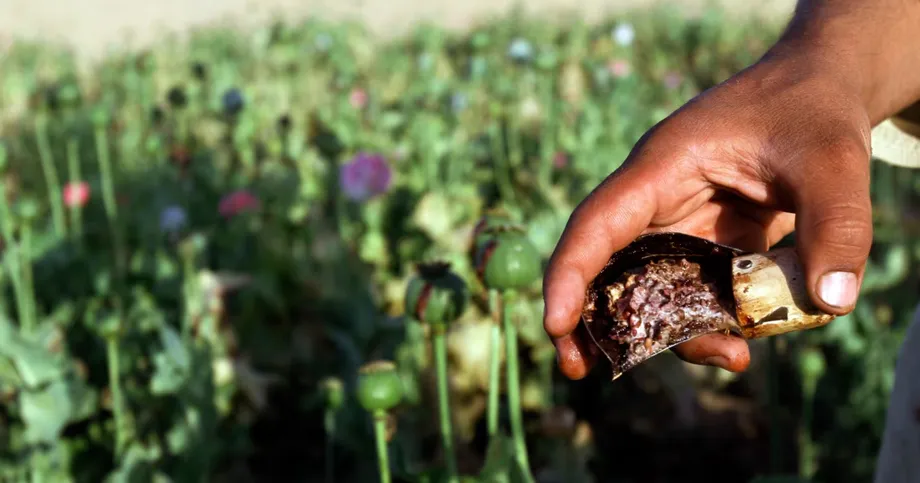
Opium is collected from the seed capsules of poppy plants and can be processed into heroin. A rise in the harvested crop therefore affects farm income as well as the supply available to drug trafficking networks.
Why the northeast now dominates
Northeastern Afghanistan accounted for approximately 33,000 hectares of poppy cultivation and 1,090 tonnes of opium in 2026. That represents 76% of the country's cultivated area and roughly three quarters of production.
Badakhshan's cultivated area rose by 344%, from 6,639 hectares in 2025 to 29,482 hectares in 2026. In neighbouring Takhar, cultivation expanded from 274 hectares to about 3,400 hectares, more than twelve times the previous year's area.
Investment has also moved. Growers and investors from the former cultivation centres in the southwest have been renting or buying land in Badakhshan to finance poppy farming. The movement brings money and farming experience into a province where the crop has become increasingly important to household livelihoods.
Helmand, once Afghanistan's dominant poppy growing province, recorded about 3,500 hectares in 2026, up from 681 hectares in 2025. Kandahar recorded 1,560 hectares, more than three times its previous year's area. Across the southwest, cultivation increased from about 1,300 hectares to just over 5,000 hectares.
Those southern increases are substantial, but Badakhshan alone still had more than eight times Helmand's cultivated area. The national recovery is therefore concentrated mainly in the northeast, alongside smaller rebounds in older production centres.
Farmers conceal crops and change planting schedules
Satellite imagery identified small poppy plots among wheat and barley fields, as well as cultivation inside walled compounds. Farmers also staggered planting and harvesting to reduce the risk of detection and eradication.
Helmand showed particularly widespread concealment. UNODC identified concealment methods on more than 90% of its poppy fields. More than half of the concealed areas were planted among cereal crops, while over 40% were within walled enclosures.
Mixing crops makes poppy plots less obvious than a large field devoted entirely to the plant. Walls restrict visibility from the ground, while different planting dates mean nearby fields may reach their most recognisable stage at different times.
The changes show how farmers are adjusting to enforcement. Authorities seeking to destroy crops must locate smaller, more dispersed plots and reach them before farmers collect the opium.
Why the Taliban disputes the survey
The Interior Ministry said UNODC relied too heavily on satellite imagery and failed to account adequately for crops destroyed before harvest. It asked the agency to publish its data sources, the dates of satellite images and its method for counting eradication operations.
The ministry's counter narcotics department, in comments included in the UN survey, estimated cultivation at about 24,000 hectares and said approximately 23,000 hectares had been eradicated before harvest. Other ministry statements put the planted area at about 26,000 hectares and described eradication totals ranging from roughly 22,000 hectares to more than 26,000 hectares of narcotics crops.
The authorities' central argument is that destruction left cultivation close to zero by harvest time. The Interior Ministry described assessments that omitted those operations in these terms:
Therefore, any assessment that fails to take these measures and their results into account in its calculations is incomplete, unreliable and unfair,
UNODC said it could not technically verify the reported eradication figures. It also said most eradication in previous years had occurred before its satellite survey, so operations following that pattern would already be reflected in the surveyed area. Further analysis was promised, without a publication date.
The timing matters: a field photographed before destruction may appear in a cultivation count even if it produces no harvest. A field destroyed before the survey should already be absent from the measured crop. Reconciling the two assessments requires agreement on when fields were observed and when they were cleared.
High prices keep poppies attractive
Dried opium averaged about $500 per kilogram in 2026, down from $570 in 2025, a decline of roughly 12%. Prices nevertheless remained around five times the approximate $100 level before the ban.
UNODC figures for 2023 illustrate the attraction for farmers: a hectare of poppy generated about $10,000, compared with just over $770 for wheat. Poppy revenue was therefore approximately thirteen times wheat revenue per hectare that year. Those figures describe revenue before allowing for differences in production costs.
Mohammad, a farmer aged 22 in Badakhshan, described the pressure facing his household:
Without opium, we cannot even afford basic food.
The estimated value generated at the first stage of the opium trade rose from $134 million in 2025 to $525 million in 2026, the highest since 2018. The larger harvest more than offset the fall in price.
UNODC put the $525 million figure at the equivalent of 2.7% of Afghanistan's gross domestic product and 8.5% of the value of its agricultural sector. Gross domestic product, or GDP, measures the value of goods and services produced in an economy. These comparisons show the scale of the opium economy within a country where legal work and farm income are scarce.
Eradication has brought violence in Badakhshan
Badakhshan experienced protests and clashes over poppy eradication in May and June 2026. Two people were reported killed during clashes in May when security forces moved to destroy fields.
The campaigns have also exposed tensions between local ethnic Tajik farming communities and newly arrived Pashtun Taliban units. Local ethnic Tajik Taliban fighters have at times sided with growers, complicating enforcement within the movement's own ranks.
Disputes over income and local authority were already visible during Badakhshan's gold disputes, when restrictions on access to mining areas and anger over poppy destruction contributed to unrest. In July, armed men briefly seized a district administration building before withdrawing as reinforcements arrived.
Farmers facing eradication can lose an expected harvest before a replacement source of income is available. That immediate household loss helps explain why destroying fields has produced resistance in a province now responsible for most of Afghanistan's opium crop.
Trafficking pressure reaches beyond Afghanistan
Badakhshan's location beside Tajikistan puts the expanding crop near a northern trafficking route through Central Asia towards Russia and Europe. Tajik border guards reported 17 armed clashes with traffickers in 2025, compared with six in 2024, and seized more than 2,700 kilograms of narcotics.
Another 17 clashes with smugglers were reported in the first half of 2026. Uzbekistan also intercepted a drone carrying drugs from Afghanistan over the Amu Darya in July. These incidents show the range of methods and routes used to move drugs across the northern frontier.
Price differences create an incentive to move opium within Afghanistan too. The northeast recorded prices of about $310 per kilogram, while the southwest could command roughly twice that amount. Traders able to transport supplies between regions can seek to profit from that gap.
UNODC warned that stocks accumulated before the ban appeared to be running low. Those reserves have helped traffickers maintain supplies through years of reduced cultivation. The agency's 2026 World Drug Report identified early signs of falling heroin supplies in Europe.
The new Afghan harvest arrives alongside poppy expansion across borders into Pakistan and Iran, where Afghan farmers, investment and expertise have moved into some growing areas. Comprehensive national cultivation totals for those two countries remain uncertain, while planting decisions during 2026 point towards further expansion in the 2027 growing season.
Replacing the crop requires more than seeds
UNODC says lasting reductions require roads, irrigation and access to markets, alongside crops that farmers can grow legally. A farmer needs a reliable buyer and a way to transport a harvest, as well as sufficient water to produce it.
UNODC Executive Director Monica Juma called for cooperation between Afghanistan's authorities and international partners:
It is essential for the de facto authorities and the international community to work together to support farming communities.
Only about 10% of the roughly $500 million that UNODC estimated an alternative livelihoods programme would cost had been funded. That amounts to approximately $50 million, leaving a gap of about $450 million.
Japan's embassy in Kabul said Japan had contributed more than $33 million to counter narcotics efforts since 2021. Its September agreement with UNODC committed an additional $9.4 million over two years. The embassy urged sustained support both to reduce cultivation and to help former poppy farmers earn income elsewhere.
The 2026 rebound leaves authorities confronting two connected problems: enforcing a prohibition and making legal farming financially workable. High opium prices, limited employment and insufficient support for replacement livelihoods continue to give households reasons to return to the crop.
Key Points
- UNODC estimated 43,300 hectares of poppy cultivation in 2026, up from 10,200 hectares in 2025.
- Opium production reached 1,466 tonnes, almost five times the previous year's harvest.
- The northeast accounted for 76% of cultivation, with Badakhshan alone recording 29,482 hectares.
- The Taliban disputed the survey and said eradication had removed most crops. UNODC could not independently verify those destruction figures.
- Average dried opium prices fell to about $500 per kilogram but remained far above levels before the ban.
- Cultivation was still about 81% below the 232,000 hectares recorded in 2022.
- Funding for alternative livelihoods remained far short of UNODC's estimated $500 million programme cost.