A weapons exchange brings the Ukraine war closer to South Korea
North Korea recorded 16 ballistic missile launches through October 12, 2026, exceeding the six recorded in all of 2025 and the 12 recorded in 2024. Behind that increase is a military partnership with Russia that is giving Pyongyang access to combat feedback, drone manufacturing knowledge and other weapons technology in exchange for soldiers, workers and ammunition.
Contents
- A weapons exchange brings the Ukraine war closer to South Korea
- How Russian combat feedback reaches North Korean weapons
- What the October launches reveal
- A growing mix of launch platforms and warheads
- From drone agreements to assembly lines
- The workers behind the drone expansion
- Why mixed attacks put pressure on air defences
- Troops and missile teams deepen the exchange
- How the partnership developed
- Key Points
The exchange connects two security crises thousands of kilometres apart. Russia receives weapons and personnel for its war against Ukraine. North Korea gains opportunities to improve missiles used by Russian forces and learn how to manufacture attack drones in large numbers, capabilities that could increase the pressure on South Korean defences.
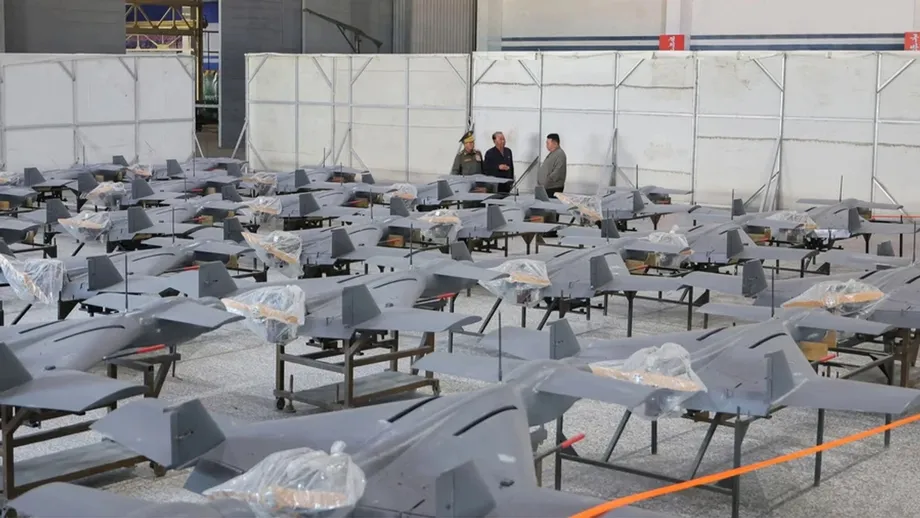
Ukraine's military intelligence chief, Lieutenant General Kyrylo Budanov, described agreements to establish production of Garpiya and Geran drones inside North Korea in an interview on June 7, 2025. Subsequent accounts describe North Korea moving into mass production of attack drones, although a verified production rate for its factories has not been published.
October's missile tests show another part of the changing threat. North Korea launched a claimed hypersonic weapon on October 3. South Korea tested its own domestically developed hypersonic glide vehicle five days later, with President Lee Jae Myung observing. North Korea then launched several ballistic missiles on October 12, including one that South Korea assessed flew more than 900 kilometres.
For Seoul, the concern is a combination of greater accuracy, heavier warheads and attacks involving several kinds of weapons at once. North Korea has already rehearsed using drones, rockets and missiles together, making the task of tracking and intercepting incoming weapons more demanding.
How Russian combat feedback reaches North Korean weapons
Russian use of North Korean missiles gives their manufacturers information that ordinary testing cannot easily supply: how weapons perform during combat, where they land and which problems appear during deployment. Russian and North Korean specialists can use that feedback to change designs and operating procedures.
Anton Ponomarenko, an analyst, attributes improvements in North Korean missile accuracy and manoeuvrability to Russian deployment data and feedback. Yang Uk, a research fellow at the Asan Institute for Policy Studies, also says information from the Ukraine war has helped Pyongyang improve targeting.
Budanov described the exchange as extending beyond deliveries of finished weapons. Asked what Russia was giving North Korea in return for troops and arms, the Ukrainian intelligence chief said:
It's more about technology transfer.
Budanov said early KN-23 ballistic missiles supplied to Russia missed their targets by several kilometres. Citing Ukrainian state prosecutors, he said around half of the early weapons deviated from their trajectories or exploded in midair. He attributed subsequent accuracy improvements to joint work by Russian and North Korean specialists.
Major General Vadym Skibitskiy, deputy head of Ukrainian Defence Intelligence, gave a less favourable assessment of newer missiles, saying versions with a range of 800 kilometres often missed by 15 to 19 kilometres. The two Ukrainian officials described markedly different levels of performance; neither supplied a common set of launch results that would allow a direct comparison.
What the October launches reveal
North Korea claimed its October 3 missile travelled about 1,000 kilometres. South Korea assessed a flight of more than 700 kilometres, while Japan estimated about 680 kilometres. Pyongyang also claimed advanced manoeuvring capabilities, including guidance assisted by artificial intelligence.
South Korea's Defence Intelligence Agency assessed that North Korea had made technical progress but still lacked stable hypersonic gliding technology. A hypersonic glide vehicle travels at more than five times the speed of sound and can change course while gliding through the atmosphere, complicating interception.
The October 12 missile launches involved different ballistic missile types. South Korea reported that one type flew more than 900 kilometres. Japan reported two flights, one of about 220 kilometres and another exceeding 910 kilometres.
Shin Jong-woo, secretary general of the Korea Defence and Security Forum, identified a missile shown in North Korean photographs as the Hwasong-11 Da-2.5. His assessment, based partly on its launcher with five axles, was that it carried a warhead weighing 2.5 metric tons.
South Korea's Joint Chiefs of Staff said the longer flight could have involved a ballistic missile of shorter range fired to its maximum distance, or a missile of greater range flown over a reduced distance. North Korea said the October 12 test checked technical updates to important components. Its announcement appeared through its external news agency rather than the newspaper read by its domestic audience.
A growing mix of launch platforms and warheads
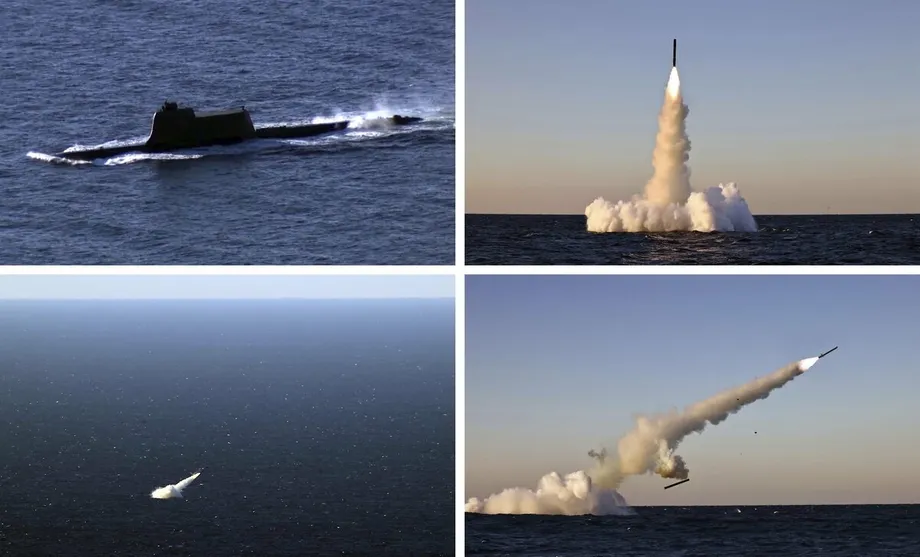
North Korea's 2026 testing programme involves more than frequent ballistic launches. Cruise missile tests occurred on seven occasions through October 14, involving launchers on land, destroyers and what Pyongyang described as a submarine. The underwater launch platform used on October 14 remains unconfirmed.
Ballistic missiles generally follow an arcing flight path after their powered launch, while cruise missiles use engines to sustain flight and can travel at lower altitudes. Combining them forces defenders to watch for weapons arriving at different heights and speeds.
Hong Min, a senior research fellow at the Korea Institute for National Unification, described the broader purpose of the testing programme:
It goes beyond showcasing individual weapons to demonstrating an entire family of systems.
Warhead development adds another concern. North Korea claimed that five Hwasong-11 Ra missiles struck an area of 12.5 to 13 hectares during an April 19 test. That area was not independently verified. Weapons that scatter smaller explosives or mines can spread damage across roads, airfields and other sites rather than concentrating it at a single point.
On May 26, Kim Jong Un observed tests that North Korea said included special purpose ballistic missile warheads, guided 240mm rockets with extended range and tactical cruise missiles using guidance assisted by artificial intelligence. South Korea detected a ballistic flight of about 80 kilometres and assessed that rockets were also launched.
From drone agreements to assembly lines
Budanov's June 2025 account identified plans to manufacture Garpiya and Geran drones in North Korea. Geran is the Russian version of the Iranian Shahed attack drone, a weapon that flies to a target and explodes on impact.
Budanov said Russia was then making about 2,000 drones from the Shahed family each month and planned to reach 5,000. Those figures describe Russian production and ambitions at that time. They show the scale of the manufacturing system whose knowledge Moscow could share with Pyongyang.
North Korean workers at Russia's Alabuga complex in Tatarstan provide another route for that knowledge to travel. Assembly work can teach technicians how to organise production, handle components and introduce modifications without stopping an entire line.
The joint study by the Center for Strategic and International Studies and the George W. Bush Institute, released on October 14, 2026, examined those risks alongside labour abuses. The Alabuga labour study warned that technicians returning to North Korea could bring practical knowledge of Russian improvements to Geran drones.
The study cited up to 12,000 North Korean workers associated with Alabuga recruitment. The underlying intelligence announcement described a plan to recruit roughly that number by the end of 2025; the number who actually arrived remains unclear. A broader estimate of as many as 25,000 North Koreans at Russian military plants covers a wider workforce than Alabuga alone.
The workers behind the drone expansion
North Korean recruits were reportedly offered about $2.50 an hour, while the study said authorities in Pyongyang withheld 70% to 90% of their wages. At that rate, a shift lasting 12 hours would generate $30 before deductions, leaving a worker between $3 and $9 if those withholding rates applied.
Alabuga also employs Russian youth and workers from other countries. The study raised concerns about coercive labour practices, including recruitment through purported college work placements, shifts lasting up to 12 hours and production quotas.
Young workers were reportedly threatened with fines if they told relatives what the facility manufactured. Satellite images from September showed construction of additional workshops and warehouses at the complex.
North Korean labour therefore serves two purposes for the partnership: it supplies workers for Russian production and creates opportunities to learn manufacturing skills. For the workers, the reported arrangements mean long hours and limited access to the wages paid for their labour.
Why mixed attacks put pressure on air defences
North Korea's September 12 exercise combined attack drones, tactical cruise missiles, rockets and ballistic missiles. A drone swarm attacked an island target while missiles approached from different directions, rehearsing the kind of coordinated assault that can stretch a defence network.
Inexpensive drones can force defenders to track many objects at once and spend interceptors protecting valuable targets. Ballistic missiles demand especially fast responses, while lower flying drones and cruise missiles create different surveillance problems. The challenge is to assign the right defensive weapon to each threat before it reaches its target.
Shin warned that coordinated attacks could overwhelm South Korean air defences. Hong called for better surveillance at low altitude, faster information sharing among South Korea, the United States and Japan, and improvements to defences operating at several heights and ranges.
South Korea's Joint Chiefs of Staff assessed that existing South Korean and American assets could detect and intercept the missiles North Korea had recently launched. Seoul's own hypersonic glide vehicle, first tested on October 8, remains under development.
The same pressures are shaping diplomacy. South Korea has been considering Ukraine's air defence appeal, including interest in its Cheongung II system. Sending equipment would require Seoul to weigh Ukraine's immediate needs against the weapons it needs to protect its own territory.
Troops and missile teams deepen the exchange
North Korean participation extends beyond factories. Budanov reported about 11,000 North Korean troops in Russia's Kursk region in June 2025. Skibitskiy later described 8,500 troops in Russia, including 400 drone operators and about 1,000 engineers and personnel clearing mines, with roughly 25,000 having served or rotated through Russia's military.
Skibitskiy said the first deployment began in Kursk in October 2024. North Korea publicly acknowledged its soldiers were fighting against Ukraine in April 2025. Personnel who return home can pass on experience of drones, surveillance and fighting under constant observation.
Skibitskiy also described about 90 North Korean personnel sent to the Voronezh area to assist missile launches. Another account described a North Korean missile unit beginning deployment in western Russia that could be equipped with 120 ballistic missiles and six launchers.
His missile delivery figures covered at least 150 KN-23 or KN-24 weapons supplied before the previous August, followed by a promise of another 120, of which 40 had arrived. Russia has also reportedly requested KN-30 missiles. Budanov said North Korea had supplied 120 M1989 Koksan artillery guns.
Russian assistance may reach other capabilities. Budanov described cooperation involving missiles fired from aircraft, submarine technology and systems carrying nuclear payloads. Skibitskiy said North Korea had requested Russia's S-400 air defence system and had received a Pantsir launcher.
How the partnership developed
The sequence shows military cooperation expanding from deployments and ammunition into manufacturing and weapons development:
- October 2024: North Korean troops began deploying to Russia's Kursk region, according to Ukrainian intelligence.
- April 2025: North Korea acknowledged that its soldiers had fought against Ukraine.
- June 7, 2025: Budanov described agreements to establish Garpiya and Geran drone production in North Korea.
- May 26, 2026: North Korea tested a combination of missiles and guided rockets under Kim Jong Un's supervision.
- September 12, 2026: A combined exercise brought together drones, rockets and missiles.
- October 3 to 12, 2026: North Korean launches bracketed South Korea's first domestic hypersonic glide vehicle test.
- October 14, 2026: The Alabuga labour study detailed risks of worker exploitation and the transfer of manufacturing knowledge.
The clearest change is the breadth of the exchange. Weapons deliveries help Russia sustain its war, while combat feedback, factory experience and technical cooperation help North Korea develop capabilities it can bring back to the Korean Peninsula.
Key Points
- North Korea recorded 16 ballistic missile launches through October 12, 2026, compared with six in all of 2025.
- Russian combat feedback is helping missile development, although Ukrainian officials give different assessments of accuracy.
- Drone production cooperation includes plans for factories in North Korea and North Korean labour at Russia's Alabuga complex.
- The Alabuga study describes severe wage deductions and risks that workers will carry manufacturing expertise home.
- Combined attacks using drones, rockets and missiles increase demands on South Korean surveillance and interception systems.
- South Korea says its existing defences can intercept the recently launched missiles while it develops its own hypersonic technology.