A December deadline puts the naval mission under scrutiny
South Korea is considering widening the Cheonghae Unit's operating area from the Gulf of Aden to the Gulf of Oman and adding surveillance aircraft as its deployment authorization approaches its December 31, 2026 expiry. The debate turns on a practical question: how can Seoul protect commercial ships near the Strait of Hormuz without helping conduct the United States' war against Iran?
Contents
- A December deadline puts the naval mission under scrutiny
- What Seoul is considering
- Why surveillance could change the mission
- Two shipping routes face overlapping dangers
- The case for stronger protection
- Parliament faces more than a routine renewal
- What the 2020 precedent means
- Waiting until the war ends needs a definition
- US pressure and the dates that matter
- Key Points
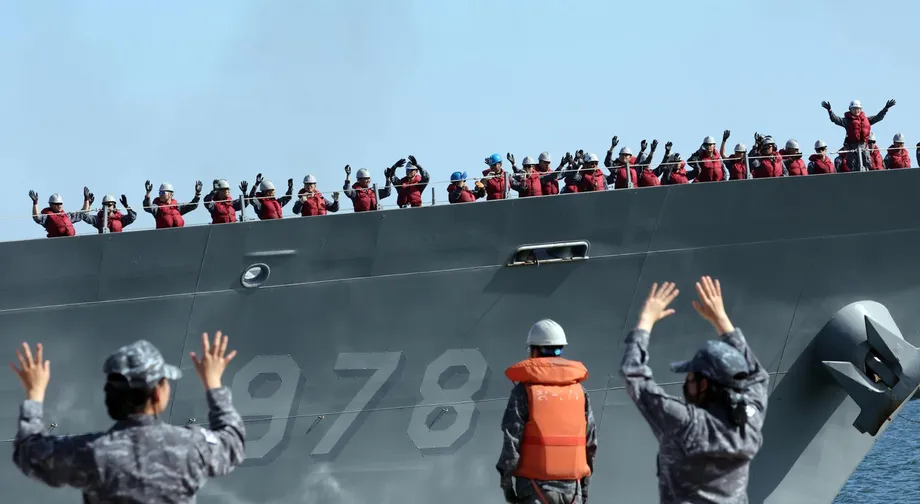
The options under review reportedly include a P-8A Poseidon maritime patrol aircraft, a possible additional frigate and broader permission to operate during emergencies involving South Korean nationals. The unit already has a destroyer of the 4,400-ton DDH-II class, a naval helicopter, up to three inflatable boats with rigid hulls and up to 320 service members.
President Lee Jae Myung ruled out sending South Korean forces or military assets to participate in the war at a September 18 press conference. He nevertheless left room to strengthen Cheonghae's existing work protecting South Korean citizens and commercial vessels.
The Ministry of National Defense says it is considering a deployment extension because security off Somalia has deteriorated. It has not confirmed an expansion to the Gulf of Oman, and the operating boundaries, additional assets, starting conditions and parliamentary timetable remain undecided.
Yu Ji-hoon, a research fellow at the Korea Institute for Defense Analyses, warned that a mission described as ship protection could still become an indirect military contribution. His central concern is what South Korean forces would do, who would direct them and how their information would be used.
What Seoul is considering
The Cheonghae Unit has operated in the Gulf of Aden off Somalia since 2009, combating piracy and escorting commercial vessels. The Gulf of Oman would take it toward another sensitive shipping area: the waters linking the Arabian Sea to the Strait of Hormuz.
The reported proposal would add wording to the deployment consent motion allowing operations in other waters during emergencies involving South Korean nationals. A maritime patrol aircraft would extend surveillance across a much larger area than the unit can watch from its destroyer and helicopter alone.
A P-8A Poseidon is among the aircraft reportedly being considered. A frigate, another type of naval warship, has also been mentioned as a possible reinforcement. These are options under review rather than an announced deployment package.
Defense Minister Kang Shin-chul described the review during a parliamentary audit before the National Assembly's Legislation and Judiciary Committee.
"We are reviewing various aspects of the Cheonghae Unit's mission and the extension of its deployment," Kang told lawmakers.
Why surveillance could change the mission
Yu said adding patrol aircraft could move Cheonghae beyond escorting merchant ships and watching for pirates. Aircraft could monitor shipping lanes and gather information about possible threats across a wider stretch of ocean.
For a commercial ship, that information could provide warning of danger ahead. For a military force, the same observations could help plan or conduct operations. Yu said information collected by South Korean aircraft could become indirect military support if shared with US forces for use against Iran.
Yu identified the operational decisions that would determine the mission's role.
"The key is not simply the expansion of the operating area, but the missions actually carried out, command and control arrangements, the scope of intelligence sharing and rules of engagement," he said.
Command and control means who gives orders and directs operations. Rules of engagement set the conditions under which troops may use force. An independent South Korean escort mission would have a different role from one supplying intelligence or operational assistance to US forces, even if both operated in nearby waters.
Two shipping routes face overlapping dangers
The Strait of Hormuz is a crucial energy corridor for South Korea. Disruption there affects the movement of crude oil and the safety of vessels carrying it. The Gulf of Oman sits on the approach to that passage, making the proposed expansion directly relevant to ships navigating near the conflict.
The Gulf of Aden presents another set of dangers. The Defense Ministry says pirate activity off Somalia, including in the gulf, has risen sharply compared with previous years. Increased activity by Yemen's Houthi group around the Bab el-Mandeb Strait has also raised concerns about shipping and crude supplies.
Cheonghae has reportedly provided escort support over long distances for South Korean oil tankers using alternative routes through the Red Sea. Those operations illustrate the practical pressure on Seoul: protecting trade may require attention to several stretches of water, each with different threats.
Piracy, drones, missiles and mines also demand different defensive responses. A force equipped to deter pirates approaching a merchant vessel may need additional protection when operating near weapons associated with a regional war.
The case for stronger protection
Rep. Kim Byung-joo of the ruling Democratic Party of Korea, who also serves as the president's special adviser on national defense, argues that Cheonghae needs stronger defenses for its existing duties. He said pirate activity in the Gulf of Aden had increased more than threefold compared with previous levels. The ministry has described a sharp increase without providing a numerical comparison.
Kim also pointed to drones as a threat exposing weaknesses in the unit's protection. He said some equipment had already been added during its latest rotation, while further improvements were needed.
"During the most recent rotation of the Cheonghae Unit, we partially reinforced the destroyer's counterdrone systems, but its self-defense capabilities remain extremely vulnerable," Kim said.
Kim said the unit relies on help from other countries' naval forces because its own defensive capabilities are insufficient. His argument centers on protecting personnel already deployed, while Yu's warning centers on the tasks a stronger force might subsequently perform. Both concerns would bear on the design of an expanded mission.
Kim rejected the description of reinforcement as a deployment to the strait.
"This is absolutely not a deployment to Hormuz," he said.
Parliament faces more than a routine renewal
The National Assembly's role is central because lawmakers consent to overseas troop deployments. Extending the duration of an existing mission and changing its purpose or operating area raise different questions about what parliament is being asked to approve.
Rep. Son Sol of the Jinbo Party argued that the Gulf of Oman directly borders the conflict zone. She warned that sending a destroyer and patrol aircraft configured for duties against piracy would expose troops to battlefield dangers.
During a parliamentary audit, Son called for lawmakers to approve any expansion and voiced concern about using the existing mission to enter the conflict indirectly.
"Many people are concerned that strengthening the Cheonghae Unit's mission should not become a backdoor deployment," Son said.
The Jinbo Party argues that changing the unit's purpose and operating area through what is presented as a routine extension would undermine the Assembly's constitutional right to consent to overseas deployments.
Rep. Lim Jong-deuk of the main opposition People Power Party, a former second deputy national security adviser, said he had received neither an official briefing nor documents on the reported proposal. He declined to predict whether he would support it or whether it would pass. Lawmakers would examine the details after submission, he said, objecting where necessary and accepting reasonable measures.
What the 2020 precedent means
South Korea temporarily expanded Cheonghae's operations toward Hormuz in 2020 without obtaining fresh parliamentary approval. A Defense Ministry spokesperson said that decision relied on an emergency provision allowing operations outside the designated area to protect South Korean nationals.
The spokesperson distinguished that temporary decision from the current annual renewal process. The reported plan to include permission for other waters during emergencies would put the scope of such authority before lawmakers again.
The practical issue is how precisely the consent motion defines an emergency, the area in which forces may operate and the activities they may undertake. Those terms would guide commanders while also determining what authority parliament had granted.
Yu's warning connects that legal wording to daily military operations. A broad geographic permission could still support a narrowly defined escort mission. A surveillance task involving intelligence shared for attacks would give the deployment a different function.
Waiting until the war ends needs a definition
Some proposals reportedly envisage expanded operations only after the US-Iran war ends. Yu cautioned that this condition would need a clear definition before it could guide a deployment.
Yu explained that several different events might be described as the end of a war.
"An end to the war could mean a ceasefire, a halt to hostilities or a formal conclusion of the conflict," he said.
A ceasefire is an agreement to stop fighting, while a halt to hostilities describes fighting having stopped. A formal conclusion concerns the declared end of the conflict. Choosing which condition triggers deployment would affect when personnel enter the area and the situation they encounter.
Mines, drones and missiles could remain threats after fighting formally ends, Yu added. A deployment beginning after an agreement would therefore still need suitable defenses and clear rules governing responses to danger.
US pressure and the dates that matter
President Donald Trump has asked South Korea to send warships and criticized Seoul for what he described as insufficient support for the war against Iran. Washington also scaled back major joint military exercises with South Korea during the summer, unsettling its ally.
Speculation about a Cheonghae role near Hormuz has circulated since March and intensified after Trump's request. The Defense Ministry says its review concerns the unit's existing mission and rising piracy off Somalia, rather than a response to Washington's deployment request.
The debate now runs toward the expiry of the current authorization. Kim said an extension motion would likely need to reach parliament by November to allow approval before the end of the year.
- 2009: Cheonghae began operating in the Gulf of Aden, conducting patrols against piracy and escorting commercial ships.
- 2020: Seoul temporarily expanded operations toward Hormuz using an emergency provision to protect South Korean nationals.
- September 18, 2026: Lee ruled out military participation in the war while allowing consideration of stronger maritime protection.
- October 16, 2026: Details of a possible wider operating area and patrol aircraft were reported as the extension debate developed.
- November 2026: Kim identified this as the likely window for submitting an extension motion.
- December 31, 2026: The unit's current parliamentary authorization expires.
The decision facing Seoul combines three concrete needs: keeping commercial ships safe, protecting deployed personnel and setting enforceable limits on involvement in the war. The consent motion's wording and the orders given to the unit would determine how those aims are put into practice.
Key Points
- South Korea is reviewing Cheonghae's deployment before its authorization expires on December 31, 2026.
- Reported options include operations in the Gulf of Oman, a P-8A patrol aircraft and a possible additional frigate.
- The Defense Ministry cites worsening piracy off Somalia and says the review is unrelated to a US deployment request.
- Yu Ji-hoon warns that intelligence sharing and operational tasks could turn ship protection into indirect military support.
- Lawmakers are debating parliamentary consent, troop protection and the limits of any expanded mission.
- A possible November submission would leave parliament time to consider renewal before the current mandate ends.