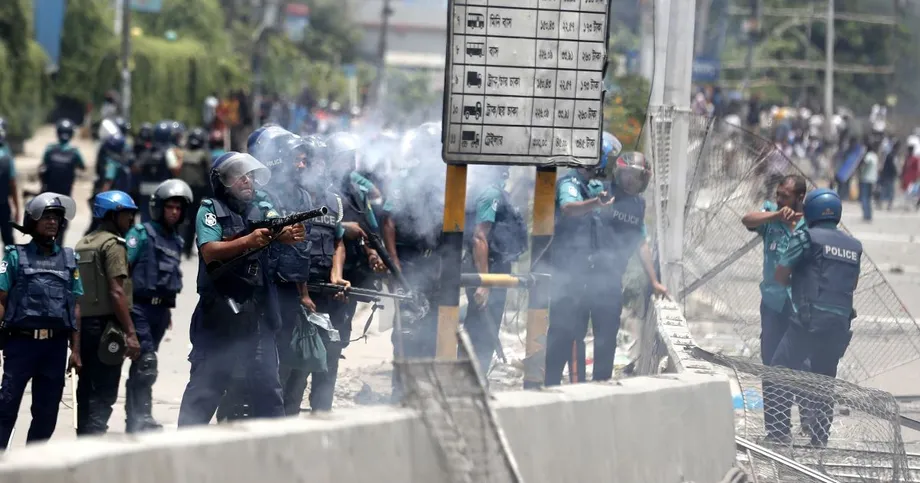
Retirements reach senior ranks as disciplinary cases continue
Bangladesh's Home Ministry has told a parliamentary committee that 147 police officers holding the rank of assistant superintendent of police or above were compulsorily retired in the public interest after the 2024 mass uprising. Another 73 officers holding the rank of inspector were retired under the same description, extending the administrative changes beyond the senior police cadre.
Contents
- Retirements reach senior ranks as disciplinary cases continue
- What happened to officers accused of leaving their posts?
- Criminal cases and tribunal verdicts add another layer
- How the changes unfolded
- Why lawmakers questioned fresh postings
- Officers contest the fairness of some decisions
- Transfers and promotion disputes affect daily policing
- Restoring morale while demanding accountability
- Crime has improved from 2025, with pressure still high
- Key Points
The ministry also reported departmental cases against 62 Bangladesh Civil Service police cadre officers accused of abandoning their posts after 5 August 2024. Half, or 31 officers, have been dismissed, while proceedings against the other 31 continue. These are internal employment proceedings, through which the authorities decide whether an officer should face disciplinary punishment.
The figures were presented at the fifth meeting of the parliamentary standing committee on the Home Ministry, chaired by Zainul Abedin and attended by Home Minister Salahuddin Ahmed. The ministry was responding to the committee's recommendation to investigate officers accused of playing controversial or harmful roles during the uprising.
The review brings together two pressing demands: removing officers responsible for misconduct and keeping police capable of protecting the public. Committee members questioned why some officers who had faced allegations or punishment were receiving fresh postings, while serving and former officers raised concerns about decisions they considered unfair.
Police Headquarters figures cited in other accounts put compulsory retirements at 141 personnel of various ranks, compared with the ministry's 147 senior officers and its separately listed 73 inspectors. A reconciled breakdown explaining the different totals, their coverage and any overlap between disciplinary categories has not been published in the accounts of the review.
What happened to officers accused of leaving their posts?
The ministry gave a more detailed account of 57 officers holding the rank of assistant superintendent or above who were suspended for absence or fleeing their workplaces in connection with the events surrounding 5 August 2024. All faced departmental proceedings. Of those 57, 28 were dismissed and one was retired in the public interest.
The ministry also listed 29 officers suspended after their arrest in criminal cases, court complaints or International Crimes Tribunal proceedings connected with the uprising. Two of those officers, both deputy inspectors general, were subsequently retired in the public interest.
Police Headquarters recorded a broader group of 137 personnel who had been absent from their workplaces after the uprising. Eighty returned, leaving 57 still absent. That count covered ranks from deputy inspector general to constable. Another disciplinary tally listed 93 officers temporarily suspended over alleged absconding under the Government Servants (Discipline and Appeal) Rules, 2018.
Suspension, dismissal and retirement have different practical effects. Suspension temporarily removes an officer from normal duties while a case is handled. Dismissal ends employment as a disciplinary punishment. Compulsory retirement also ends service, through an administrative decision described by the authorities as being in the public interest.
Criminal cases and tribunal verdicts add another layer
The ministry said action had been taken against 13 officers holding the rank of assistant superintendent or above following judgments in four cases heard by International Crimes Tribunals 1 and 2 in 2025. Five convicted officers were dismissed, while departmental proceedings against eight others continued.
At inspector level, five officers were dismissed or removed over conduct connected with the uprising. Proceedings were continuing against another 30 inspectors, alongside the 73 compulsory retirements. The ministry said action under service rules was also being pursued against other inspectors linked to the events.
Across the force, 1,490 police personnel have been named as accused in cases concerning firing on protesters, according to the broader police figures. Sixty-eight had been arrested. Criminal courts handle allegations of offences and determine sentences; departmental authorities decide employment consequences. An officer can therefore face both processes.
How the changes unfolded
The police changes stretch across the uprising, subsequent court proceedings and the transition to a Bangladesh Nationalist Party government in 2026. The sequence helps explain why several rounds of administrative action now sit alongside one another.
- November 2023: The previous government promoted 140 superintendents of police to additional deputy inspector general through special arrangements because regular vacancies were insufficient.
- July and August 2024: The mass uprising and its aftermath brought allegations of police firing on protesters, attacks on police facilities and widespread disruption to policing.
- 2025: International Crimes Tribunals 1 and 2 delivered judgments in four cases cited in the ministry's employment review.
- 12 and 17 February 2026: A national election was followed by the formation of the BNP government. A police tally recorded 56 compulsory retirements before the election and 85 after the government took office.
- 3 May, 5 July and 23 July 2026: Three retirement rounds covering 17, 33 and 17 officers respectively accounted for 67 departures.
- 13 August: The parliamentary committee's first meeting recommended investigation and departmental action against officers linked to controversial conduct during the uprising.
The date of the fifth committee meeting needs clarification. It is described as Thursday, 15 August, while the crime statistics discussed extend through September 2026. This leaves the timing of the parliamentary review uncertain.
Why lawmakers questioned fresh postings
Committee member Shirin Sultana asked how officers accused of controversial conduct during the uprising, including some who had received disciplinary punishment, were securing postings to police stations in Narsingdi and around Dhaka. She called for investigation and action against the officers concerned.
Another member, Monowar Hossain, said some officers named in the commission investigating enforced disappearances, as well as officers who had received departmental punishment, remained in their positions. He asked the home secretary and inspector general of police to address the matter.
Those concerns focus on who exercises police authority now, rather than simply how many officers have left. A station posting places an officer in direct contact with residents seeking protection, reporting crime or making complaints. The committee's demand for scrutiny therefore reaches beyond retirement lists to current assignments and supervision.
Officers contest the fairness of some decisions
Some serving and former officers allege that cases and administrative action have reached people who were elsewhere during the incidents concerned, were absent from relevant duty rosters or served in different units. They also allege that internal rivalries and political influence affected whose names appeared in cases.
Former additional deputy inspector general Rebecca Sultana disputed the basis of her compulsory retirement. She said a false report placed her at the removal of former prime minister Khaleda Zia from her cantonment residence, although she had been working at Police Headquarters. She also alleged that rivalry over promotion contributed to her removal. Police Headquarters had not supplied a detailed individual explanation for the decisions involving her and several other officers whose colleagues questioned their retirement.
Additional Inspector General Khandoker Rafiqul Islam rejected the suggestion that action was being taken arbitrarily. Explaining the police position on checking allegations, he said:
We do not take action against anyone without properly verifying the information that appears in the media or elsewhere.
Former inspector general Md Abdul Quayyum also called for decisions based on investigation and evidence, saying innocent officers should not be punished or denied promotion. The disagreement centres on the quality of individual investigations and the reasons given for administrative decisions.
Transfers and promotion disputes affect daily policing
Frequent transfers have added to uncertainty inside the force. Examples include the withdrawal of a Feni superintendent shortly after appointment and the transfer of a Panchagarh superintendent before taking charge. District police chiefs need time to understand local crime, build contacts and coordinate their teams.
Omar Faruk, professor of criminology and police science at Mawlana Bhashani Science and Technology University, said repeated reshuffles weaken officers' ability to adapt, especially when they move between rural and metropolitan policing. He supported legal proceedings against officers accused of specific crimes but opposed indiscriminate retirement that could discard substantial professional experience.
Promotion disputes predate the uprising. Of the 140 superintendents promoted to additional deputy inspector general in November 2023 through supernumerary arrangements, only 29 had since moved into regular positions. That leaves 111, about four out of five, still waiting. A supernumerary promotion gives an officer a higher rank even though a normal vacancy at that rank is unavailable.
Restoring morale while demanding accountability
Police entered this period with severe losses. About 1,400 people were killed during the uprising, according to a United Nations estimate cited in the accounts of the police transition. Forty-four police personnel were killed during and after the uprising, while hundreds of police stations and installations were vandalised or looted.
Committee member Abdul Baten asked whether special training and a separate budget allocation were available to address the damage to police morale and mental wellbeing, alongside losses of vehicles and infrastructure. Senior Home Secretary Monzur Morshed Chowdhury said regular training was continuing to improve morale.
The secretary also said mobs had obstructed police duties after the uprising. He described immediate legal and administrative action against those responsible for assaults on officers inside police stations. His response addressed training and protection, without specifying a separate budget allocation.
The Bangladesh Police Service Association said in a statement on 9 August that morale was gradually recovering. Former inspector general Ashraful Huda described reshuffles as an expected part of the transition, while urging the authorities to protect innocent officers from punishment. His position and the committee's concerns point to the same practical requirement: decisions that officers and the public can understand through individual evidence and stated reasons.
Crime has improved from 2025, with pressure still high
The parliamentary secretariat said the committee reviewed crime figures comparing January to September in 2025 and 2026, along with figures for July to September in both years. The categories included robbery, murder, rape, violence against women and children, kidnapping, theft, drugs, weapons and explosives cases.
Committee members expressed satisfaction with the improvement described in that review. Police Headquarters figures for a different comparison, January to July, showed declines from 2025 in several categories while robbery, murder, violence against women and children, kidnapping and theft remained above their levels in the same months of 2024. Improvement from a difficult year can still leave residents facing more recorded crime than before the uprising.
The committee discussed progress against extortion, street robbery, drug abuse, youth gangs and organised crime. It recommended greater use of modern technology and discussed an initiative for a separate cyber police unit. Home Minister Salahuddin Ahmed outlined crime prevention activity after member Nurul Islam asked about recent crime in Dhaka.
For residents, the practical test is whether police can investigate complaints and act against offenders consistently. For the force, that work now runs alongside continuing disciplinary proceedings, contested retirement decisions and unresolved postings.
Key Points
- The Home Ministry listed 147 senior officers and 73 inspectors compulsorily retired after the 2024 uprising.
- Of 62 police cadre officers facing departmental cases over alleged desertion, 31 were dismissed and 31 still faced proceedings.
- Five senior officers were dismissed following convictions in four tribunal cases; departmental proceedings continued against eight others.
- Lawmakers questioned new postings for officers accused of misconduct or previously punished.
- Police leaders defended verification procedures, while some officers challenged the evidence behind action against them.
- Crime declined from 2025 in several categories, but some major indicators remained above comparable 2024 levels.