Deforestation Climbed in 2024 as Projects Wait for Land
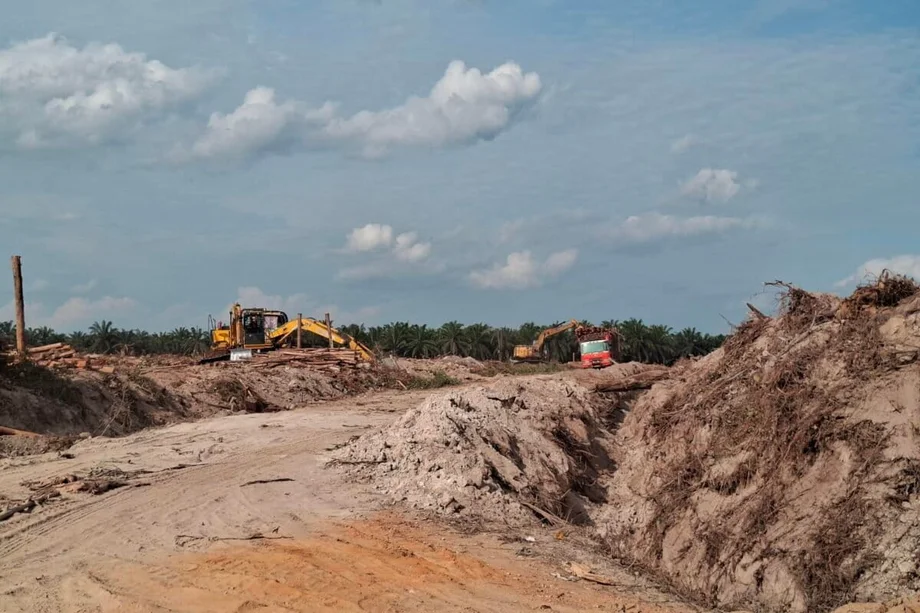
Indonesia recorded 175,437.7 hectares of net deforestation in 2024, up from 121,103.5 hectares in 2023, according to Statistics Indonesia (BPS). Net deforestation is the forest area lost once regrowth is counted. The increase arrives while the government works toward FOLU Net Sink 2030, a pledge that the forestry and land use sector will absorb more carbon than it releases by the end of the decade.
Contents
- Deforestation Climbed in 2024 as Projects Wait for Land
- A COP31 Outcome That Leaves Forests to National Politics
- Nine Carbon Projects and an Unanswered Question on Rights
- Sugarcane, Nickel and the E50 Bioenergy Push
- A 100 Gigawatt Solar Plan Beside a Growing Coal Fleet
- What Carbon Capture Can and Cannot Fix
- A US$472.6 Billion Bill and the Risk of a Green Debt Trap
- Carbon Trading, Blue Carbon and the Consent Question
- Degraded Land, Food Estates and the Biofuel Promise
- Customary Forests and Young People Who Want Influence, Not a Seat
- Key Points
Mapping by the Madani Berkelanjutan Foundation puts the country's remaining natural forest at 90.16 million hectares in 2024. Across 2024 and 2025, about 259,000 hectares of natural forest disappeared, and around 90 percent of that loss was secondary forest, meaning cover regrowing after earlier logging or clearing. A sharper figure sits inside the total: 57.4 percent of the lost area, roughly 149,000 hectares, overlapped with land permits and concessions.
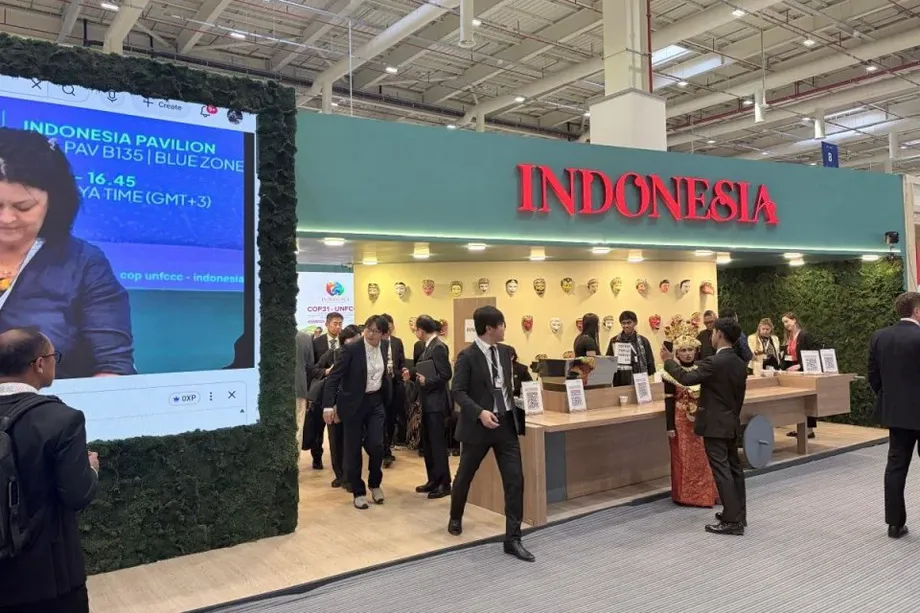
Those numbers framed a briefing in Jakarta on Thursday, 26 November 2026, organised by the Justice Coalition for Our Planet (JustCOP), where researchers and campaigners examined how the commitments Indonesia carried to the 31st UN Climate Change Conference (COP31) in Antalya, Türkiye, line up with policy at home.
A COP31 Outcome That Leaves Forests to National Politics
Negotiators in Antalya drafted a cover decision that initially called on countries to halt and reverse deforestation by 2030. No consensus formed around that umbrella text, so the call never became a joint commitment, and the conference closed without binding language on forests.
Nadia Hadad, executive director of the Madani Berkelanjutan Foundation, argued that the commitment to protecting forests should not weaken simply because global negotiations have not produced a strong political agreement.
"The process is underway, but there is no binding language that would compel countries to take it seriously," she said.
For Indonesia, the missing umbrella decision moves the weight of the 2030 target onto domestic choices about permits, concessions and land use. Several dates now carry that weight, from the launch of a carbon registry to the government's deadline for recognising customary forest.
- July 1, 2026: the B50 biodiesel mandate takes effect, requiring diesel sold in Indonesia to be half biodiesel made from crude palm oil.
- July 9, 2026: the Carbon Unit Registry System (SRUK) opens for recording carbon transactions.
- September 24, 2026: President Prabowo Subianto orders the creation of the National Peatland and Mangrove Management Agency (BPGMN).
- November 26, 2026: JustCOP holds its briefing on the direction of Indonesia's climate commitments.
- January 2028: the aviation offset scheme CORSIA is estimated to need 200 million to 250 million eligible carbon units by that point.
- 2029: the government target for recognising 1.4 million hectares of customary forest.
- 2030: deadline for FOLU Net Sink, and for Japan's Joint Crediting Mechanism to reach 100 million tonnes of reductions across partner countries.
- 2035: end point for the Second NDC investment need of US$472.6 billion.
- 2038: deadline for Norway's purchase of up to 12 million tonnes of carbon dioxide equivalent from Indonesian solar projects.
Nine Carbon Projects and an Unanswered Question on Rights
At COP31 the government presented nine carbon projects in forestry and land use to investors, according to Nadia, without setting out how the rights of communities living in or near those areas would be settled. She described the offer as a gap between the accounting and the people who would live with the contracts.
"FOLU Net Sink 2030 will not be achieved if one hand plants and the other opens the forest," she said.
Her prescription is regulatory rather than diplomatic. She called on the government to extend the freeze on new permits across all natural forest and peatland, to review permits already issued in sensitive ecosystems, and to require national strategic projects to comply with climate targets instead of being treated as exceptions to them.
Sugarcane, Nickel and the E50 Bioenergy Push
Three programmes sit at the centre of the contradiction Nadia describes. Land is being opened for food projects, for sugarcane plantations tied to the bioenergy programme known as E50, and for nickel and critical mineral processing, a policy usually labelled downstreaming because it keeps more refining inside Indonesia instead of exporting raw ore. Each one needs land, and much of the land in question is forest.
Nickel carries a double load. Analysis published in September 2026 by the energy think tank Ember found that nickel processing consumed more than 81 terawatt hours of electricity in 2025 from captive power plants, more than 94 percent of it generated from coal. A captive plant is built and run for a single industrial user, usually outside the public grid, which means the electricity behind electric vehicle batteries can be among the dirtiest in the system.
Earlier land use decisions have already reshaped the map. Forest clearing for pulpwood rose from about 5,600 hectares in 2017 to 24,300 hectares in 2022, a reversal after a decade of progress in the pulp sector's forest clearing. At the same time, Indonesia's largest palm oil market is now at home: domestic purchases were linked to 67 percent of the sector's deforestation exposure, a footprint reaching 629,000 hectares against 71,400 hectares tied to exports to India, as shown in the analysis of domestic palm oil demand.
A 100 Gigawatt Solar Plan Beside a Growing Coal Fleet
Hashim Djojohadikusumo, head of Indonesia's delegation at COP31 and the president's special envoy for climate and energy, presented an ambition to build solar power stations with a capacity of 100 gigawatts peak, and a target of carbon neutrality by 2060. The peak figure measures output under full sunlight, the condition at which solar panels are rated.
Agung Budiono, executive director of Yayasan Indonesia Cerah, said the solar ambition is worthwhile on paper. The domestic record tells a different story, with large scale expansion of coal fired steam power plants (PLTU) still supported by the government, and the delegation in Antalya declining to back a global goal of 35 percent clean electrification by 2035.
"I don't see any reflection of what the Indonesian Government is promoting in the context of energy at this COP31," Agung said.
He framed the problem as a sequencing failure: targets are announced before the rules that would make them reachable. The measures he listed are a firm timetable for retiring coal plants early, an end to permits for new captive coal plants, and electricity regulation that gives renewable generators room to connect and sell.
"Without clarity on a schedule for retiring coal plants early, a halt to new captive coal permits, and reform of electricity regulations that opens space for renewables, the energy transition target risks becoming diplomatic cosmetics," he said.
One measure costs almost nothing and needs no treaty. Agung urged the government to remove the quota on rooftop solar installation, so that households and businesses that want to generate their own electricity are not blocked by a policy ceiling on consumer participation.
What Carbon Capture Can and Cannot Fix
Carbon capture and storage, known as CCS, traps carbon dioxide from a plant or industrial process and injects it underground rather than releasing it into the air. The technology works on a fraction of emissions and does nothing about the fuel that produced them.
Agung warned that CCS must not become the argument for keeping fossil fuel plants alive for decades, and that spending on it must not crowd out investment in renewables. His point is physical rather than political: capturing carbon from a coal plant still requires burning the coal, so the dependence on imported fuel and the mining that feeds it continue.
Bhima Yudhistira, executive director of the Centre for Economic and Law Studies (Celios), placed the technology in the same category as carbon trading. In his reading, the government leans on markets and CCS because they raise money and preserve existing assets, while inclusive green jobs built with communities get less attention.
A US$472.6 Billion Bill and the Risk of a Green Debt Trap
Indonesia's Second Nationally Determined Contribution, the document that sets out what the country will do and what it needs, estimates climate investment requirements of US$472.6 billion through 2035. Alongside that figure, Indonesia is asking for global climate finance of US$300 billion a year until 2035.
Bhima cautioned that the scale of the need makes the choice of instruments decisive. Money that arrives as commercial loans at market rates adds to the fiscal burden and can leave the public with little to show for it. He used the Just Energy Transition Partnership, or JETP, a financing package assembled with international partners, as the cautionary case. State utility PLN has mobilised US$2.94 billion for the energy transition, including US$1.1 billion through the JETP.
"We must not repeat the mistakes of the JETP; many of the solutions are debt-based and focused on commercialisation, with the host country actually deriving little benefit," he said.
COP31 also advanced the Climate Implementation BRIDGE initiative, under which Indonesia is among the first pilot countries alongside Fiji, Pakistan and Ethiopia. Bhima argued that the design of such schemes, not their headline size, decides who pays.
"The push for US$300 billion a year in global funding at COP31 does not automatically benefit developing countries if most of the money is still commercial debt at high interest, rather than grants or fair concessional finance," he said.
He also asked for more work with developing countries to build a common negotiating position, so that access to finance and the pace of transition are argued on equal terms rather than accepted as offered.
Carbon Trading, Blue Carbon and the Consent Question
Money is already moving through markets. Indonesia signed its first deal under Article 6.2 of the Paris Agreement at COP31, in which Norway will buy up to 12 million tonnes of carbon dioxide equivalent from PLN solar projects by 2038, with units priced between US$20 and US$40 per tonne. Article 6.2 governs transfers of mitigation outcomes between countries, which requires rules against counting the same tonne twice.
The legal scaffolding is in place. Presidential Regulation No. 110/2025 and Forestry Ministerial Regulation No. 6/2026 authorise international transfers and set procedures for forestry carbon trading, and the Carbon Unit Registry System, launched on July 9, 2026, requires transactions to be recorded within two working days and is being linked to the Verra registry. BloombergNEF data for 2025 estimates Indonesia's forest carbon potential at 13.4 gigatonnes of carbon dioxide. The Ministry of Forestry's director general for sustainable forest management, Laksmi Wijayanti, said transactions under Article 6 need clear governance, credible accounting, safeguards and commercially viable terms for both investors and buyers.
Buyers are lining up. Singapore lets companies offset up to 5 percent of taxable emissions with international credits, Japan's Joint Crediting Mechanism is aiming for 100 million tonnes of reductions across partner countries by 2030, and the aviation scheme CORSIA is estimated to need 200 million to 250 million eligible units through January 2028. Forty seven nationally certified projects hold an estimated 4.6 million tonnes of annual reduction potential, with five ready to issue credits, while 86 energy projects offer up to 22 million tonnes combined.
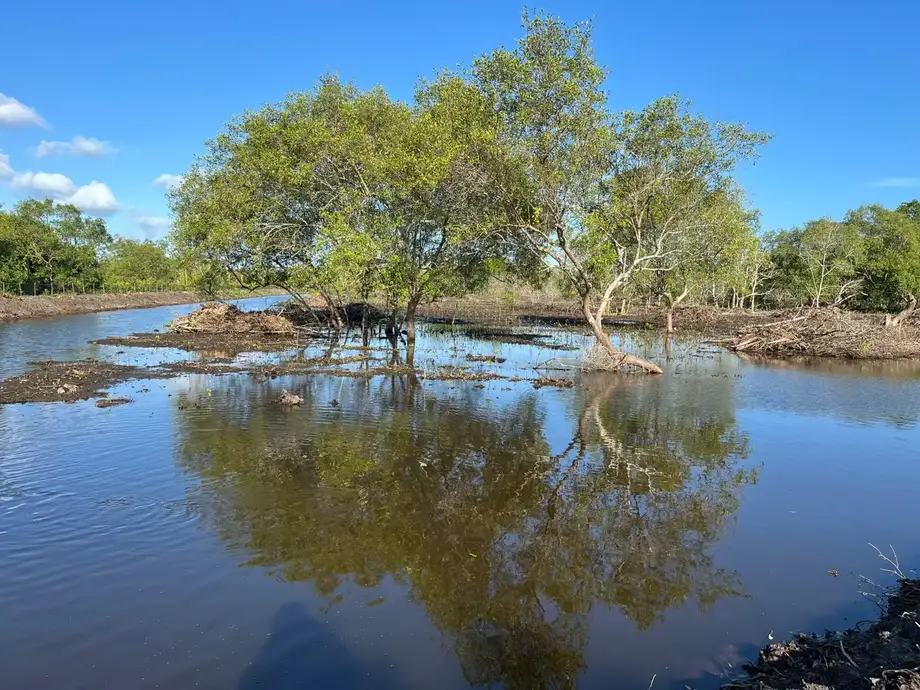
Uli Arta Siagian, national campaign coordinator at the Indonesian Forum for the Environment (Walhi), said the delegation appeared busier with trading carbon than with cutting emissions or protecting rights. She pointed to three blue carbon projects announced at COP31 in North Kalimantan, along Java's northern coast and in East Belitung. Carbon trading in sea areas, in her account, creates the same conflicts as trading in forests when consent is missing.
"Without clear FPIC, without recognition of community rights, this will only extend conflict," she said.
FPIC stands for free, prior and informed consent, the principle that communities must agree to projects before they begin rather than be compensated afterwards. Walhi instead wants the government to use non-market approaches under Article 6.8 of the Paris Agreement, which fund and support communities that protect forests and coastlines through recognition, finance and technology transfer rather than through the sale of credits.
"Behind the negotiating stage in Antalya, people on the ground keep losing living space to energy plantation expansion, to nickel mines for electric vehicle batteries, and to carbon trading projects that push residents aside," Uli said.
Degraded Land, Food Estates and the Biofuel Promise
Hashim offered a different route at COP31: grow the fuel and the food on land that has already lost its forest. He said Indonesia is moving toward energy self sufficiency through biofuels with B50 and B100, using degraded land, degraded forests and damaged forests rather than primary forest, and put the country's damaged or degraded forest at 12.7 million hectares.
The B50 mandate, in force since July 1, requires all diesel sold in Indonesia to be half biodiesel derived from crude palm oil, with B100 the eventual aim. Whether the land exists in the right condition is another matter. The Forestry Ministry has estimated that restoring 12 million hectares of degraded land would cost around US$42 billion, and Indonesia has not set a target or timetable for the agricultural expansion.
Brazil's attempt shows the scale involved. Its programme to recover degraded pasture, launched in 2010 at 30 million hectares by 2030 and raised in 2023 to 40 million hectares by 2033, is expected to cost about US$120 billion, and results have been mixed, with some land too expensive to rehabilitate profitably. Dwi Andreas Santosa, a professor of agriculture at IPB University, questioned whether the state can supply the technical and financial support smallholders would need, warning that large corporations could dominate and plant cash crops such as oil palm instead of food.
Fire adds to the damaged area each year. Independent monitoring platform Nusantara Atlas counted about 2.8 million hectares burned in 2026, an area roughly 38 times the size of Singapore. Scientists estimated that recent fires released 370 million tonnes of carbon dioxide, about the annual emissions of 97 coal fired power plants, with peatlands making up 20 percent of the burned area but 80 percent of the emissions. Indonesia lost more than 2.63 million hectares of primary forest between 2016 and 2024, and forest loss in 2025 rose 66 percent, the fastest rate in eight years.
The food estate programme, started in 2020 under President Joko Widodo, converted 770,000 hectares of forest, peatland and other land for rice, corn and other crops, and President Prabowo Subianto has pledged to add about 3 million hectares. Refki Saputra, a forest campaigner at Greenpeace Indonesia, said the programme has driven deforestation, environmental damage and the dispossession of indigenous communities, and called for it to be cancelled and cleared land to be restored. Mahawan Karuniasa, an environmental science expert at the University of Indonesia, argued that forest protection cannot be separated from how the surrounding landscape is managed.
Customary Forests and Young People Who Want Influence, Not a Seat
Rights over land sit at the centre of the argument. About 400,000 hectares of customary forest have been designated so far, against a government target of 1.4 million hectares by 2029. Nadia called for faster recognition under a dedicated law on indigenous peoples, and for communities to be involved from the planning stage of climate policy, including the right to say no under the principle known in Indonesian as Padiatapa, the local rendering of free, prior and informed consent.
Elisabeth Simanjuntak, chair of the Archipelago Indigenous Youth Alliance (BPAN), said the presence of young people at forums such as COP31 does not by itself amount to meaningful participation. She set out three conditions: recognition of their existence, participation in the negotiation process, and real influence over the decisions reached.
"Young people, indigenous youth and future generations are the ones who will feel the impact of the decisions made today. It is only right that they should be given a genuine opportunity to express their views and help shape those decisions," she said.
Indigenous youth, in her account, already manage forest, local seed and customary territory as a defence against climate change, and that practice rarely enters the negotiating room. BPAN is asking the government to recognise dialogue across generations, to treat traditional knowledge as evidence, and to protect the living space of future generations from both climate impacts and land acquisition.
"The COP31 negotiations are putting the future at stake, yet the voices of indigenous youth and young people from affected communities are still pushed to the margins of decision making," she said.
Key Points
- Statistics Indonesia recorded 175,437.7 hectares of net deforestation in 2024, up from 121,103.5 hectares in 2023.
- The Madani Berkelanjutan Foundation puts remaining natural forest at 90.16 million hectares in 2024, with about 259,000 hectares lost across 2024 and 2025.
- Some 149,000 hectares of that loss, 57.4 percent of the total, overlapped with land permits and concessions.
- COP31 ended without an umbrella decision on halting deforestation by 2030, leaving forest protection to national politics.
- Indonesia offered nine forestry and land carbon projects to investors without settling community rights.
- Nickel processing used more than 81 terawatt hours in 2025, over 94 percent of it from coal fired captive plants.
- The Second NDC estimates a US$472.6 billion investment need through 2035, while Indonesia seeks US$300 billion a year in global climate finance.
- Norway will buy up to 12 million tonnes of carbon dioxide equivalent from PLN solar projects by 2038 at US$20 to US$40 per tonne.
- Yayasan Indonesia Cerah says the 100 gigawatt solar ambition needs a coal retirement timetable and an end to new captive coal permits to be credible.
- Customary forest designation stands at about 400,000 hectares against a target of 1.4 million hectares by 2029.