A Sugar That Costs a Tenth as Much
On November 27, 2026, a team at Texas A&M University published a study in ACS Measurement Science AU showing that a sugar compound called beta-mannopentaose matched the performance of alpha-mannopentaose, the material used in earlier versions of its experimental glucose sensor, at roughly one tenth of the price. The older compound costs about $10 per milligram. The substitute can be bought in bulk for under $1 per milligram.
Contents
- A Sugar That Costs a Tenth as Much
- How a Sensor Measures Sugar With Light
- Why the Cheaper Sugar Was the Surprise
- What the Seven Day Test Shows, and What It Does Not
- The 90 Percent Applies to One Ingredient
- A British Price Tag for Glucose Sensing
- A Cambridge Chip That Reads Light Through Skin
- What Comes Next
- Key Points
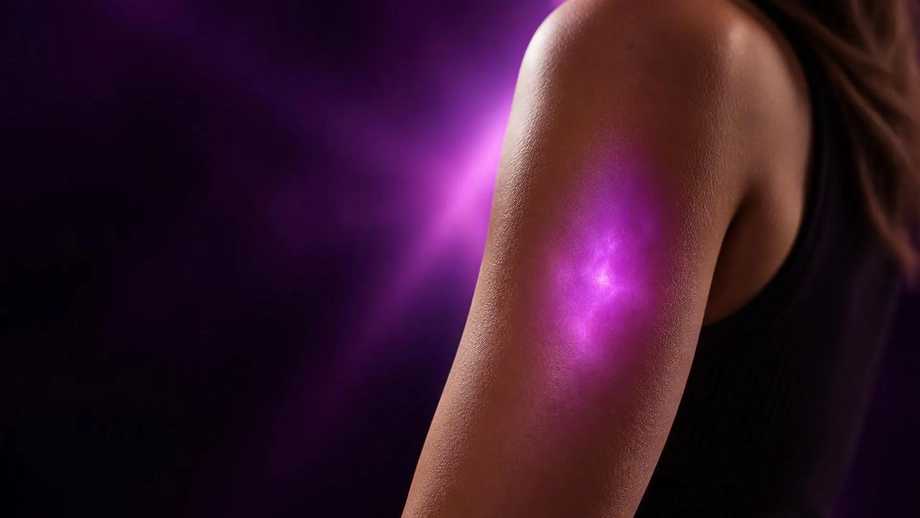
The sensor is not a product. It is a laboratory design for a device that would be injected beneath the skin, where fluorescent molecules lit by near-infrared light would report how much sugar surrounds them. Continuous glucose monitors already let millions of people with diabetes follow their blood sugar in real time and adjust insulin, meals and exercise accordingly. The price of those devices keeps a large share of patients from ever using one, and cost is the reason the Texas A&M group picked this problem.
The research was paid for by the National Science Foundation's Engineering Research Center for Precise Advanced Technologies and Health Systems for Under-resourced Populations, and every author works at Texas A&M: Sayantan Tripathy, Gerard L. Cote, Melissa Grunlan, Carolina Martinez, Anthony Dongchau and Samyucktha Ganesapandian.
One number attached to the work needs care. The reduction of about 90% applies to a single sensing material, not to the shelf price of a finished monitor. The study measures the cost and the behaviour of one chemical in the sensing chain, and it sets out no price for a device that does not yet exist.
How a Sensor Measures Sugar With Light
Most glucose monitors in use today depend on enzymes. An enzyme reacts with glucose and produces an electrical signal in proportion to how much sugar is present. Enzymes work well, but they are sensitive to heat and acidity and lose activity as they age, which is one reason researchers keep looking for other ways to read glucose.
The Texas A&M design drops enzymes entirely. It relies on fluorescent molecules and near-infrared light, the band of light just past the red end of the visible spectrum. That light travels deeper into tissue than visible light does, which matters when the sensing chemistry sits under the skin rather than in a drop of blood on a test strip.
The reading comes from a process called competitive binding. Inside the sensor, a protein called concanavalin A, or ConA, offers binding sites. Glucose molecules and a fluorescent sugar compound both want those sites, so they compete for them. As glucose levels rise, more sites are taken by glucose and fewer by the fluorescent sugar, and the glow that comes back through the skin shifts in intensity. A detector outside the body measures that change and works back to a glucose value.
All of this chemistry sits inside a hydrogel, a gel that is mostly water held in a polymer mesh. The mesh keeps the sensing ingredients from drifting away while letting glucose move freely in and out, so the sensor keeps sampling the fluid around it rather than going stale.
Why the Cheaper Sugar Was the Surprise
The fluorescent sugar compound is the expensive part of the assay. The team screened several molecules that bind to ConA before settling on beta-mannopentaose, which is built from the same five mannose units as alpha-mannopentaose but arranged differently at one carbon atom, known as the anomeric carbon. That single flip changes which face of the sugar the protein sees, and it changes the price far more than it changes the signal.
The surprising part was how closely the lower-cost material matched the performance of the more expensive alternative," said Sayantan Tripathy, an assistant research scientist in the university's Optical and Bio-Sensing Laboratory and the study's lead author. "In this case, the cheaper option wasn't really a compromise, and that's an important finding when you're thinking about future glucose-monitoring technologies.
The comparison held in artificial interstitial fluid, a laboratory solution built to imitate the fluid that surrounds cells beneath the skin. That fluid, not blood, is what a monitor worn on the body or placed under it actually samples, so a material that fails there would fail in practice no matter how well it behaves in plain water.
Gerard L. Cote, the study's principal investigator and a professor of biomedical engineering, framed the result as one piece of a wider cost problem. Materials have to work together, not only on their own.
Developing an affordable glucose sensor means considering the cost of the individual materials as well as how well they work together," Cote said. "This study shows that we can substantially reduce the cost of one sensing component while maintaining comparable performance, giving us a promising foundation for further development.
What the Seven Day Test Shows, and What It Does Not
The hydrogel test produced the number the team leans on. In laboratory experiments, more than 94% of the sensing assay was still inside the gel after seven days. That matters because a sensor that leaks its fluorescent compounds into surrounding tissue loses accuracy as it loses material, and the body has to clear whatever escapes.
Seven days in a dish is not seven days in a body. The sensor has not been tested in animals or in people, and the study reports no accuracy figures for human use. Several questions sit open: whether the fluorescent signal drifts over months, whether tissue reacts to the hydrogel, and how a device under the skin would pass readings to a phone or a receiver without a wire.
Melissa Grunlan, a co-author who holds professorships in biomedical engineering and in chemistry, tied the chemistry to who ends up wearing the result.
When new medical technologies are expensive, access can be limited," Grunlan said. "Our goal is to develop sensors that are not only effective but affordable for the people who rely on them.
Tripathy and Cote both describe the work as a research stage result. Cote has said that a monitor worth building has to balance affordability with reliability, compatibility with the body and how long it keeps working. No date has been given for animal testing or for a first study in people.
The 90 Percent Applies to One Ingredient
Cheap chemistry does not make a cheap monitor on its own. A continuous glucose monitor carries a sensing element, a transmitter, a power source, packaging that must stay sterile and watertight, software, and the clinical trials and regulatory filings behind every claim it makes about health. The Texas A&M team has priced one reagent in that chain.
The reasoning behind the study is that early choices lock in later costs. A material picked at the design stage sets manufacturing expense for the life of a product, and replacing it after clinical testing means repeating much of the work. Cote's group argues that affordability belongs in the first prototype rather than in a fix applied at the end.
Where the work is meant to lead is a reliable injectable sensor for people in communities with limited resources and for patients without adequate insurance coverage. Cote described the destination in his own terms.
Our long-term goal is to develop a reliable, affordable injectable glucose sensor that can expand access to continuous glucose monitoring, particularly for people in under-resourced communities and those without adequate insurance coverage," he said. "Reducing the cost of the sensing materials is one step toward making these technologies accessible to more people who need them.
A British Price Tag for Glucose Sensing
Cost questions about glucose sensing go beyond manufacturing. On November 15, 2026, a team led by the University of Manchester published an economic evaluation in Diabetes, Obesity and Metabolism that put real time glucose sensors for type 2 diabetes at £5,943 per quality adjusted life year gained. That sits well inside the £25,000 to £35,000 range England's health service treats as good value, at less than a quarter of the lower bound.
The finding runs against guidance the National Institute for Health and Care Excellence issued in 2022, which concluded that real time sensors were not cost effective for adults with type 2 diabetes. The new analysis drew on the FreeDM2 trial, which randomly assigned 303 adults at 24 centres across the United Kingdom to wear Abbott's FreeStyle Libre 3 sensor or to use standard finger prick testing for 32 weeks. Every participant had glucose levels above target despite taking insulin and other diabetes drugs.
Sensor wearers improved their glucose control more than the finger prick group. The researchers fed those gains into a computer model projecting costs and health over a lifetime. The sensors added £4,341 per person in direct costs and produced 0.73 quality adjusted life years, a measure that combines how long and how well someone lives. They also cut projected spending on diabetes complications by £2,437 per person. Over the 32 weeks of the trial itself, costs and quality of life looked much the same in both groups, with incremental costs of £254 and adjusted quality adjusted life years of -0.015.
The arithmetic depends on persistence. Cost effectiveness holds only if patients keep wearing the sensors and keep their improved control for at least four years.
About 5.8 million people in the United Kingdom live with diabetes, roughly 90% of them with type 2, and the condition cost the country an estimated £8.8 billion in 2021/22, with 64% of that spending tied to severe complications such as heart disease, kidney failure, sight loss and amputations.
For people with type 2 diabetes who use insulin, being able to choose a sensor over finger-prick testing can make managing their condition easier," said Rachel Elliott, professor of health economics at the University of Manchester. "Our results suggest this technology offers good value for the NHS, as long as people use the sensor to manage their glucose levels for 4 or more years.
A Cambridge Chip That Reads Light Through Skin
Another group is chasing the same goal without an implant. On November 25, 2026, researchers at the University of Cambridge described a packaged optical spectrometer measuring 4.8 by 6.2 by 0.6 centimetres that weighs 16.5 grams and, according to its authors, could be mass produced at low cost. The device shines light at skin and reads the reflected spectrum, using a computational model to estimate glucose changes rather than measuring sugar directly. The details appeared in Nature Photonics in a paper titled Optical convolutional spectrometer, with Chunhui Yao as first author.
In an oral glucose tolerance test with 27 participants, a routine procedure in which a person drinks a known amount of sugar and is monitored for the next hours, the chip's estimates came within an average absolute error of 0.363 millimoles per litre of reference values. Monitoring over several days in everyday conditions was tried on one person, using a model trained for that individual. The authors state that the glucose model does not transfer reliably to other people without recalibration, which leaves the hard part unsolved: an algorithm that works on any wrist, with any skin tone and any level of hydration.
The low cost projected for the chip covers the optical component in mass production, not a finished watch, which would add a battery, a display, connectivity, a housing and regulatory clearance. The Cambridge and Texas A&M results sit at the same distance from a product, and each shows a different part of the way there: one a sensing chemistry that survives inside the body, the other an instrument small enough to wear.
What Comes Next
The team's next steps are set out in the study: refine the chemistry, try other hydrogel formulations that might keep the sensor working for longer than a week, and move toward preclinical testing. Cote and Tripathy both make clear that the sensing material is one part of a device that does not yet exist.
"While the work remains in the research stage, the findings suggest that future glucose-monitoring technologies may not have to rely on expensive materials to deliver effective results," Tripathy said.
Four moments trace how the field has moved in recent weeks and years.
- 2022: the National Institute for Health and Care Excellence concludes that real time glucose sensors are not cost effective for adults with type 2 diabetes.
- November 15, 2026: a University of Manchester team publishes an evaluation placing the sensors at £5,943 per quality adjusted life year.
- November 25, 2026: Cambridge researchers describe a 16.5 gram spectrometer chip that estimates glucose from reflected light.
- November 27, 2026: Texas A&M publishes the beta-mannopentaose results in ACS Measurement Science AU.
No trial dates have been announced for the injectable sensor. The next test for the Cambridge chip is a wider study to see whether its accuracy holds outside controlled conditions and across people it was not calibrated for.
Key Points
- Texas A&M researchers found that beta-mannopentaose performs as well as alpha-mannopentaose in an experimental injectable glucose sensor at about one tenth of the cost, roughly $1 per milligram against $10.
- The study appeared in ACS Measurement Science AU on November 27, 2026, and was funded by a National Science Foundation engineering research center.
- The sensor uses fluorescent molecules and near-infrared light, with glucose and a fluorescent sugar competing for binding sites on the protein concanavalin A.
- More than 94% of the sensing assay stayed inside the hydrogel after seven days in laboratory tests, including trials in artificial interstitial fluid.
- The 90% saving covers one sensing material, not the price of a finished monitor, and the device has not been tested in animals or people.
- A separate University of Manchester analysis put real time glucose sensors for type 2 diabetes at £5,943 per quality adjusted life year, below England's cost effectiveness threshold.
- Cambridge researchers built a 16.5 gram optical spectrometer chip that estimated glucose with an average absolute error of 0.363 millimoles per litre in a test with 27 participants, though its model needs recalibration for each new user.