A galaxy caught soon after its first chemical inheritance
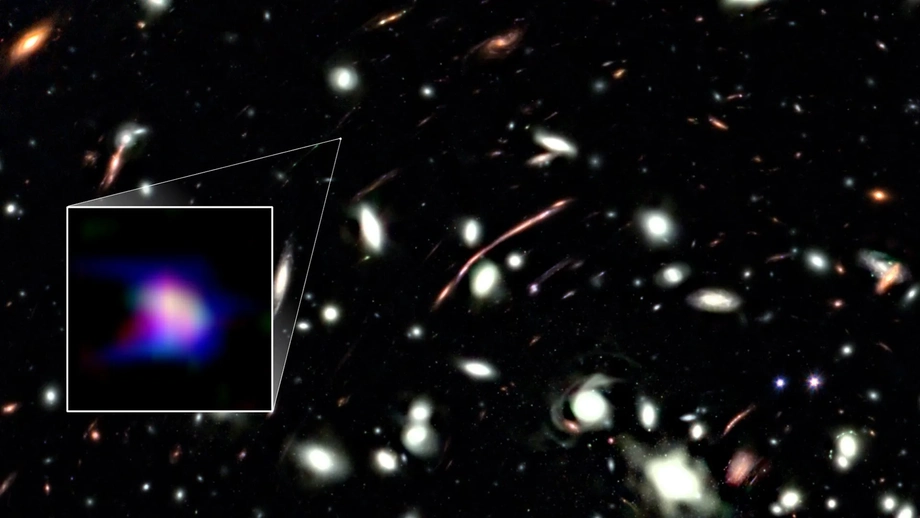
Astronomers have measured the chemistry of LAP1-B, a tiny galaxy seen as it existed 13 billion years ago, and found an oxygen abundance of only 0.42% of the Sun's value. That is approximately 1/240th of the solar level, making LAP1-B the most chemically primitive galaxy forming stars that has been identified so far. Its redshift is 6.625 ± 0.001, placing it about 800 million years after the Big Bang.
Contents
- A galaxy caught soon after its first chemical inheritance
- Webb was not the first telescope to see it
- How a galaxy cluster became a magnifying glass
- What the oxygen measurement actually means
- Why carbon and radiation point toward the first stars
- How can so few stars occupy such a massive galaxy?
- Why LAP1-B is a fossil in the making
- What independent astronomers want checked next
- What this means for the ingredients of planets and life
- What to Know
An international team led by Associate Professor Kimihiko Nakajima of Kanazawa University used the James Webb Space Telescope, or JWST, to examine gas rather than resolve individual stars. The results appear in Nature, volume 653, under the title An Ultra-Faint, Chemically Primitive Galaxy Forming in the Reionization Era. The scientific paper, also identified as arXiv:2506.11846, supplies the detailed measurements and statistical limits.
LAP1-B is remarkable for more than its oxygen shortage. Its gas contains an unusually large amount of carbon relative to oxygen, its radiation is extraordinarily energetic, and its stars account for less than 3,300 solar masses under the team's main limit. Gas movements indicate a much larger gravitational mass, pointing to a halo dominated by dark matter. Together, those properties make the galaxy a candidate ancestor of the ancient Ultra-Faint Dwarf galaxies found around the Milky Way.
Webb was not the first telescope to see it
LAP1-B was first announced in 2020, before Webb began its scientific work. Eros Vanzella, an astronomer at Italy's National Institute for Astrophysics, led the team that identified it using data from the European Southern Observatory's Very Large Telescope at Paranal in Chile. That investigation followed earlier Hubble Space Telescope studies of the galaxy cluster in front of LAP1-B. Webb's contribution was to measure the object's chemistry, radiation and internal motion in much greater detail.
- 2020: Astronomers announced LAP1-B using Very Large Telescope data, following Hubble observations of its surrounding field.
- 2021: JWST launched. It is the largest and most powerful infrared space telescope built, designed to detect extremely faint and distant objects.
- 4 and 5 November 2024: Webb's Near Infrared Spectrograph observed LAP1-B under program GO-4750, led by Nakajima as principal investigator, as part of the DREAMS survey.
- 14 May 2026: Kanazawa University, the National Astronomical Observatory of Japan and the University of Tokyo's Institute for Cosmic Ray Research coordinated announcements of the Nature result.
NAOJ's announcement lists the paper's DOI as 10.1038/s41586-026-10374-1. The sequence also explains why describing LAP1-B simply as a new Webb discovery would miss an important part of the story: a ground based telescope found the object, while Webb supplied the spectroscopy that revealed its primitive state.
How a galaxy cluster became a magnifying glass
LAP1-B lies behind MACS J0416.1-2403, also shortened to MACS J0416, a massive cluster of galaxies. The cluster's gravity bends and concentrates light passing through space, acting like a natural magnifying glass. The paper calculates a magnification of 98, with an uncertainty range from five above to four below that value. Without this roughly 100-fold boost, LAP1-B would be extraordinarily difficult to examine.
Webb spent more than 30 hours observing the galaxy, including 16.37 hours of integration for each of two wavelength settings. The measurements covered 0.8 to 1.8 micrometres and 2.9 to 5.2 micrometres. Researchers detected five emission lines: Hα, Hβ, doubly ionized oxygen at a wavelength of 5007 angstroms, C IV at 1549 angstroms and hydrogen Lyman α. These features come mainly from glowing gas, not from a clearly detected blanket of starlight.
Spectroscopy separates light into wavelengths, much as a prism spreads visible light into a rainbow. Each element leaves a distinctive pattern, allowing astronomers to read something resembling a barcode. The pattern can reveal chemical ingredients, distance and motion. In LAP1-B's case, ordinary Webb camera imaging did not detect a continuous stellar glow, but the spectrograph captured faint emission from hydrogen, oxygen and carbon. The scientists also credited artificial intelligence algorithms with helping capture the faint light, although they gave no further public detail about that part of the analysis.
Redshift describes how much the expansion of the universe has stretched light. LAP1-B's value of 6.625 corresponds to the era about 800 million years after the Big Bang. The raw observations are available through the Space Telescope Science Institute's MAST archive under Program ID 4750. The team reduced them with JWST pipeline version 1.17.1 and the calibration reference file jwst_1298.pmap, giving other researchers a defined route to examine the data.
What the oxygen measurement actually means
Astronomers express oxygen abundance by comparing oxygen atoms with hydrogen atoms, written as O/H. Hydrogen has existed since the universe's earliest moments, so it provides a convenient reference. Stars create oxygen and other heavy elements through nuclear reactions. When stars die, some of that material returns to the surrounding gas. A galaxy with very little oxygen relative to hydrogen has therefore experienced limited chemical enrichment.
LAP1-B's measured oxygen abundance is 12 + log(O/H) = 6.31, with an uncertainty of +0.15 and -0.23. This corresponds to (4.2 ± 1.8) × 10^-3 of the solar value. The calculation began with a ratio of doubly ionized oxygen to Hβ of 0.69 ± 0.28. Researchers then used theoretical models beyond their usual empirical calibration range. The ratio of Hα to Hβ also matched the expected value for gas with negligible dust, reducing the need for a large correction for obscured light.
Earlier Webb spectroscopy of galaxies at redshifts from 4 to 10 had confirmed none below a metallicity level of about 2% of the Sun's value. LAP1-B's 0.42% is roughly one fifth of that earlier level. This is why the measurement extends the accessible chemical range rather than merely setting a small numerical record.
Kimihiko Nakajima, the Kanazawa University associate professor leading the team, described his response when the oxygen result emerged:
I was instantly thrilled by the extreme lack of oxygen revealed in the data. Finding a galaxy in such a primitive state is astonishing. It's a chemical signature that clearly indicates a primordial galaxy caught in the moments shortly after its formation.
The uncertainty remains important because the oxygen calculation requires an extrapolation of theoretical models. Even so, the detected oxygen line is weak but statistically meaningful, and the galaxy's other measurements independently support a system with very little chemical enrichment.
Why carbon and radiation point toward the first stars
The universe initially contained almost entirely hydrogen and helium. The first stars, called Population III stars, formed from gas without heavier elements. Their light ended the Cosmic Dark Ages, while nuclear reactions inside them began producing carbon, oxygen and other ingredients later incorporated into subsequent stars, planets and living things. Astronomers have long searched for galaxies preserving evidence of that initial chemical transfer.
LAP1-B's ratio of carbon to oxygen is about one to two times the solar ratio, despite its extremely low oxygen abundance. The team derives log(C/O) = -0.07, with an uncertainty of +0.16 and -0.24. That is unusual for gas so poor in heavy elements. It agrees with predictions for enrichment by Population III stars and differs from the pattern produced by standard models of later stellar populations.
The paper offers a physical explanation involving faint or relatively weak supernovae. Population III stars without initial heavy elements may develop compact structures and lose little mass during their lives. If such a star explodes with limited energy, its inner layers, which contain much of the oxygen, can fall back into a central remnant. Outer layers richer in carbon are expelled more easily. The surrounding gas would then receive more carbon than a conventional explosion would supply.
The radiation field provides a second clue. LAP1-B has an ionizing photon production efficiency above log ξ_ion = 26.1 at the team's three sigma limit, and its Hα equivalent width exceeds 1,800 angstroms. Those measurements describe an exceptionally strong output of radiation capable of stripping electrons from atoms. The detected C IV emission requires photons carrying more than 47.9 electron volts of energy. Standard stellar populations enriched in heavy elements and actively feeding black holes do not reproduce the full combination as well as the primitive stellar models examined by the team.
There are still alternatives within those models. The radiation can fit Population III stars or an extreme Population II population with metallicity around 10^-7 and an initial collection composed only of very massive stars. C IV alone cannot separate every possibility. The carbon pattern could reflect a specially synchronized burst of supernovae, but that requires finely tuned conditions, or enrichment scattered across earlier generations of faint Population III explosions. The precise properties of those earlier stars remain unsettled.
An earlier hint near GN-z11, a luminous galaxy at redshift 10.6, involved helium emission associated with hard radiation. Missing additional lines prevented a firm measurement of that source's nature and metallicity. LAP1-B supplies several chemical lines alongside the radiation measurements, allowing researchers to examine extreme oxygen deficiency and energetic radiation in the same system.
How can so few stars occupy such a massive galaxy?
Webb's inability to detect LAP1-B's continuous stellar glow sets an upper limit on its stellar mass. The principal result is less than 3,300 times the Sun's mass at three sigma confidence. A more conservative calculation still places the limit below 18,000 solar masses. For scale, the Milky Way contains roughly 100 billion solar masses of stars, although the two galaxies are very different kinds of system.
The gas tells a separate story. Its estimated mass is about 100,000 to 500,000 solar masses. Broadening of the Hα line gives a velocity dispersion of 58.3 ± 17.8 kilometres per second, meaning the gas moves at a range of speeds around the galaxy's centre. Using those motions, an assumed intrinsic size of about 10 parsecs and the virial theorem, the researchers infer a total dynamical mass of roughly 10 million solar masses.
Stars and gas therefore account for at most about 1% of the inferred mass. The remainder is attributed to an invisible halo of dark matter, whose gravity keeps the fast moving gas bound together. Dark matter emits no light, so astronomers detect it through its gravitational effects. Across the universe, it is thought to make up roughly 85% of all matter.
The stellar mass also places LAP1-B in an almost unexplored part of the relation between galactic mass and chemical composition. The paper compares it with 300 galaxies at redshifts from 4 to 12.5, most containing more than 10 million solar masses of stars. LAP1-B is more than 1,000 times below that comparison threshold, yet its oxygen level fits the expected trend when the relation is extended to extremely small masses.
Why LAP1-B is a fossil in the making
Ultra-Faint Dwarf galaxies, or UFDs, are small and exceptionally dim systems near the Milky Way. They contain few stars, many older than 12 billion years, and have undergone limited chemical evolution. Their dominance by dark matter resembles the mass budget inferred for LAP1-B. The researchers therefore describe the distant galaxy as a fossil in the making, seen while it was still forming stars.
The chemical comparison adds substance to that description. LAP1-B lies on the relation between mass and metallicity defined by local UFDs with stellar masses below 100,000 solar masses. Its carbon and oxygen measurements also align with those of Carbon-Enhanced Metal-Poor stars, known as CEMP stars, found in local UFDs. Those stars carry abundance patterns often interpreted as chemical remnants of Population III supernovae.
Timing supplies another connection. The researchers note that reionization, when energetic light transformed much of the hydrogen between galaxies into an ionized state, ended around redshift 5.3. That process heated intergalactic gas and could suppress its flow into small gravitational halos, stopping star formation in vulnerable systems. LAP1-B existed earlier, at redshift 6.625, offering a view of active formation before such quenching could leave a small galaxy old and quiet.
Masami Ouchi, a professor at NAOJ and the University of Tokyo and a member of the research team, explained why the resemblance surprised him:
It is a profound surprise to find that LAP1-B looks exactly like the 'ancestor' we had only imagined in theories. This helps us solve the mystery of why these cosmic fossils have survived in their current form to the present day.
The proposed link connects a distant gas rich galaxy with local collections of ancient stars. LAP1-B's gas could represent the material from which stars resembling those in today's UFDs formed, while its dark matter halo and small stellar mass provide matching structural clues.
What independent astronomers want checked next
Roberto Maiolino, an astronomer at the University of Cambridge who uses Webb to study early galaxies, regards LAP1-B as a compelling object while describing its place in the transition from pristine gas to chemically enriched galaxies:
I do think this is a compelling object. LAP1-B may indeed be tracing the transition between the earliest pristine stellar populations and the regime of chemically enriched galaxies.
Evan Kirby, an astronomer at the University of Notre Dame who studies dwarf galaxy chemistry, welcomed the kind of laboratory it provides:
This is the galaxy that chemical evolution experts have wanted JWST to find.
Kirby also said the team's interpretations "will need corroboration by future observations and other research groups." The areas open to further testing include the extrapolation used to calculate oxygen abundance, assumptions about carbon's ionization state, and the models used to distinguish primitive stars from black hole activity.
Vanzella, whose team first identified LAP1-B, welcomed the confirmation of its very low metallicity through deeper spectroscopy. He suggested that still deeper Webb observations might detect the galaxy's starlight directly, and said, "The story of this remarkable source is far from over." No date has been announced for those observations. The research team plans to continue searching for objects that are even more primitive, with the aim of approaching the first galaxies formed after the Big Bang.
What this means for the ingredients of planets and life
Much of the evidence for early chemical enrichment has come from old stars relatively close to Earth. Astronomers examine their elemental patterns and work backwards, much like archaeologists reconstructing events from surviving objects. LAP1-B offers a complementary approach: its gas is being examined at a time more than eight billion years before the solar system formed.
Nakajima contrasted those two ways of investigating the past:
Usually, we act like 'cosmic archaeologists,' trying to guess the past by looking at old stars in our own neighborhood. But now, we can analyze the gas directly from the original scene 13 billion years ago. We are witnessing the moment when a galaxy first inherited the chemical building blocks created by the universe's earliest stars.
The oxygen people breathe and the carbon in living cells required many later cycles of star formation and element distribution. LAP1-B captures an early contribution to that long process, when a tiny galaxy appears to have received some of its first heavy elements. Its unusual chemistry provides a way to test how those elements entered galaxies, while its possible connection to UFDs links that early activity with objects that can still be studied near the Milky Way.
Nakajima described the wider ambition behind the team's continuing search:
We hope this discovery marks a historic step in understanding how the elements that make up our own bodies were first born and accumulated across the Universe.
What to Know
- LAP1-B is seen 13 billion years ago, when the universe was about 800 million years old, at redshift 6.625 ± 0.001.
- Its oxygen abundance is 0.42% of the solar value, approximately 1/240th, the lowest measured in a galaxy forming stars.
- The galaxy cluster MACS J0416 magnified its light by a calculated factor of 98, enabling more than 30 hours of Webb spectroscopy.
- Five emission lines revealed hydrogen, oxygen and carbon, along with gas motion and an exceptionally energetic radiation field.
- A carbon to oxygen ratio of one to two times the solar value matches predictions for enrichment by the earliest stars.
- LAP1-B contains less than 3,300 solar masses of stars under the main limit, but its inferred total mass is roughly 10 million solar masses, indicating a dominant dark matter halo.
- Its chemistry, mass and dark matter make it a candidate ancestor of local Ultra-Faint Dwarf galaxies, although independent astronomers want future observations and separate analyses to test that interpretation.