A historic podium, with a narrow margin for third
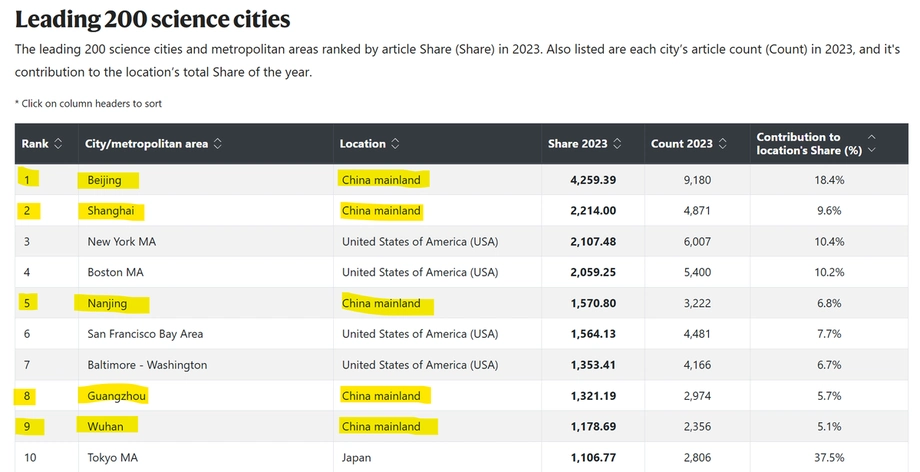
Beijing, Shanghai and Nanjing have become the first three Chinese cities to occupy the leading places in the Nature Index global science city rankings. The Nature Index 2026 Science Cities supplement gives Beijing a Share of 6,518.56, followed by Shanghai with 3,928.46 and Nanjing with 2,635.38. Nanjing finished only 37.15 points ahead of the New York metropolitan area, a narrow margin that turned its rise from fifth place last year into a historic sweep for China.
Contents
- A historic podium, with a narrow margin for third
- How a city receives credit for a scientific paper
- The biggest changes sit outside the top three
- China dominates chemistry, while US cities lead health sciences
- Beijing's second place in another index measures something broader
- Hangzhou and Hefei show how quickly the map is widening
- Xi'an, Changchun and the next tier add depth
- What the rankings change for researchers and cities
- Key Points
Beijing has now held first place for 10 consecutive years, covering 2016 through 2025, while Shanghai has remained second for three years. Guangzhou rose from sixth to fifth, and Hangzhou advanced from tenth to ninth. The complete leading 10 is Beijing, Shanghai, Nanjing, the New York metropolitan area, Guangzhou, the Boston metropolitan area, the San Francisco Bay Area, Wuhan, Hangzhou and Baltimore-Washington. Chinese cities therefore hold six of the 10 places.
The wider tables show both American breadth and Chinese concentration near the top. The United States has 49 cities and metropolitan areas in the leading 200, compared with 47 for China. Within the leading 50, however, China has 24 entries, twice the American total of 12.
Springer Nature dates the supplement to Nov. 25, while its online release and the presentation of related reports at Tsinghua University were reported on Nov. 26. Simon Baker, editor in chief of the Nature Index, described Beijing's result as part of a national movement.
Beijing's success is a microcosm of China's overall rise in the Nature Index.
How a city receives credit for a scientific paper
The rankings are built from research published in 145 natural science and health science journals tracked by the Nature Index. Although the supplement carries a 2026 title, its principal city table ranks output from 2025. Its decade comparisons run from 2016 to 2025.
Two measurements matter. Count records articles associated with an institution or city. Share, the main basis for the city ranking, divides credit among the authors and their affiliated institutions. When researchers from institutions in different cities collaborate, each location receives a portion of the credit rather than every location receiving an entire paper. This makes Share a measure of fractional authorship, or each institution's piece of a publication.
Adjusted Share supports comparisons across years by accounting for changes in the amount of material tracked by the index. A high score consequently represents a large contribution to a selected group of journals. It is not a census of every scientific paper, patent, invention or medical advance produced by a city.
- 2014: The Nature Index was first published.
- 2016: This became the starting point for the supplement's decade comparison.
- 2022: Health sciences were added to the index.
- June 2026: The index expanded further to include applied science and social science journals.
- Nov. 25 and 26, 2026: The new supplement was dated, released online and presented alongside a broader innovation index.
A Nature Index analysis of the city data was written by Bec Crew, senior editor of Nature Index, and Elliot Yates, an intern on the Nature Careers and Supplements team. The supplement received financial support from the Beijing Municipal Science and Technology Commission and the Administrative Commission of Zhongguancun Science Park. Nature states that it retains full independence over editorial decisions concerning the content.
The biggest changes sit outside the top three
A separate natural sciences table removes health sciences and reveals an even stronger Chinese presence. Seven Chinese cities occupy its leading 10: Beijing is first, Shanghai second, Nanjing third, Guangzhou fifth, Wuhan sixth, Hangzhou eighth and Hefei tenth. The remaining places belong to the New York metropolitan area in fourth, the Boston metropolitan area in seventh and the San Francisco Bay Area in ninth.
Beijing recorded the fastest growth in natural science output over the decade when measured by adjusted Share, followed by Shanghai and Guangzhou. Five additional Chinese cities entered the natural sciences leading 10 between 2016 and 2025. Two American cities that had been in that group fell outside the leading 20.
The movement of individual cities is striking. Hangzhou climbed from 43rd in 2016 to eighth in natural sciences, Guangzhou rose from 31st to fifth, and Wuhan advanced from 24th to sixth. Tokyo, Paris, Baltimore-Washington, Los Angeles and Chicago all left the global leading 10 in this subject group during the same period.
These changes spread research visibility well beyond China's two largest cities. A decade ago, a reader scanning the highest ranks would have encountered a much larger group of established American, Japanese and European centres. The 2025 table instead places several Chinese provincial capitals directly alongside New York, Boston and San Francisco.
China dominates chemistry, while US cities lead health sciences
Chinese cities take every place in the chemistry leading 10 and eight of the 10 places in physical sciences. Beijing leads the city tables for chemistry, physical sciences, and Earth and environmental sciences. Beijing and Shanghai each added almost 900 points of adjusted Share in chemistry between 2016 and 2025, the largest increases among the world's 50 leading cities in that field.
Beijing also accounted for 25 percent of China's entire Share in Earth and environmental sciences in 2025. That was the highest share of national output attributed to a leading five city across the natural science and health science subjects examined in the supplement. Beijing gained 703 adjusted Share points in the field over the decade, the largest points increase. Qingdao recorded the largest percentage change among the subject's leading 10 cities, rising 545.5 percent between 2016 and 2025. Qingdao stands 27th in the main city table.
The biological sciences remain more geographically mixed. Their leading 10 contains four American cities, four Chinese cities and two European cities, with the New York metropolitan area in first place. This makes biology the most geographically diverse of the natural science subjects covered by the analysis.
American metropolitan areas retain their clearest advantage in health sciences, which include medical and clinical research. Boston, New York, Baltimore-Washington and the San Francisco Bay Area hold the first four positions, and American cities account for five of the leading 10. Beijing is fifth, Shanghai seventh and Guangzhou eighth. Across the leading 50 in health sciences, the United States has 21 cities compared with eight for China.
Beijing's second place in another index measures something broader
Beijing's publication leadership coincided with a new result in the Global Innovation Hub Index 2026, presented at Tsinghua University on Nov. 26. Now in its seventh edition, the innovation hub index has tracked city innovation since 2020. It evaluates 127 cities through three dimensions: strength as science centres, performance as innovation hubs and the quality of their innovation ecosystems.
Beijing rose to second place in that broader index for the first time, behind the San Francisco and San Jose corridor. The two lists answer different questions. Nature Index measures contributions to selected research journals, while the innovation hub index also considers the environment surrounding scientific discovery and innovative economic activity.
Beijing leads in research institution development and knowledge creation, according to the innovation assessment. It has 48,000 active researchers per million residents, a talent density described as markedly higher than that of other cities.
Chen Ling, a professor at Tsinghua University's School of Public Policy and Management, said the Chinese results displayed a sequence extending from scientific research towards industrial activity and city clusters.
Chinese cities show a development pattern in which scientific innovation breaks through first, industrial innovation expands from leading cities to city clusters, and innovation ecosystems are beginning to concentrate.
Hangzhou and Hefei show how quickly the map is widening
Hangzhou's ninth place comes with a 2025 Share of 1,726.85. It ranks fifth in chemistry, seventh in physical sciences, eighth in Earth and environmental sciences, ninth in biological sciences and 21st in health sciences. Its position in the main table improved by one place from the previous year.
The city spent 94.21 billion yuan on research and development in 2025. Its research spending intensity was 4.09 percent, meaning that expenditure was equivalent to that share of economic output. Both the amount and the intensity ranked first in Zhejiang province. Thirty four achievements involving Hangzhou institutions received 2025 National Science and Technology Awards, the city's best result on record.
Hangzhou has also been developing a laboratory structure known as 1+2+33+7+N and four related research programmes named Xinghuo, Liaoyuan, Juguang and Dengta. An official from the Hangzhou Science and Technology Bureau said the city planned to increase investment, build research platforms and tackle key technologies as it pursues its goal of becoming an innovation source with global influence.
Hefei provides an even clearer example of rapid movement. It now stands 11th globally, up one place, and seventh among Chinese cities. Its institutions published or participated in 3,561 papers in the tracked journals during 2025, producing a Share of 1,408.17. Those figures increased by 607 papers and 194.62 Share points from the previous year.
In natural sciences alone, Hefei recorded 3,464 papers and a Share of 1,382.40, placing tenth worldwide. Its global city position has moved from 15th in the 2024 list to 12th in 2025 and now 11th, a gain of four places across three editions.
Xi'an, Changchun and the next tier add depth
Xi'an ranks 13th after rising three places from the previous edition. Its trajectory extends from 34th in 2020 to 20th in the 2024 list, 16th in 2025 and 13th this year. It ranks ninth in chemistry, tenth in physical sciences, 11th in natural sciences and 19th in Earth and environmental sciences.
The city has 71 academicians belonging to the Chinese Academy of Sciences or the Chinese Academy of Engineering, along with 40 newly built or reorganised national key laboratories. Xi'an spent 74.07 billion yuan on research and development in 2025, an increase of 3.2 percent, with spending intensity reaching 5.33 percent. Technology contracts completed in the city were worth 480.57 billion yuan, up 6.8 percent.
Changchun stands 24th in the leading 200. Changchun's research network is led by Jilin University and includes the Changchun Institute of Applied Chemistry, the Changchun Institute of Optics, Fine Mechanics and Physics, the Northeast Institute of Geography and Agroecology, and Northeast Normal University.
Jilin University separately ranked 15th in the Nature Index global university table updated on Nov. 26, immediately behind Stanford University and ahead of the Massachusetts Institute of Technology. That university table uses a different statistical period, running from Aug. 1, 2025 to July 31, 2026. Jilin University's chemistry has entered the top 0.01 percent of the Essential Science Indicators ranking, and the university has seven national key laboratories and a major facility for experiments under extreme conditions.
Other cities fill out a changing Asian research map. Hefei is immediately followed by Tokyo in 12th and Xi'an in 13th, with Seoul 14th, Shenzhen 15th, Tianjin 16th and Chengdu 17th. Paris is 18th, Hong Kong 19th, Los Angeles 20th and London 21st.
What the rankings change for researchers and cities
For a university or research institute, the subject tables can be more useful than the main ranking. A chemistry team looking for collaborators will find Chinese cities throughout the highest positions. A medical institution examining health sciences will still see Boston, New York, Baltimore-Washington and San Francisco in the first four places. Students and researchers also have a wider set of emerging locations to consider, including Hangzhou, Hefei and Xi'an, rather than treating Beijing and Shanghai as the only major Chinese choices.
The institutional setting includes the Double First Class University Plan, which directs support towards universities and selected disciplines, and the Five Onlys reform, which seeks to move evaluation away from excessive reliance on simple indicators. Research districts such as Zhongguancun in Beijing and Zhangjiang in Shanghai place universities, laboratories and companies close together. The city figures document the resulting publication output, while local spending and laboratory numbers show the scale of the supporting infrastructure.
The supplement also examines smart city technology in Beijing, Helsinki, London and Singapore. That work concerns how digital systems can support urban competitiveness and is separate from the calculation of Share.
A separate measure of global urban reach appeared in September 2025, when Beijing rose to sixth and Shanghai to eighth in the International Exchange Centres Index. That earlier global city ranking considered exchange activity, connectivity and openness, while also recognising the role of scientific publications and technology in bringing universities, businesses and international visitors together.
Key Points
- Beijing, Shanghai and Nanjing are the first Chinese cities to take all three leading places in the Nature Index science city table.
- Beijing's Share is 6,518.56, and it has led the ranking for 10 consecutive years.
- Nanjing beat the New York metropolitan area by just 37.15 points to take third place.
- Chinese cities hold six of the main table's leading 10 positions and 24 of the leading 50.
- Chinese cities take all 10 chemistry places, while American cities retain the first four positions in health sciences.
- Beijing also reached second place in a broader innovation hub index, behind the San Francisco and San Jose corridor.
- Hangzhou, Hefei, Xi'an and Changchun illustrate the growth of research centres beyond Beijing and Shanghai.
- The main scores cover 2025 output in 145 natural science and health science journals, using fractional authorship through Share.