A rare record from Earth's first billion years
Rocks found in Lulong County in eastern China's Hebei Province are about 3.95 billion years old, making them the oldest known in Asia. Their age places them just tens of millions of years behind Canada's Acasta rocks, among the oldest known on Earth. The China Geological Survey announced the discovery on November 20, 2026.
Contents
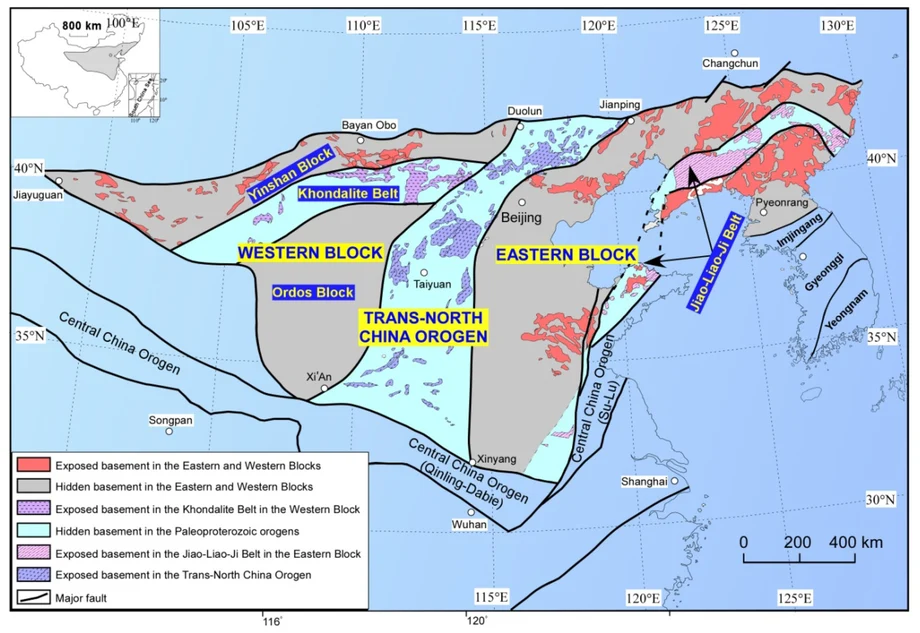
The rocks are part of the Shimen Complex, a geological area that preserves several kinds of ancient rock. Researchers studied three samples of trondhjemitic gneiss, a rock formed when older material melts and then cools and changes deep underground. The exposed patch where the rocks were found is about 15 square metres, roughly the size of a small room.
Their age makes the samples valuable, but their chemistry is just as important. The results suggest that surface material may have been carried more than 50 kilometres into Earth before it partly melted. The study also points to chemical separation between Earth's mantle and its early crust more than 4.3 billion years ago. Together, these clues help scientists investigate how the young planet moved and made its first crust.
How did scientists date the rocks?
The team, led by Hangqiang Xie of the Chinese Academy of Geological Sciences, examined tiny zircon crystals trapped inside the rock. Zircon can preserve clues from the time it formed, even after the surrounding rock has been altered by heat and pressure.
Scientists date zircon by measuring uranium and lead. Uranium slowly changes into lead at a known rate. By comparing the amounts of the two elements, researchers can estimate when the crystal formed. That method gave the Hebei samples an age of about 3.95 billion years.
The research team also included Wan Yusheng, a researcher at the Chinese Academy of Geological Sciences. Wan and Xie were corresponding authors of the study, meaning they handled key communication about the paper. Xie and Chunyan Dong were its joint first authors. Researchers from Jilin University, Nanjing University and Curtin University in Australia also took part.
Earth formed about 4.5 billion years ago. Rocks from its first few hundred million years are scarce because geological activity has destroyed, buried or changed many of them. The period from Earth's formation to about 4 billion years ago is called the Hadean Eon. The Hebei rocks offer a surviving record from near the end of that interval.
What can the chemistry reveal?
Age is only one part of the story. To work out where the rock's ingredients came from and what happened to them, the researchers studied the chemistry of the samples, including oxygen and hafnium isotopes in zircon. Isotopes are forms of the same element that differ slightly in their atomic structure. Their proportions can preserve information about a rock's history.
The oxygen measurements point to material that had been altered by water at or near Earth's surface. That is a clue to an earlier stage in the material's journey. The rock's other chemical features, however, indicate that its source later experienced the high pressure and heat found far below the surface.
Models used in the study suggest that basaltic material partly melted at temperatures of about 740 to 820 degrees Celsius and pressures above 1.6 gigapascals. Those conditions correspond to depths greater than 50 kilometres. The models estimate that only about 8 to 16 percent of the original material melted.
In simple terms, the evidence links a surface setting, where water could alter the material, with a deep setting, where pressure and heat changed it again. The researchers used the chemical measurements and computer models to test what kind of process could connect those two stages.
Could this have been an early form of subduction?
One possible explanation is subduction. Today, subduction happens where one section of Earth's outer shell sinks beneath another and descends into the planet. It helps recycle crust and is part of modern plate tectonics. The Hebei evidence suggests that a similar sinking process may have carried surface material deep underground nearly 4 billion years ago.
The authors describe the proposed event as short lived. In their paper, the researchers wrote:
We propose that this rapid burial was most likely achieved through a transient subduction event.
A transient event means a temporary episode, rather than proof of a continuous process operating across the whole planet. The finding is consistent with subduction like movement in at least one place. It does not show that Earth already had the same global system of moving plates seen today.
That distinction matters because early Earth was hotter than it is now. Its crust and mantle may have moved and recycled material in ways that were different from modern plate tectonics. The study offers evidence about one possible mechanism, while the larger question of when a global plate system began remains open.
What does the mantle evidence say?
The mantle is the thick layer of hot rock beneath Earth's crust. Hafnium isotope measurements in the zircon suggest that the mantle source for the Hebei rocks had already lost some of its hafnium. The researchers interpret this as evidence that material had been removed from the mantle to help form crust.
That separation appears to have begun before the Hebei rocks formed. The study points to mantle and crust becoming substantially distinct more than 4.3 billion years ago. Some model estimates put the chemical change earlier still, at more than 4.2 billion years ago and possibly around 4.35 billion years ago. These dates are estimates of an earlier stage in the source material's history, not the age of the rocks themselves.
Scientists have debated when large amounts of crust first separated from the mantle because different isotope systems preserve different records. The hafnium evidence from the Hebei zircons adds another way to investigate that timing. It suggests that Earth's crust was already developing during the Hadean, hundreds of millions of years before the samples formed.
How does the discovery compare with Canada's oldest rocks?
Before the Hebei discovery, Canada's Acasta Gneiss was widely cited as the oldest known rock formation, at about 4 billion years old. Some estimates for Acasta material are around 4.03 billion years. The Chinese samples, at 3.95 billion years, are therefore roughly 50 to 80 million years younger, depending on which Acasta estimate is used.
The comparison is useful because the two places preserve different evidence. The Hebei rocks include chemical clues consistent with material that began near the surface and later reached great depth. That gives researchers another setting in which to study how Earth's early crust changed, rather than relying on a single ancient rock formation.
The discovery also builds on earlier work in eastern Hebei, where geologists identified igneous rocks from several periods between about 3 billion and more than 3.8 billion years ago. The new samples extend that local record further back, adding a rare point of comparison for scientists studying ancient crust.
What remains uncertain?
The evidence supports a possible episode of rapid burial and partial melting, but scientists have not established that a modern style, global plate tectonic system was operating 3.95 billion years ago. A local or temporary process could produce some of the same signs. More ancient rocks and further chemical analyses may help show how widespread such movement was.
The exact path of the material is also reconstructed from clues preserved in the rocks, rather than observed directly. Oxygen and hafnium isotopes, pressure and temperature estimates, and computer models each contribute to the interpretation. Together, they make a case for deep recycling of surface material, while leaving room for further testing of how that process worked on a hotter early Earth.
The study, titled "Hadean mantle depletion and 3.95-Gyr subduction implied by North China rocks," was published in Nature in 2026. Its findings give researchers a rare sample from a time when few rocks survived, and a way to examine both the early movement of crust and the older separation of crust from mantle.
Key Points
- Three rock samples from the Shimen Complex in Hebei are dated to about 3.95 billion years ago.
- The samples are the oldest known in Asia and are close in age to Canada's Acasta rocks.
- Zircon dating uses the measured change of uranium into lead to estimate when a crystal formed.
- Oxygen, hafnium and modelling results suggest surface material was carried to depths greater than 50 kilometres and partly melted.
- The findings point to early crust and mantle separation before 4.3 billion years ago, but do not show that modern global plate tectonics already existed.