A landmark calculation wins computing's top application prize
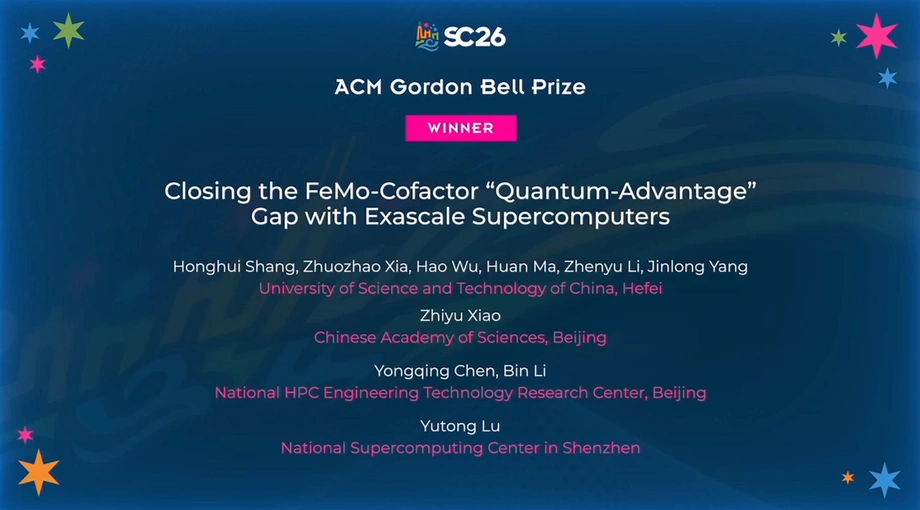
A 10 member Chinese research team won the 2026 ACM Gordon Bell Prize on November 19 at the SC26 supercomputing conference in Chicago, for using exascale computers to solve a major quantum chemistry problem involving the iron molybdenum cofactor, or FeMoco. The work produced the first exascale classical solution to the standard FeMoco complete active space model, a calculation long used as a benchmark for quantum computing.
Contents
- A landmark calculation wins computing's top application prize
- What made the FeMoco problem so hard?
- What performance did the team report?
- Why were two supercomputers involved?
- What could the chemistry help scientists understand?
- A climate model also reached the final round
- Materials research was also among the recognized work
- Who received the prize?
- Key Points
The project, titled "Closing the FeMo Cofactor 'Quantum Advantage' Gap with Exascale Supercomputers," brought together researchers from the University of Science and Technology of China, Hefei National Laboratory, the Chinese Academy of Sciences' Institute of Physics, the National High Performance Computer Engineering Technology Research Center, Sun Yat Sen University and the National Supercomputing Center in Shenzhen. ACM's prize announcement named the team as the winner.
FeMoco is the catalytic center of an enzyme called molybdenum nitrogenase. The enzyme helps turn nitrogen gas from the air into ammonia, a form of nitrogen that plants and other organisms can use. The team's result is a powerful way to study the electronic structure behind that chemistry, rather than a new fertilizer or a direct change to farming.
What made the FeMoco problem so hard?
The standard model tracks 113 electrons across 76 orbitals. Orbitals are regions where electrons are likely to be found. Because electrons interact with one another, their possible arrangements multiply rapidly, making the model extremely demanding for computers.
Scientists use a complete active space, or CAS, model to focus a calculation on the electrons and orbitals most relevant to a molecule's chemistry. For FeMoco, finding the model's lowest energy states means accounting for many interacting possibilities. Researchers have treated the problem as a test of the power of quantum computers because of that scale.
An exascale computer can perform at least one quintillion, or one billion billion, mathematical operations per second. The award recognizes a classical computing approach: the team used conventional computing methods, running on exceptionally powerful machines, to address the problem.
What performance did the team report?
The team's paper abstract says its code was tuned for two exascale systems, LineShine and China's New Generation Intelligent Supercomputer, referred to as CNIS. On 20,480 LineShine nodes, the code sustained 1.456 exaflops per second in double precision, equal to 58.9 percent of the machine's peak, and 5.626 exaflops per second in mixed precision.
Double precision uses more bits to represent numbers and is often used when a calculation needs greater numerical accuracy. Mixed precision combines calculations with different levels of accuracy to increase speed while managing error. The figures describe sustained computing performance, not simply the machine's theoretical maximum.
A separate account of the execution details put the completed calculation at 1,280 LineShine nodes and 105 minutes. It compared that run with an 8.5 hour estimate used for a hypothetical fault tolerant quantum computer tackling the benchmark. Those figures describe a particular run and comparison, while the paper abstract's larger node count reports the code's measured performance at scale.
Why were two supercomputers involved?
ACM's description names LineShine and CNIS but does not give details identifying the second machine. Chinese public reporting has identified CNIS as Sugon 8000, a domestically built cluster described as having 100,000 AI accelerator cards. The project's code was adapted for both systems, an unusual demonstration of the same scientific application running across two different large scale platforms.
Reporting on the project says its full research and development cycle relied on the Sugon 8000 cluster through the National Supercomputing Internet. The platform was put into service in Zhengzhou in July and connected to that national network. The award therefore highlights both the finished calculation and the work needed to make research software run efficiently on large, complex machines.
One description of the system says it combines high performance computing with artificial intelligence hardware and software. In practical terms, that means researchers can bring different kinds of processors and computing methods together for a job, rather than relying only on a single traditional design. The prize result shows how much depends on algorithms and software as well as on the number of machines available.
What could the chemistry help scientists understand?
Nitrogen gas makes up much of Earth's atmosphere, but most plants cannot use it directly. Nitrogenase enzymes carry out a natural conversion that makes nitrogen available to living things. Understanding the FeMoco center could help researchers explain how the enzyme performs this difficult chemical task.
High accuracy simulations may give scientists a closer look at the molecule's electronic states and chemical reactions. ACM says insights from this work could be useful across fields including agriculture and medicine. The research also extends beyond a resting, or baseline, FeMoco model to catalytic intermediates, which are temporary chemical states that appear as a reaction proceeds.
The results are a tool for studying chemistry at a level that is hard to observe directly. They do not by themselves set out a new agricultural process or a medical treatment. The near term value lies in giving researchers a way to test ideas about the structure and behavior of a key biological catalyst.
A climate model also reached the final round
Another Chinese project was named a finalist for the Gordon Bell climate modeling award: the SD3 global kilometer scale weather simulation system, developed by Chinese company Zhongke Tianji. Its reported results include global simulations at 1.5 kilometer resolution using 24,576 domestically made heterogeneous accelerators, with peak throughput of 205.7 simulated days per day.
That measure compares simulated time with the time needed to run the calculation. At the stated peak, the system could simulate more than 205 days of weather for each day of computing time. The project was described as the first global kilometer scale model developed by a Chinese company team to reach the climate modeling award final, and as a system tested through years of operational use.
Its developers said several measures exceeded those of two widely used international weather models, the European Centre for Medium Range Weather Forecasts' IFS and the US National Centers for Environmental Prediction's GFS. The finalist result shows another use of large scale computing: simulating weather across the globe at a fine level of detail, rather than calculating the electronic structure of a molecule.
Materials research was also among the recognized work
A separate finalist project described in Chinese coverage focused on large scale linear scaling density functional theory, a method for calculating the properties of materials. The work applied the method to interface design for all solid state batteries and involved the National Supercomputing Center in Shenzhen, several Chinese universities and ETH Zurich.
Linear scaling methods aim to keep computing demands from rising as sharply as a material model grows. That matters when researchers want to study systems containing very large numbers of atoms. The project's battery focus links high performance computing to the design of materials and interfaces that could be useful in future energy storage.
Together, the FeMoco, weather and materials projects illustrate different scientific uses for large computing systems: modeling a biological catalyst, simulating the atmosphere and calculating materials. The projects also show why software must be adapted to each task. A larger machine alone does not produce a useful scientific answer unless the code can use its processors effectively.
Who received the prize?
The winning team included Honghui Shang, Zhuozhao Xia, Hao Wu, Huan Ma, Zhenyu Li and Jinlong Yang, from the University of Science and Technology of China and Hefei National Laboratory; Zhiyu Xiao, from the Institute of Physics at the Chinese Academy of Sciences; Yongqing Chen and Bin Li, from the National High Performance Computer Engineering Technology Research Center; and Yutong Lu, affiliated with Sun Yat Sen University and the National Supercomputing Center in Shenzhen.
The Chinese team's win is its fourth Gordon Bell Prize since 2016. The previous time the prize went to a Chinese supercomputing application team was 2021. ACM presents the annual award for advances in applying high performance computing to scientific, engineering and large scale data problems.
The FeMoco result brings together a difficult molecular model, carefully tuned software and two exascale systems. Its immediate contribution is a new classical route for studying a benchmark problem, while the other finalists show how the same broad computing infrastructure can support weather and materials research.
Key Points
- A 10 member Chinese team won the 2026 ACM Gordon Bell Prize on November 19 in Chicago.
- The team developed the first exascale classical solution to the standard FeMoco model, which contains 113 electrons in 76 orbitals.
- Its code was tuned for LineShine and CNIS, with reported sustained performance of 1.456 exaflops per second in double precision on 20,480 LineShine nodes.
- Chinese public reporting identifies CNIS as the Sugon 8000 cluster, though ACM's description uses the name CNIS.
- The SD3 global weather model was a climate modeling finalist, and a separate finalist project applied large scale calculations to battery materials.