A model that learns RNA letters and their connections
Researchers at the University of Science and Technology of China have released structRFM, an open RNA foundation model trained on 21 million pairs of RNA sequences and computationally annotated structures. The release includes the paired training data, model weights and source code, giving other laboratories the materials to reproduce the work and adapt the system.
Contents
- A model that learns RNA letters and their connections
- Why folding matters as much as sequence
- How 21 million training pairs were assembled
- Teaching the model with hidden information
- What the structure tests found
- From RNA processing to functional classification
- What the open release gives researchers
- The team and publication timeline
- What the results change for RNA research
- Key Points
The study, published by Nature on November 4, 2026, describes a model that learns both the order of RNA's molecular building blocks and the connections that help those molecules fold. Its adaptation for predicting three dimensional structures, called Zfold, achieved performance the authors describe as comparable to AlphaFold3 across CASP15-natural, CASP16 and RNA-Puzzles evaluations.
The practical attraction is that structRFM needs only an RNA sequence as input after training. It produces information that researchers can use for several tasks, including predicting molecular structure, identifying sites involved in RNA processing and classifying RNA molecules by function.
Nature's structRFM research paper presents the work as a way to make structural knowledge useful across different prediction tasks. Peng Xiong and S. Kevin Zhou are the corresponding authors, and Heqin Zhu is the first author.
Why folding matters as much as sequence
RNA participates in protein production, gene regulation and the processing of genetic messages. Its sequence is the order of its nucleotides, the molecular units commonly represented by the letters A, U, C and G. That order carries information, while the way the molecule folds helps determine how it works.
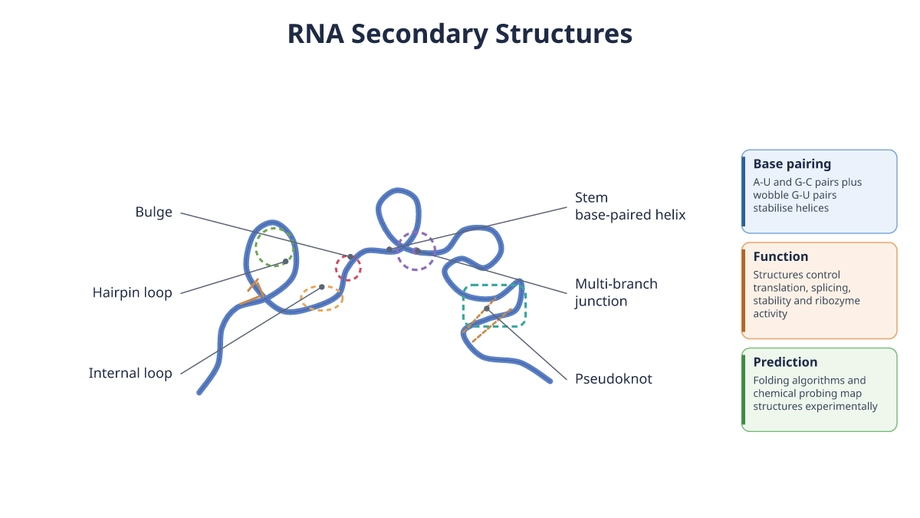
Parts of an RNA strand can pair with other parts of the same strand. Those connections create a secondary structure, a pattern of paired regions, stems and loops. The molecule then folds into a three dimensional shape, known as its tertiary structure, which affects its activity and interactions with other molecules.
Many RNA language models learn patterns from large collections of sequences, much as a language model learns relationships among words. structRFM adds information about which nucleotides pair together during training, helping it learn connections between positions that may be far apart along the sequence.
The researchers sought to preserve the flexibility of a foundation model: a broadly trained system whose learned features can be adapted for different purposes. Their aim was to bring folding information into that shared foundation rather than train a system useful for just one structural task.
How 21 million training pairs were assembled
The team built a dataset of about 21 million RNA sequence and secondary structure pairs. The structural annotations were generated computationally, allowing the researchers to train at a scale far larger than a collection consisting only of structures resolved through laboratory experiments.
Computer predictions can contain errors and can reflect the strengths and weaknesses of the method that produced them. To reduce dependence on a single predictor, the researchers introduced MUSES, a multi-source secondary-structure ensemble. An ensemble combines information from several prediction sources rather than relying entirely on one.
MUSES addresses a central problem in teaching models from predicted structures: repeated errors in the training annotations can shape what the model learns. Combining structural predictions was designed to reduce predictor bias while retaining useful information about base pairing.
The study's training and evaluation resources draw on established biological collections, including RNAcentral, Rfam and the Protein Data Bank. Its data statement identifies the relevant releases, including RNAcentral version 24.0 and Rfam versions 14.10 and 15.0, so researchers can trace the datasets used in the experiments.
Teaching the model with hidden information
structRFM uses masked language modelling, a training method in which parts of an input are hidden and the model learns to recover the missing information from the surrounding context. For RNA, this means learning relationships among nucleotides rather than words.
The team incorporated base pairing into this process through a pair matching operation. A dynamic masking ratio balances training guided by structural connections with masking at individual nucleotide positions. This gives the model opportunities to learn both local sequence patterns and relationships linked to folding.
The resulting model supplies three kinds of features: information about the sequence as a whole, information about each nucleotide and information about pairs of nucleotides. A feature is a numerical representation that another prediction system can use. Different tasks can draw on different levels of that representation.
The researchers also performed ablation experiments, which remove or change parts of a model to test their contribution. Those experiments supported the contribution of both structural information and the masking strategy to the reported improvements, providing evidence for the design choices behind structRFM.
What the structure tests found
structRFM performed strongly in zero-shot homology classification. Homology concerns relationships inherited from a common evolutionary origin. In this setting, zero-shot classification tests how useful the learned representations are for recognizing such relationships without training specifically on the target classification task.
The authors also report improved secondary structure prediction and strong performance on newly released RNA families. An RNA family groups related molecules with shared sequence or structural features. Testing newly released families examines how well the model works beyond familiar groups represented in established datasets.
For tertiary structure prediction, the team developed Zfold by adapting structRFM's learned features for a model that predicts three dimensional shapes. The authors report improvements in both the predicted shapes and the secondary structures extracted from those predictions.
Zfold was evaluated on CASP15-natural, CASP16 and RNA-Puzzles, benchmark collections used to assess molecular structure prediction. Across those evaluations, the paper describes its performance as comparable to AlphaFold3. The comparison concerns Zfold's results on those named benchmarks, while structRFM supplies the underlying RNA representations.
The study presents several kinds of success rather than one accuracy score covering every use. Recognizing related sequences, predicting base pairs and reconstructing a three dimensional shape are different problems, each requiring its own evaluation.
From RNA processing to functional classification
structRFM was also tested on tasks concerned with what RNA does. These included splice site prediction, internal ribosome entry site identification and non-coding RNA classification, extending the evaluation beyond molecular shape.
Splice sites mark boundaries used when cells process RNA messages. During splicing, selected portions are removed and the remaining sections are joined. Predicting those boundaries helps researchers examine how a genetic message is assembled before it is used to make a protein.
Internal ribosome entry sites, or IRES elements, are RNA regions that allow the cellular machinery responsible for making proteins to begin translation internally. Identifying them requires recognizing functional patterns within a sequence, making the task another test of the information captured during pretraining.
Non-coding RNAs perform roles other than serving as templates for protein production. Classifying them means assigning molecules to relevant groups. The authors report improved performance across these functional tasks, showing that the learned representations remained useful when the prediction target changed from structure to biological role.
The team also extended the model to long non-coding RNA classification using a segmentation strategy. Dividing a long sequence into sections makes it possible to apply the model to inputs that would otherwise be difficult to process as a single unit.
What the open release gives researchers
The release covers three resources with different uses. The dataset provides the examples used for learning. Model weights contain the numerical values learned during training. The source code describes how the software is implemented and run.
Access to the weights allows researchers to work from an already trained model instead of repeating the entire pretraining process. Access to the data and code supports closer examination of the training procedure, reproduction of experiments and development of alternative approaches.
The paper identifies the project repository as heqin-zhu/structRFM on GitHub. It also lists a Zenodo archive for the pretraining dataset under DOI 10.5281/zenodo.18272040 and an archive for source code and model checkpoints under DOI 10.5281/zenodo.18274292. A DOI is a persistent identifier intended to keep a research resource traceable over time.
The data statement says the training and test datasets are publicly available through the project repository. It also provides the processed IRES split used in the study and the source data underlying the figures. The authors state that no restrictions apply to data availability.
Those details matter for comparisons. Researchers can inspect which datasets and divisions were used, rerun evaluations and test whether a different training choice changes the results. The release therefore supports scrutiny of the findings as well as reuse of the model.
The team and publication timeline
The work was led through USTC's School of Biomedical Engineering and the Medical Imaging, Robotics, Analytic Computing and Learning laboratory, known as MIRACLE. The authors list affiliations in Hefei and at USTC's Suzhou Institute for Advanced Research. Coauthor Ruifeng Li is affiliated with Zhejiang University's College of Computer Science and Technology in Hangzhou.
Zhou, a professor, and Xiong, a special research fellow, conceived and supervised the study. Zhu designed and implemented the framework, conducted pretraining and several structure prediction and RNA classification experiments, and analyzed the results. Other team members worked on homology testing, dataset comparisons, IRES identification and structural evaluation.
The publication and public presentation of the work fall across two calendar dates:
- November 4, 2026: Nature lists the publication of An open structure-guided RNA foundation model for generalizable prediction.
- November 5, 2026: The work and its open release were publicized in China, with the online publication described as appearing in the early morning.
The authors report support from China's National Natural Science Foundation, the National Key R&D Program, research programs in Jiangsu and Suzhou, and the Sanming Project of Medicine in Shenzhen. They declare no competing interests.
What the results change for RNA research
structRFM brings several research activities onto a shared starting point. A laboratory investigating RNA processing can adapt the same underlying model that another group uses to study folding or classify non-coding molecules. Each application still requires its own task specific development and evaluation.
The combination of 21 million training pairs, structure guided learning and released checkpoints gives researchers a concrete system to examine rather than only a description of an algorithm. MUSES and the masking experiments also offer specific design choices that other teams can test or modify.
The reported findings center on computational prediction and classification. Work toward biomedical applications would involve further biological experiments, including checking predicted structures and testing the functions assigned to particular RNA molecules.
The paper gives no timetable for a clinical application. The immediate change is access: researchers worldwide can obtain the training resources, inspect the implementation and investigate whether the reported gains carry over to their own RNA datasets.
Key Points
- USTC researchers released structRFM, an RNA foundation model trained on about 21 million sequence and secondary structure pairs.
- The model learns sequence patterns and base pairing relationships, then produces features from sequence input alone.
- MUSES combines structural prediction sources, while dynamic masking balances structural and nucleotide information during training.
- The authors report strong homology classification and improved secondary structure prediction, including tests on newly released RNA families.
- Zfold, its adaptation for tertiary structure prediction, achieved performance described as comparable to AlphaFold3 on three named benchmark collections.
- The dataset, model weights, source code and evaluation resources are publicly available for reuse and reproduction.