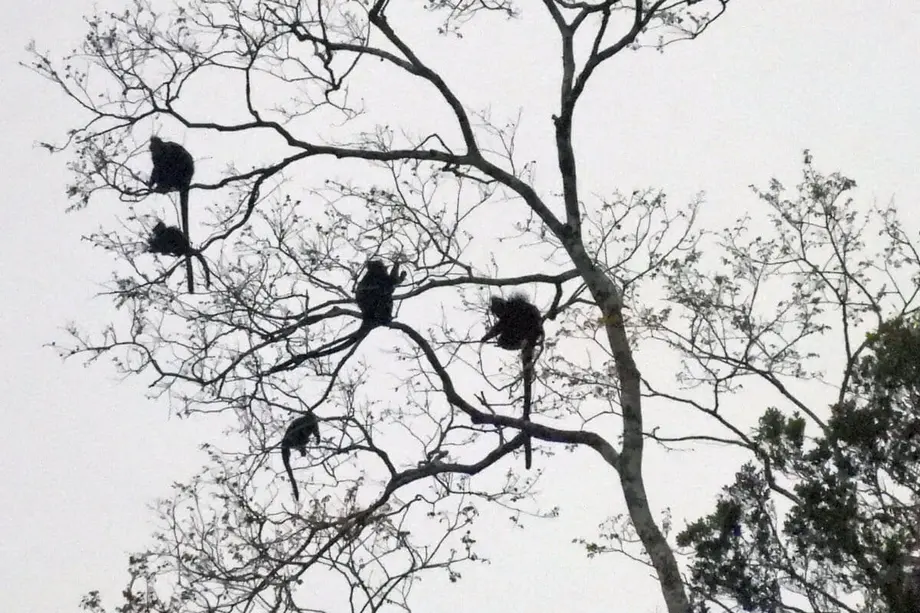
A monkey identified by its unusually short tail
Researchers have proposed that black langurs living in limestone hills in central Laos are a previously unknown species. The monkeys, named the short tailed langur, or Trachypithecus brevicaudus, have tails that the researchers estimate are about 11 to 15 centimetres shorter than those of closely related langurs.
Contents
The case rests on photographs, not a body or genetic test. In a 2026 paper in the Vietnamese Journal of Primatology, Tilo Nadler, Vuethao Vangkhou, Jochen Menner and Jeremy Phan argue that the animals' tail shape and length set them apart from two other southern limestone langurs. The paper calls a pictured male a "photographic holotype," meaning the image serves as the reference for the proposed species.
That name does not end the scientific debate. Primate specialist Vincent Nijman, who was not involved in the study, says the evidence so far is not strong enough to establish that the langurs are a distinct species. Researchers plan to seek droppings for genetic testing and search villages for animal remains that could provide further evidence.
What did the researchers find?
The langurs were photographed in Bolikhamxai Province, in rugged limestone formations near the villages of Na Di and Khamkouna. These rocky outcrops, known as karsts, rise above surrounding land and support sparse forest. The monkeys eat leaves and are thought to use caves or rock openings as sleeping places.
The paper compares photographs of six proposed short tailed langurs with photographs of 20 Hatinh and Lao langurs. Researchers measured each animal's back, from the neck to the base of the tail, and compared that length with its tail. The average back to tail ratio was 1:1.80 for the proposed species, compared with 1:2.10 to 1:2.18 for the other langurs. In simple terms, the photographed animals had shorter tails in relation to their backs.
Based on those comparisons, the authors estimate that the proposed species' tail is 63 to 80 centimetres long. The short tail may still look long to a person seeing the animal, but it is shorter than the tails of the related species examined in the study. The researchers also describe the tail as thicker, though they did not provide a measured comparison of its thickness.
When were the langurs photographed?
The evidence came together through a series of photographs and surveys. A picture taken in 2024 first drew attention to a langur with an unusual tail. Nadler and colleagues later surveyed the area and photographed additional animals. The paper's caption credits the first published photograph, taken on May 1, 2024, to Saola Foundation staff member Souksamian Laladeth. Rob Timmins, the foundation's technical director, is also identified as having first photographed the langur in 2024.
- May 1, 2024: The first published photograph of the unusual langur is taken.
- February and May 2025: Researchers interview local residents about langurs in Bolikhamxai.
- November and December 2025: Nadler photographs langurs near Na Di.
- January and March 2026: Researchers photograph another group near Khamkouna.
The paper describes a group with five adults and two juveniles, which were estimated to be about 1.5 to 2 years old. That sighting gives a glimpse of the animals, but it does not tell researchers how many langurs live in the region. Nadler says two populations are currently known and that the species' full range is unclear.
Why do scientists disagree about the evidence?
Nadler says the short tails appear across a group of animals, rather than being the result of one monkey injuring its tail. He says his first encounter made the difference apparent to him. Nadler is lead author of the paper and a wildlife consultant to the Vietnamese government and non-governmental organisations.
"The first time I observed a group of these langurs, it was immediately clear to me that they were different from all the other limestone langurs I had previously encountered and knew well," Nadler said.
Nijman, director of EcoVerde Global Consulting, accepts that photographs can sometimes support the description of a species. His concern is that the tail measurements do not yet separate the proposed langur clearly from its relatives. He says some Hatinh langurs have tails as short as those of the proposed species, while the study does not quantify tail thickness.
"It could well be a new species, but I think the data that have been presented do not give sufficient support for this," Nijman said.
The authors acknowledge that photographs are an imperfect way to measure animals. A physical specimen and genetic data could help test whether the langurs are different from known species. Earlier primates, including the highland mangabey described in 2003 and the Arunachal macaque described in 2005, were first described using photographs before DNA evidence was available. Those examples show that a photograph based proposal is possible, while leaving the evidence for this particular langur open to further testing.
How does it compare with known Lao langurs?
The proposed monkey resembles the black form of the Hatinh langur in its colour. The researchers place it among the southern limestone langurs, a group that also includes the Hatinh langur and the Lao langur. The name brevicaudus combines Latin words meaning "short" and "tail."
The Laotian langur profile describes the Lao langur as living in Bolikhamxai and Khammouan provinces, with reported tail lengths of 79 to 90 centimetres. It also says Lao and Hatinh langurs share habitat in parts of Laos, where their appearance can overlap. This context helps explain why researchers need more than a general sighting to work out which langur they have found.
The proposed short tailed langur's estimated tail range reaches 80 centimetres, close to the lower end of the Lao langur range. The more direct comparison in the new paper is with Hatinh langurs: Nijman says the shortest Hatinh tails overlap with the longest estimated tails of the proposed species. The researchers argue that the combination of tail length, thickness, appearance and habitat supports treating it as a distinct species.
Where have researchers found them?
The paper records langurs on two limestone blocks near Viengthong, about 20 kilometres apart. The southeastern block near Na Di is named as the type locality, the specific place used to anchor a species description. It covers about 3,600 hectares. The northeastern block covers about 3,000 hectares and borders the Phou Sithone Endangered Species Conservation Area.
Neither limestone block where the langurs were recorded has protected status. The paper says the northeastern block borders a provincial conservation area of about 14,000 hectares. Researchers have not yet mapped the full range, and Nadler says other populations may live on limestone formations that are difficult to reach.
That uncertainty matters for conservation planning. A species known from two separated areas may occupy a wider range, or it may be confined to a small number of isolated rocky habitats. The current photographs and surveys do not settle that question.
What risks do the monkeys face?
Nadler says the langurs were heavily hunted in the past, particularly when people travelled into remote mountains to grow hidden opium poppy fields. He says poppy cultivation and the associated hunting have stopped following legislation and strict enforcement. The paper says hunting pressure now appears low, based on information gathered during four surveys.
Researchers also report illegal logging in the area. The paper says time spent in the forest is now often used to process timber, which can be more valuable than hunting. The broader concern is that logging and other changes to forest habitat can affect animals that depend on limestone hills and their vegetation.
Related Lao and Hatinh langurs are listed as Endangered on the IUCN Red List. The paper's authors say the proposed short tailed langur may also qualify for that category, but it has not yet received a separate Red List assessment. The Lao langur is protected under Lao wildlife law and listed in Appendix II of the Convention on International Trade in Endangered Species, according to the conservation profile.
What happens next?
A future expedition is planned to search local villages more thoroughly for remains and to collect droppings for genetic analysis. DNA is material in living cells that can help researchers compare animals and test how closely related they are. The researchers have not announced a date for that work or when results might be available.
The Saola Foundation, which was not involved in Nadler's research, plans to start a conservation programme in 2027 featuring the proposed langur as its flagship animal. The foundation is also searching the Annamite Mountains for the saola, a rare bovine sometimes called the Asian unicorn. Its chief executive, Lorraine Scotson, said the foundation would welcome attention for the monkey and the karst habitat.
Having been geographically isolated for millions of years, this karst complex habitat is likely to host many other endemic species of the Annamites Bioregion," Scotson said, "and quite possibly some of them still undescribed to science.
The Annamite Mountains are home to species including the giant muntjac, the Annamite striped rabbit, two gibbon species and the Laotian rock rat. The region is reported to contain about 3% of the world's land vertebrates. The proposed langur's protection could therefore draw attention to a landscape that may shelter other animals found nowhere else.
Key Points
- A 2026 paper proposes the short tailed langur, Trachypithecus brevicaudus, as a new species based on photographs.
- Researchers estimate its tail is 63 to 80 centimetres long, but an independent primate specialist says the evidence remains inconclusive.
- Langurs have been recorded on two limestone blocks near Viengthong, neither of which has protected status.
- Researchers plan to seek droppings for DNA testing and search villages for remains.
- The Saola Foundation plans a conservation programme featuring the proposed langur in 2027.