Two crystals turn nuclear signals into working clocks
Research teams in Austria and China have independently demonstrated working nuclear clocks that use thorium-229 embedded in calcium fluoride crystals to control the rhythm of laser light. Their papers, published in Nature on 7 October 2026, describe a step toward more stable timekeeping and an immediate application: testing theories about dark matter.
Contents
- Two crystals turn nuclear signals into working clocks
- What makes a nuclear clock different?
- The crucial step is automatic correction
- Vienna's clock ran without intervention for a day
- China used a brighter laser and improved crystals
- What one second in 30 million years means
- A clock becomes a dark matter experiment
- How decades of work reached this point
- Better light and materials are the next tasks
- Key Points
The Vienna experiment approached a fractional frequency instability of 10 to the power of minus 15 over a day, a level commonly expressed as roughly one second in 30 million years. The Chinese experiment also reached the 10 to the power of minus 15 range over its measured interval. Both remain behind the best optical atomic clocks.
The advance is that the nuclei now help correct the lasers continuously. Earlier experiments had located and measured the thorium transition. These systems turn that measurement into a feedback loop, allowing the nuclear signal to steer a working clock.
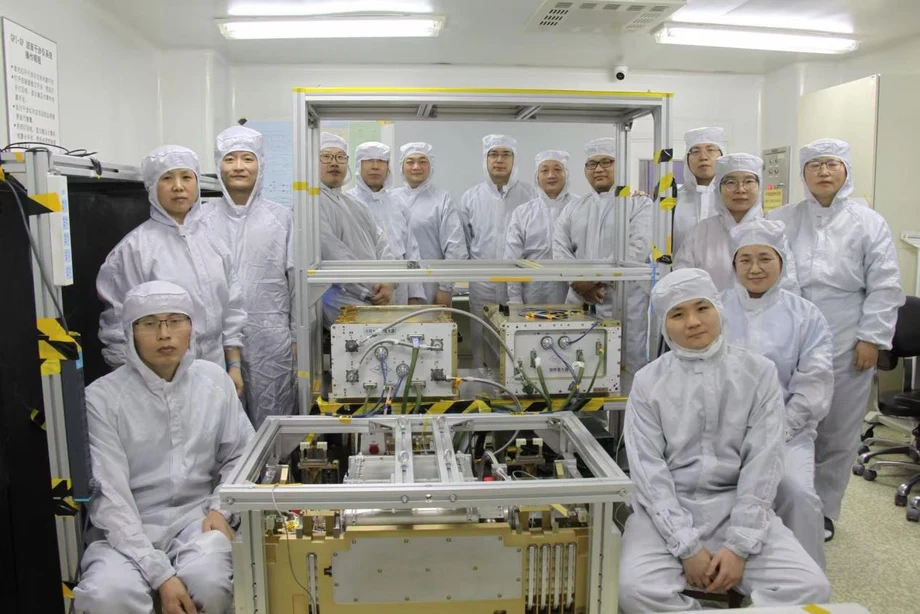
Thorsten Schumm at TU Wien led the Austrian effort, working with Ekkehard Peik's team at Germany's national metrology institute, PTB, in Braunschweig. Shiqian Ding led the Chinese effort involving Tsinghua University and collaborators who produced the crystals in Shanghai.
Nature's research announcement, dated 8 October, presents the two papers together as the first working clocks based on thorium-229 nuclei. Their shared achievement rests on different laser sources, detectors and crystal designs, giving researchers two practical routes for developing the technology.
What makes a nuclear clock different?
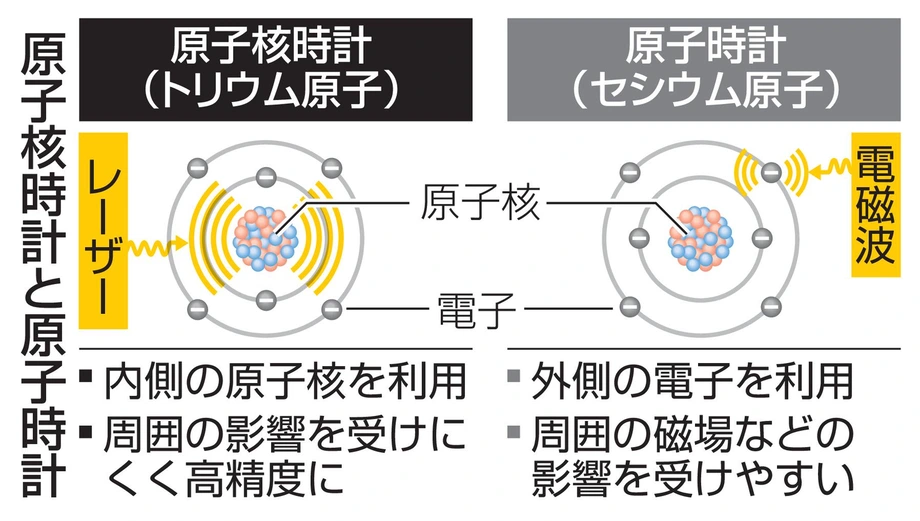
Conventional atomic clocks use changes between energy states involving an atom's electrons. The international definition of the second has used a microwave transition in cesium-133 since 1967, corresponding to about 9.2 billion cycles per second. Optical atomic clocks use transitions at much higher frequencies.
A nuclear clock moves the reference to the atom's tiny central core, made of protons and neutrons. Light at the correct frequency can raise a thorium-229 nucleus into a slightly higher energy state. Researchers use that sharply defined response to keep a laser running at a consistent frequency.
Thorium-229 is unusual because the energy needed for this transition is only about 8.4 electronvolts, accessible with light at a wavelength near 148 nanometres. Most nuclear transitions require far more energy than ordinary precision lasers can provide. This particular transition lies in the vacuum ultraviolet, a range beyond the ultraviolet light familiar from sunlight.
Nuclei interact more weakly with many external disturbances than electrons do. That offers the prospect of a more dependable reference. Inside a crystal, however, the surrounding material still affects the measured frequency, making crystal quality and environmental control central engineering tasks.
The crucial step is automatic correction
A laser can drift because its surroundings change. Both teams used the thorium nuclei to detect that drift and send a correction back to the laser. The process resembles a thermostat: measure the difference from the desired setting, then adjust the system to bring it back.
The nuclei absorb light most strongly when the laser frequency matches their transition. By measuring changes in the light transmitted through the crystal, the researchers determine how far the laser has moved from the desired frequency.
Schumm, a professor at TU Wien's Institute of Atomic and Subatomic Physics, explained the principle in the university's experiment announcement:
The basic idea is simple: you have a laser and you have thorium. The laser changes the energy state of the thorium nuclei, and the thorium nuclei are used to stabilize the frequency of the laser.
Measuring absorption also provides a faster way to obtain corrections than waiting for excited nuclei to emit light. The Chinese team measured an excited state lifetime of 631 seconds, about 10.5 minutes. Absorption measurements let the feedback system respond while those nuclei are still excited.
Vienna's clock ran without intervention for a day
The Austrian team's feedback loop study describes a continuous laser operating near 148 nanometres and a crystal only millimetres across. The crystal remained near room temperature, around 294.7 kelvin, or 21.6 degrees Celsius.
The team generated its ultraviolet light using frequency conversion involving a strontium tetraborate crystal. A detector behind the thorium crystal counted transmitted photons, providing the absorption signal used to correct the laser.
TU Wien says the prototype operated for more than 24 hours without intervention. To assess its performance, the researchers compared it with a clock based on a single ytterbium ion, using a reference signal supplied through an optical fibre connection from Austria's Federal Office of Metrology and Surveying.
The comparison gave a fractional frequency instability described by 3 × 10⁻¹² divided by the square root of the averaging time in seconds. In simple terms, random fluctuations became smaller as the researchers averaged more measurements, approaching the 10⁻¹⁵ level over a day.
The device can take its continuing frequency corrections from thorium while an atomic clock supplies an external benchmark for evaluating performance. That combination allowed the researchers to study both how steadily it ran and how its nuclear reference responded differently from an electronic one.
China used a brighter laser and improved crystals
The Chinese team's synchronized clock study describes a different source of 148.4 nanometre light. The researchers combined laser fields in cadmium vapour heated to 600 degrees Celsius, generating 10 microwatts of continuous ultraviolet radiation.
About 5 microwatts reached the front of the thorium crystal. Although those powers are tiny compared with household lighting, producing steady, narrow frequency light at this wavelength is technically demanding.
The team also improved how it detected the weak nuclear absorption. A phototube that measured current directly could accept more transmitted light than the earlier photomultiplier configuration. More detected photons meant a clearer signal for deciding how to correct the laser.
Materials development provided another gain. The first crystal, S1, was grown at the Shanghai Institute of Optics and Fine Mechanics. A second, TS1, was produced through collaboration between the Shanghai Institute of Ceramics and Tsinghua University. TS1 transmitted 7% of the ultraviolet light, compared with about 1% for S1.
TS1 was made from a growth solution containing just 1.4 micrograms of thorium-229. The isotope's scarcity left little material for repeated attempts to refine the growth process. The resulting crystal was free of the bubbles present in S1 and supplied a stronger absorption signal.
After further adjustments, the Chinese clock reached an instability of 5 × 10⁻¹³ divided by the square root of the averaging time in seconds. Its numerical coefficient is six times smaller than Vienna's 3 × 10⁻¹². Each team measured performance in its own apparatus, with different references and operating conditions.
What one second in 30 million years means
The striking time comparison comes from expressing a fractional frequency difference of about 10⁻¹⁵ as an accumulated timing difference. At a constant offset of that size, collecting one second of error would take roughly 30 million years.
The experiments measured how the clocks behaved over laboratory runs lasting hours or about a day. Stability describes how much the frequency fluctuates as measurements accumulate. Accuracy concerns how close that frequency is to its intended value after accounting for effects that shift it.
Reproducibility is another practical requirement: a clock needs to return to the same frequency after restarting, and another device built from a different crystal needs a well understood reference frequency.
Vienna's measurements on different days reproduced the frequency at about 5 × 10⁻¹³, a larger variation than the fluctuations reached through averaging during a continuous run. The researchers associated this problem with small changes in the laser's path through the crystal after realignment.
The Chinese team measured a difference of approximately 560 hertz between its independently fabricated crystals. Relative to a transition frequency of about 2,020 trillion hertz, that difference was 2.8 × 10⁻¹³. These measurements give material scientists a concrete target for improving consistency.
A clock becomes a dark matter experiment
The Vienna team also compared the thorium and ytterbium frequencies to search for possible effects of ultralight dark matter. Dark matter is the unseen matter inferred from its gravitational influence; some theories propose extremely light particles that could subtly change quantities governing ordinary matter.
Those changes could make the two clocks respond differently. Thorium's unusually small transition energy results from a near cancellation between much larger electromagnetic and nuclear energy contributions. A small change in those contributions could therefore produce a relatively large change in the transition frequency.
The researchers searched for periodic variations and slow drifts on timescales from about 20 seconds to one day. No periodic signal exceeded their detection threshold. They used the measurements to set upper limits on the strength of interactions proposed by the dark matter models.
For interactions involving photons, the limits were competitive with leading comparable atomic clock experiments. For some interactions involving the strong nuclear force and quarks, the analysis reached sensitivities 10 to 1,000 times beyond earlier atomic clock experiments.
The exact sensitivity depends on nuclear properties that cannot yet be calculated precisely. Even at its present timing performance, the nuclear clock gives researchers access to a different physical response from that of an electronic clock, making the comparison useful for fundamental physics.
How decades of work reached this point
The operating clocks followed a long effort to identify the thorium transition closely enough for a laser to address it. Each stage reduced uncertainty or supplied a missing part of the apparatus.
- 1976: Gamma ray spectroscopy began the research sequence that narrowed down the energy of thorium-229's low excited state.
- 2003: Ekkehard Peik and Christian Tamm proposed using the transition as the reference for a nuclear clock.
- 2016: Researchers confirmed the existence of the excited nuclear state through its decay.
- April 2024: The TU Wien and PTB collaboration demonstrated laser excitation of the thorium nuclear transition.
- September 2024: A team centred on JILA measured the transition frequency to 12 significant digits using an optical frequency comb and a strontium atomic clock.
- 2025: Advances in continuous ultraviolet lasers helped make rapid absorption measurements possible.
- 7 October 2026: The Austrian and Chinese papers described working clocks whose lasers receive feedback from the nuclear transition.
The decisive change in 2026 was integrating the light source, crystal, detector and automatic correction system into an operating frequency reference. Both teams built on the earlier spectroscopy while solving that control problem through different experimental designs.
Better light and materials are the next tasks
The Vienna experiment found differences of up to about 1.7 kilohertz when the laser probed different positions in the same crystal. The researchers suspect uneven internal strain associated with structural variations. Keeping the beam on the same volume, distributing thorium more uniformly and improving crystal growth could make the frequency more reproducible.
The measured resonance width was about 100 kilohertz in the Vienna apparatus and 27 kilohertz for the Chinese clock transition in TS1. A narrower resonance can make a small frequency displacement easier to identify, although the available light and detector noise also determine performance.
The Chinese team controlled crystal temperature and used magnetic shielding to reduce disturbances. Its measurements connected temperature fluctuations of three thousandths of a degree with frequency fluctuations of about six hertz, showing why environmental engineering still matters even with a nuclear reference.
Schumm's team projects that further development could improve stability by around four orders of magnitude, or a factor of 10,000. Stronger ultraviolet lasers and better thorium crystals are among the proposed changes. A timetable for reaching that performance has not been announced.
Atomic clocks already support satellite positioning, communications and precise timestamps. The immediate achievement here is a new laboratory reference and a working tool for physics experiments. More consistent crystals, steadier operation and better control of frequency shifts are the practical steps toward broader use.
Key Points
- Teams in Austria and China published independent demonstrations of working thorium-229 nuclear clocks on 7 October 2026.
- Both clocks use nuclear absorption in calcium fluoride crystals to correct a laser's frequency automatically.
- The experiments reached frequency instability around 10⁻¹⁵, while the best optical atomic clocks still perform better.
- The Vienna clock operated for more than a day without intervention and set limits on proposed ultralight dark matter interactions.
- The Chinese team improved performance with a brighter ultraviolet source, a different detector and a more transparent crystal.
- Stronger lasers and more uniform crystals are central to improving stability and reproducibility.