A pressure test clears a key step in Hainan
China's Linglong-1 small modular nuclear reactor has completed a major pressure test at the Changjiang nuclear power base in Hainan, moving the demonstration project further through commissioning before fuel loading and electricity generation. The reactor is designed to produce 125,000 kilowatts of electricity, with projected annual output of 1 billion kilowatt-hours.
Contents
- A pressure test clears a key step in Hainan
- What did the cold test check?
- From construction to the remaining startup steps
- The control room must coordinate thousands of operations
- How the design responds to an emergency
- What 125 megawatts could supply
- Electricity is only one intended use
- Why the demonstration matters beyond Hainan
- Key Points
The State-owned Assets Supervision and Administration Commission of the State Council, known as SASAC, recorded the successful cold functional test on October 16, 2025. Its cold test announcement said the primary circuit's pressure boundary was intact and properly sealed, confirming the installation quality of equipment and associated piping.
The latest project description says civil construction is complete, equipment inside the plant has been installed, and teams are continuing system commissioning and final cleaning. Before the reactor can supply electricity, engineers must check how its many systems work together under conditions approaching normal operation.
China National Nuclear Corporation, or CNNC, presents Linglong-1 as the world's first commercial small modular reactor project on land and the first such design to pass an International Atomic Energy Agency general safety review. Also called ACP100, it is intended to demonstrate a smaller nuclear plant that can supply electricity and useful heat for several kinds of customers.
What did the cold test check?
The primary circuit carries heat away from the reactor through a closed system of equipment and pipes. Its pressure boundary consists of the components that keep the pressurized coolant contained. Engineers need to verify that this boundary can withstand demanding conditions before progressing to later tests.
SASAC said the cold functional test examined the primary circuit, its equipment and auxiliary piping at high pressure. Teams also tested the main and auxiliary systems at different pressure levels. The successful result established that the tested boundary was complete and sealed, providing a foundation for hot testing, fuel loading and eventual commercial operation.
Cold and hot functional tests have different jobs. The cold test focuses on performance under pressure. Hot testing brings plant systems closer to operating temperatures and pressures, allowing engineers to check equipment behavior under more demanding conditions before nuclear fuel begins producing heat.
For people waiting for electricity from the project, commissioning is therefore a series of checks, rather than a single switch being turned on. Pumps, pipes, controls and safety equipment must work individually and together before the plant proceeds through startup.
From construction to the remaining startup steps
Linglong-1 began construction at the Hainan nuclear power base on July 13, 2021. By May 22, 2024, construction of its main control room was complete, bringing the project closer to coordinated testing of nearly 100 process systems.
Hainan Nuclear Power had identified 27 milestones before its planned entry into operation in 2026. A visit to the Changjiang site on October 22, 2026, again highlighted the reactor's planned applications and electricity output. The accounts describe a target of operation in 2026 but give no confirmed dates for fuel loading, first connection to the grid or commercial service.
- July 13, 2021: Construction began at the Hainan nuclear power base.
- May 22, 2024: Completion of main control room construction was reported, with system commissioning work to follow.
- October 16, 2025: The primary circuit completed its cold functional test.
- October 22, 2026: A visit to the site highlighted the project's intended electricity supply and industrial uses.
- Remaining startup sequence: Hot testing, nuclear fuel loading, criticality testing, connection to the grid and commercial operation.
Criticality is the point at which a reactor sustains a controlled nuclear chain reaction. After reaching that stage, operators carry out further checks as power rises. Connecting the generator to the electricity grid and beginning commercial operation are later milestones in that process.
The control room must coordinate thousands of operations
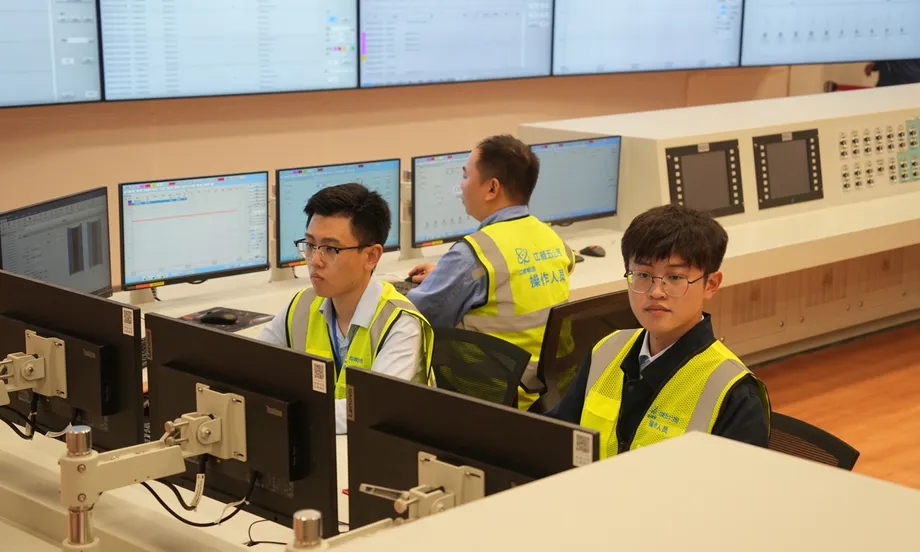
Linglong-1's main control room is designed to monitor and control hundreds of systems and nearly 10,000 equipment operations. A wall mounted monitoring screen forms part of the layout, giving operators a central view of the plant's condition.
Gao Yaofeng, from the nuclear plant's engineering management office, described the work still needed after control room construction was completed in May 2024:
Next, we will further improve the monitoring and control functions of the control room, cooperate with the commissioning of nearly 100 process systems, and provide a strong guarantee for subsequent tests,
Hainan Nuclear Power was also preparing about 60 operators through training. As commissioning progresses, responsibility for systems transfers to the operations department, whose staff will run the plant.
The scale of that preparation helps explain why a small reactor still requires extensive testing. Its electrical capacity may be smaller than that of a large nuclear unit, but operators must still understand a network of cooling, monitoring, electrical and safety systems.
How the design responds to an emergency
Linglong-1 uses an integrated modular design intended to simplify equipment arrangements and reduce potential points of failure. Integration places major functions within a more compact arrangement, while modular construction organizes the plant around components or assemblies that can be manufactured and installed as units.
The reactor also uses passive safety features. These rely on natural physical processes, including gravity and convection, to help systems respond during an accident. Convection is the movement of fluid as warmer, less dense material rises and cooler material sinks, allowing heat to move without depending entirely on powered pumps.
The project's stated design provides for 72 hours without human intervention after an accident, including extreme circumstances in which the plant loses all electrical power and personnel cannot reach the site. That period is particularly relevant when a wider emergency affects both the plant and access to it.
Qu Yong, deputy chief engineer of Hainan Nuclear Power, has described the passive safety features as intended to cope with extreme conditions such as earthquakes, typhoons and flooding. At the Hainan site, those design objectives make the testing of cooling, electrical and control systems a central part of preparations for operation.
What 125 megawatts could supply
Linglong-1's designed electrical capacity of 125,000 kilowatts equals 125 megawatts. Capacity describes how much power the generator can produce at a given moment. The projected 1 billion kilowatt-hours describes the total amount of electricity it would generate over a year.
At its full designed output, producing 1 billion kilowatt-hours would take 8,000 hours. A year of 365 days contains 8,760 hours, so the annual projection is equivalent to about 91 percent of continuous operation at full capacity. Actual annual generation will depend on operating performance, maintenance and other conditions.
Hainan Nuclear Power estimates that the projected electricity output would meet the annual needs of 526,000 households in Hainan. The comparison gives residents a practical sense of the plant's intended scale: a single small reactor could produce an amount of electricity comparable to the combined use of more than half a million homes.
The company's environmental estimate is a reduction of about 880,000 tonnes of carbon dioxide a year once the plant is operating. SASAC repeats that estimate and compares it with planting 7.5 million trees in a year. These are projected benefits associated with future operation.
Electricity is only one intended use
Wang Yuming, deputy head of the project control department at CNNC's Hainan Nuclear Power, described applications extending beyond the public electricity grid during the October 2026 site visit. The company envisages deployment in industrial parks, mining areas and petrochemical complexes, where a local source could serve concentrated demand.
A distributed power source generates electricity near the customers using it, rather than relying entirely on distant large plants. Linglong-1's proposed applications include urban heating, industrial steam, seawater desalination, oil extraction and replacement of coal plants that supply both heat and electricity.
Those uses depend on the heat a nuclear reactor produces. A generator converts part of that heat into electricity, while suitably configured facilities can use heat for buildings or industrial processes. Desalination removes salt from seawater to produce usable fresh water, requiring energy that a nuclear installation could supply.
For a factory or industrial park, the practical attraction would be access to electricity and process heat from a nearby plant. The Changjiang demonstration is intended to provide construction and operating experience for that wider range of uses.
Why the demonstration matters beyond Hainan
CNNC officials view Linglong-1 as a test of China's ability to design, manufacture and build a commercial small modular nuclear plant. Zeng Hailong, head of the Party building and mass work department at Hainan Nuclear Power, described it during the October 2026 visit as a major advance in China's independent nuclear innovation.
SASAC's account of the cold test placed particular weight on nuclear system design, advanced equipment manufacturing and coordination of complex engineering work. The test result gives the project a concrete achievement in that construction record: its primary pressure boundary passed a major integrated check.
Deng Xiaoliang, deputy general manager of Hainan Nuclear Power, has said small modular reactors could help developing countries seeking safe, clean nuclear energy to meet environmental goals. Linglong-1's proposed mix of electricity, steam, heating and desalination explains that interest, especially where demand is concentrated around a city or industrial site.
The next practical task at Changjiang is to complete the remaining commissioning and startup stages. Successful commercial operation would add operating experience to the construction lessons already gathered, giving future customers a fuller picture of how the design performs in service.
Key Points
- Linglong-1 completed its primary circuit cold functional test on October 16, 2025, according to SASAC.
- The test confirmed that the primary pressure boundary was intact and properly sealed.
- The reactor is designed to produce 125 megawatts of electricity, with projected annual generation of 1 billion kilowatt-hours.
- Hainan Nuclear Power estimates that output could meet the electricity needs of 526,000 households and reduce annual carbon dioxide emissions by about 880,000 tonnes.
- The design uses passive safety features intended to provide 72 hours without human intervention after an accident.
- Hot testing, fuel loading, criticality testing and connection to the grid remain part of the sequence leading to commercial operation.
- Planned applications extend to industrial steam, urban heating, desalination and replacement of coal plants supplying heat and electricity.