A cloud of atoms just above absolute zero
Chinese scientists have cooled a cloud of rubidium atoms aboard the Mengtian laboratory module of China's space station to an equivalent temperature of 9.7 picokelvin, the research team says, while observing its expansion for seven seconds. The result brings together an unusually low temperature and a long observation window, two conditions that could help scientists measure gravity and investigate quantum behavior more precisely.
Contents
- A cloud of atoms just above absolute zero
- What scientists mean by cooling atoms
- Why seven seconds matters in space
- How laser light becomes an atomic trap
- A different route from the International Space Station
- From a laboratory room to an orbital cabinet
- A crucial breakthrough before launch
- Longer measurements could reveal weaker effects
- A platform for quantum experiments
- Key Points
The Chinese Academy of Sciences' Technology and Engineering Center for Space Utilization announced the achievement on November 6, 2026. The study, titled Quantum gases below 10 picokelvin in space, appeared online in Science. The center led the project with Peking University and the Shanghai Institute of Optics and Fine Mechanics.
The team describes the result as a record for the coldest artificial matter. Its 9.7 picokelvin figure is roughly a quarter of the 38 picokelvin achieved by a University of Bremen team in 2021, and less than a fifth of the 52 picokelvin reached by NASA's Cold Atom Laboratory aboard the International Space Station in 2022.
A picokelvin is one trillionth of a kelvin. The new figure therefore equals 0.0000000000097 kelvin above absolute zero, the temperature corresponding to minus 273.15 degrees Celsius. Scientists calculate this equivalent temperature from the extremely slow expansion of the released atoms. The temperature describes the motion of that tiny atomic cloud inside the apparatus.
About 400 kilometers above Earth, the experiment uses the station's microgravity environment to weaken the forces holding the atoms and follow them for longer than a compact laboratory on the ground could manage.
What scientists mean by cooling atoms
Rubidium atoms normally move in many directions at different speeds. Cooling reduces the random motion within a group of atoms. At extremely low temperatures and suitable densities, they can form a Bose-Einstein condensate, a state in which many atoms share a common quantum state and behave collectively.
A condensate gives researchers a larger, controllable system for investigating effects usually associated with individual particles. Rather than trying to follow one atom amid rapid motion, scientists can prepare an organized cloud, change its surroundings and measure how it responds.
The experiment's equivalent temperature comes from how slowly the cloud spreads after release. A cloud whose atoms have very little relative motion expands extremely slowly. Watching that expansion helps researchers determine the energy associated with the motion.
Absolute zero remains beyond reach under the laws of thermodynamics. The practical goal is to reduce atomic motion enough to reveal weak effects and maintain useful experimental conditions for longer. In this experiment, the seven seconds of observation are a central part of the achievement.
Why seven seconds matters in space
Earth's gravity creates two linked problems for cooling experiments. It pulls atoms downward as researchers weaken their trap, and it limits how long a released cloud can remain inside the observation chamber. A weaker trap helps cooling, yet it also becomes less able to support atoms against gravity.
The space station and its laboratory contents fall around Earth together. This produces microgravity, allowing atoms to remain near the apparatus with much weaker confinement. Scientists can then cool them further and observe their expansion for longer.
Wolfgang Ketterle, a Massachusetts Institute of Technology physics professor and recipient of the 2001 Nobel Prize in Physics, explained the scale of the problem for an experiment lasting seven seconds on Earth:
On Earth, it would fall down by about 250 meters, so it would actually crash to the ground unless you have a vacuum chamber, which is 250 meters high,
The orbital laboratory provides that extended observation opportunity within a compact instrument. Researchers on the ground remotely operate its equipment, using automated controls to carry out the carefully timed cooling sequence.
How laser light becomes an atomic trap
The instrument contains about 5 grams of metallic rubidium as its supply of atoms. The sequence begins by heating the metal to release vapor. Lasers and magnetic fields then capture and initially cool atoms from that vapor, before the team transfers them into traps formed by laser light.
The researchers use two stages of crossed optical traps. In an optical trap, carefully arranged laser beams exert forces that hold atoms in a small region. Reducing the light intensity makes the trap shallower, allowing more energetic atoms to escape. The remaining atoms have less energy on average, a process called evaporative cooling.
The final stage uses non-adiabatic expansion, a controlled change in confinement that lets the cloud expand and further reduces the motion associated with its effective temperature. Together, the stages brought the rubidium cloud below 10 picokelvin.
Microgravity also created a technical difficulty: evaporation in an optical trap became less efficient. The team developed a method using an additional magnetic gradient, a magnetic field whose strength changes across space, to assist the process and produce a condensate with high purity.
The optical trap remains the central tool for the advanced cooling stages, while magnetic fields assist parts of the preparation. Keeping those roles coordinated requires precise control of laser intensity, timing and surrounding disturbances.
A different route from the International Space Station
NASA's Cold Atom Laboratory has used magnetic traps formed with an atom chip, radiofrequency evaporation and a final cooling technique involving a short pulse. The Chinese team instead chose optical confinement, evaporation controlled through light intensity and deep cooling through expansion.
The researchers say optical trapping offers useful flexibility for future experiments and reduces sensitivity to magnetic interference during confinement. Multiple laser beams can also create structures that would be useful for quantum simulation, where a controllable atomic system reproduces selected features of another physical system.
The earlier records provide two comparisons. Bremen's 38 picokelvin result in 2021 used a drop tower to create a brief period of microgravity. The International Space Station experiment reached 52 picokelvin in 2022. China's reported 9.7 picokelvin is about 3.9 times lower than the Bremen figure and about 5.4 times lower than the earlier orbital result.
The new experiment combines its temperature result with seven seconds of observed expansion. For researchers preparing precision experiments, a cloud that stays slow and observable for longer can be more useful than a temperature record alone.
From a laboratory room to an orbital cabinet
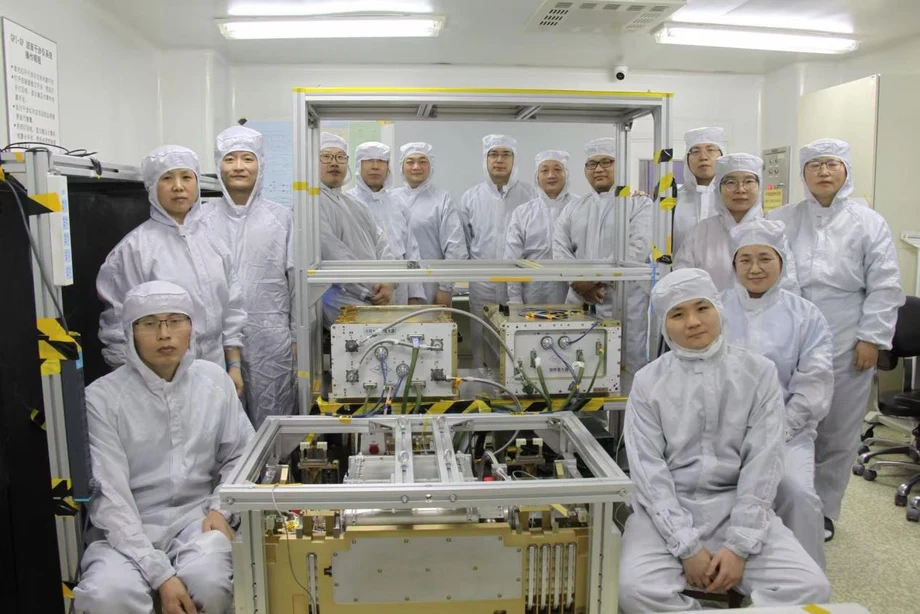
The ground apparatus occupied about 20 cubic meters and weighed approximately 10 tonnes. Engineering descriptions put the integrated orbital cabinet at about 0.7 cubic meters and 500 kilograms. The center's announcement also gives a description of less than one cubic meter, about 300 kilograms and roughly 700 watts; the difference between the quoted masses has not been explained.
Using the detailed engineering figures, the orbital system occupies about one twenty-ninth of the ground system's volume and has one-twentieth of its mass. Achieving that reduction required lasers, precision optics, vacuum equipment and electronic controls to work together inside a tightly constrained space.
The developers used optical fiber connections for the laser system, precise laser control, an ultrahigh vacuum, automated electronics and vibration isolation. The vacuum reduces collisions with unwanted gas particles, while isolation limits mechanical disturbances that could disrupt the delicate cloud.
The cabinet also has a modular design. Researchers can select experimental modules and timing sequences for different studies, allowing the same platform to support several kinds of quantum research rather than a single cooling demonstration.
A crucial breakthrough before launch
The project began its initial assessment in 2011, well before the apparatus reached orbit. A critical difficulty arose near the end of 2021, when the team repeatedly failed to produce the Bose-Einstein condensate needed for the later cooling stages.
The developers secured an additional 10 days to resolve the problem before a decision on including the instrument in the planned flight. They tested and adjusted hardware and software across the system. The condensate finally appeared in the early hours of January 8, 2022, clearing a key step toward launch.
The main milestones span more than a decade:
- 2011: Initial assessment of the space station's ultracold atom experiment began.
- Late 2021: Difficulty producing a condensate threatened the instrument's planned inclusion in the flight.
- January 8, 2022: The team produced the required condensate after an intensive troubleshooting effort.
- 2022: The facility traveled to the space station aboard the Mengtian laboratory module.
- November 6, 2026: The 9.7 picokelvin result was announced and the study appeared online in Science.
Peking University professor Zhou Xiaoji and Shanghai Institute of Optics and Fine Mechanics researcher Chen Weibiao were among the study's corresponding authors. Researchers identified as sharing first authorship include Li Tang of the Shanghai institute and Peking University's Xiong Wei and Jin Shengjie.
Longer measurements could reveal weaker effects
Atom interferometers are among the instruments that could benefit from the new platform. They use the wave properties of atoms, splitting and recombining atomic waves so that the resulting pattern reveals effects such as acceleration or gravity.
Ernst M. Rasel, a physics professor at Leibniz University Hannover in Germany, described the conditions these instruments need:
Atom interferometers highly benefit from sources providing a large number of atoms in an ultracold ensemble and long observation times,
Rasel explained that interferometer sensitivity increases with the square of the time atoms spend in the instrument. With other conditions unchanged, doubling that time can increase the response to the measured effect by a factor of four. This makes extended observation especially valuable for signals that are very small.
The next step he identified is an orbital interferometer in which the atomic waves remain coherently split for several seconds. Coherence means preserving the relationship between the waves so they can produce a useful measurement when recombined. The seven seconds of cloud observation provide a starting point for developing that capability.
Researchers envisage applications in mapping Earth's gravity, navigation and determining satellite orbits. Better gravity measurements could also help track changes in glaciers and ocean currents, because moving water and ice change the distribution of Earth's mass.
A platform for quantum experiments
The optical system could support optical lattices, patterns of laser light that hold atoms in arrangements resembling a crystal. By changing the arrangement and interactions, researchers can investigate how collections of particles behave under controlled conditions.
Chen Weibiao identified quantum phase transitions, the behavior of many interacting quantum particles and tests of fundamental physical theories as possible research areas. The project also lists simulations related to the early universe, searches involving ultralight dark matter and studies related to Higgs models among its proposed directions.
Those are prospective experiments requiring their own designs and measurements. The immediate achievement is a source of extremely slow atoms and an extended period in which to study them. Researchers also see possible uses in quantum sensors and atomic clocks in space.
Lü Congmin, chief designer of the space application system for China's crewed space program and deputy director of the space utilization center, invited researchers worldwide to conduct experiments using the facility and share experimental opportunities. No application timetable or date for the proposed follow-up experiments was announced.
Ketterle described the achievement as "an excellent starting point to advance atomic thermometry and precision measurements." Atomic thermometry, the measurement of temperature in atomic systems, will itself remain a key part of understanding and improving such experiments.
Key Points
- China's space station team reports cooling a rubidium atomic cloud to an equivalent temperature of 9.7 picokelvin and observing its expansion for seven seconds.
- The experiment took place in the Mengtian laboratory module, using a facility launched in 2022.
- The reported temperature is below the 38 picokelvin achieved in Bremen in 2021 and the 52 picokelvin reached aboard the International Space Station in 2022.
- The cooling sequence combines optical trapping, evaporative cooling assisted by a magnetic gradient and non-adiabatic expansion.
- Future research could include quantum simulations, atom interferometers, gravity measurements and tests of fundamental physics.