Two Riau cases put forest control and restoration in focus
Indonesia has revoked the forest use permit held by Riau Andalan Pulp and Paper (RAPP) for an area of about 338,536 hectares in Pelalawan, Riau, while a separate case in Kuantan Singingi has led officials to recommend rejecting a pending application to release about 32 hectares of forest land.
Contents
The RAPP decision was made under Forestry Ministerial Decree No. 971 of 2026, dated November 19, and announced on November 20 by the Forest Area Enforcement Task Force, known as Satgas PKH. The government cited recurring fires on peatland, oil palm plantations, unlicensed mining and damage to protected areas. It said all activity inside the revoked permit area must stop and the land returns to state control.
The task force says the RAPP decision does not end the company's duties to repair environmental damage or meet legal responsibilities. RAPP, a major pulp and paper producer in Riau, said it had learned of the revocation through media coverage and was waiting for formal notice and clarification from the authorities.
The two cases involve different steps. RAPP has lost an existing permit, while the recommendation in the Gemilang Sawit Lestari case concerns a still pending request to release forest land. Together, they show how the government is using administrative action to address alleged use of forest areas without permission.
What violations did the government cite?
Satgas PKH said its findings against RAPP included recurring peatland fires, about 18,362.74 hectares of oil palm plantations, 541.46 hectares of land cleared for mining without permission, and damage to about 211.54 hectares of protected areas.
The task force also raised concerns about protection of the buffer zone around Tesso Nilo National Park. The park and nearby forest areas provide habitat for Sumatran elephants, and officials said the problems could threaten that habitat.
The figures describe different types of alleged problems within the permit area. They should not be added together to estimate the total land affected, because the government has not said whether any of those areas overlap.
Satgas PKH spokesperson Barita Simanjuntak said the permit had been revoked through an administrative sanction. He said the decision ended activities covered by the permit and returned control of the area to the state, while leaving the company responsible for environmental recovery and legal liabilities.
With the revocation of this license, all activities within PT RAPP's licensed area are halted, and the land will revert to state control.
What happens to RAPP's operations and local workers?
RAPP is part of APRIL Group, a pulp, paper and forestry business owned by Royal Golden Eagle. The company's operations are centred near Pangkalan Kerinci in Pelalawan, where the mill and its suppliers form an important part of local business and employment.
APRIL said RAPP and the wider group employ more than 41,000 people. The company estimates its operations support about 170,000 jobs in Riau and 300,000 across Indonesia, including people working for businesses that supply goods and services. Those are company estimates, and the government has not yet explained how the halt will be carried out across the entire permit area or what it will mean for each worker and contractor.
APRIL also said RAPP contributed more than 350 trillion rupiah to Riau's gross regional domestic product between 2016 and 2025, and invested 970 billion rupiah in community programmes over the past decade. The company says those programmes included work to reduce child stunting in 138 villages and health equipment for 26 community health centres.
In a statement, APRIL said it respected the government's authority and would respond through official channels after receiving notice. It described the welfare of communities that depend on the business as an immediate priority, and said it would work to reduce disruption for employees, contractors, suppliers and customers.
We respect the authority of the government and will continue to communicate constructively with the relevant authorities.
The company also says RAPP maintains nearly 500,000 hectares of conservation areas and that its Fire Free Village Programme has reduced fire affected areas by more than 90% in participating communities. These claims describe the company's own environmental programmes; the government's cited findings concern alleged violations that it says led to the permit revocation.
What is the separate case against Gemilang Sawit Lestari?
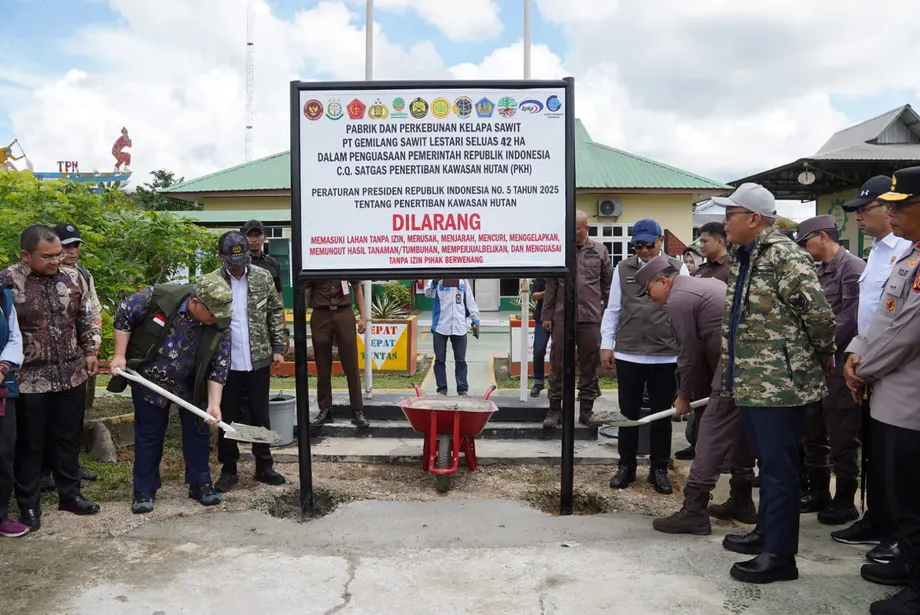
In Kuantan Singingi, Satgas PKH said it found indications that a non estate palm oil mill owned by PT Gemilang Sawit Lestari bought and processed palm fruit from plantations operating inside forest areas without permission. The task force also said the mill may have encouraged further forest clearing nearby for oil palm cultivation.
The company had a pending application to release about 32 hectares from the forest estate. Satgas PKH recommended cancelling the application, rejecting the release and returning the area to state control. That recommendation is not the same as the completed revocation of RAPP's permit.
Forest release is a process for changing the legal status of land so it can be used outside the forest estate. In this case, the task force's recommendation would stop the application from advancing and keep the land under state control. The government has not provided a date for a final decision on the recommendation.
Research by Eyes on the Forest offers a wider view of the challenges that can follow permit cancellations. Its monitoring report examined 16 companies whose plantation permits had been revoked. Six were still operating in the areas examined, while 10 had stopped. The report also indicated that PT Merbau Pelalawan Lestari was a supplier to RAPP; it listed that company among those no longer operating. The findings concern those monitored plantation companies, not a determination about RAPP's own permit case.
Why does the future of the land matter?
Revoking a permit changes who may conduct business on the land, but it does not by itself restore forests, repair peatland or settle how local communities will use the area. Eyes on the Forest called for careful decisions about any redistribution of revoked land, restoration of forests with high conservation value and protection of local livelihoods.
The question has broader importance because Satgas PKH has been part of a much larger government campaign to recover land it considers to be used unlawfully. Government announcements have put the total area taken back at about 5.9 million hectares, with 4.12 million hectares assigned to the state owned company Agrinas Palma Nusantara. The RAPP announcement does not say that its 338,536 hectares will be transferred to Agrinas or another company.
That distinction matters to people living near former concessions. A forest area could be managed for conservation, opened to community programmes or placed under another operator. Each choice affects access to land, jobs and the condition of forests. The government has not announced a specific management plan for the RAPP area.
Indonesia's newer enforcement approach is linked to Presidential Regulation No. 5 of 2025 and Government Regulation No. 45 of 2025. The rules provide for state recovery of areas judged to be used unlawfully. Earlier rules under Government Regulation No. 24 of 2021 allowed a different administrative path for some businesses, including paying fines while seeking to regularise their operations. Environmental law specialists have questioned how the newer approach fits with existing laws and how decisions will be applied in practice.
What remains unclear?
APRIL said it was awaiting formal notification and further clarification, even though the task force had publicly announced the decision and identified the ministerial decree behind it. The company has said it will reply through official procedures once it receives that notice.
The announcement also leaves practical questions unanswered: how the shutdown will be managed across such a large area, who will carry out and pay for restoration, and how workers and communities that rely on RAPP's operations will be affected. No timetable for restoration or a new land management plan was given.
The next immediate step is the company's response after formal notice. The government has not announced a hearing or another scheduled decision on the Gemilang Sawit Lestari land application.
- Indonesia revoked RAPP's forest use permit for about 338,536 hectares in Pelalawan, Riau.
- The government cited peat fires, oil palm plantations, unlicensed mining, protected area damage and risks near Tesso Nilo National Park.
- RAPP must halt activity in the permit area, while environmental restoration and legal responsibilities remain in force.
- For Gemilang Sawit Lestari, the task force recommended rejecting a pending application involving about 32 hectares of forest land.
- The government has not said how the RAPP area will be managed or set a restoration timetable.