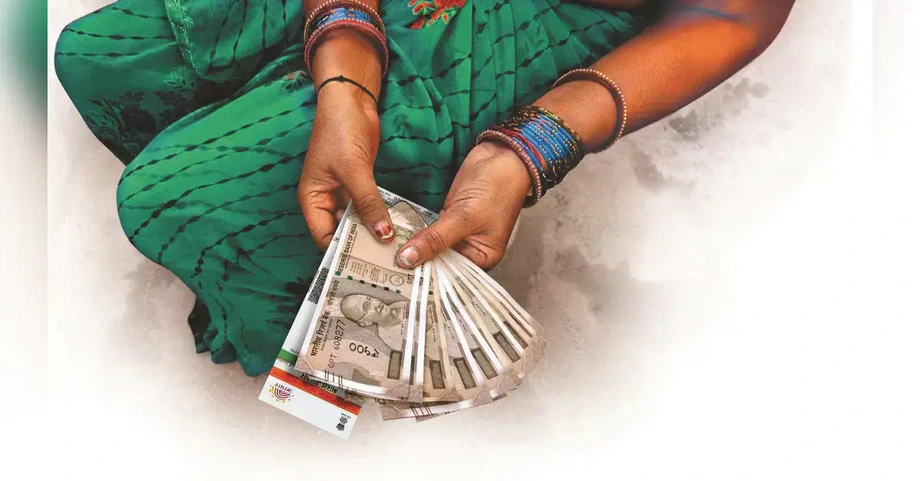
Direct payments take a larger place in state budgets
Indian states have set aside about ₹4.02 lakh crore for 128 identified unconditional cash transfer schemes in the 2026-27 financial year, equal to roughly 1% of the country's gross domestic product. The schemes support women, farmers, young people and people receiving social security pensions. Their combined budget is nearly three times the ₹1.5 lakh crore recorded in 2022-23.
Contents
- Direct payments take a larger place in state budgets
- Which states are spending the most?
- Women receive the largest share
- Farmers, pensioners and young people receive different levels of support
- What does the spending mean for budgets?
- How much can cash transfers change for women?
- Why the 2027 election cycle matters
- What to Know
The increase has been swift. Spending on subsidies and transfers rose from 16% of state revenue receipts in 2018-19 to 21% in 2023-24. Within that spending, transfers grew at an average annual rate of 24%, twice the 12% rate for subsidies. Revenue receipts are the money states collect and receive, including taxes and grants.
Direct transfers put money into a recipient's bank account, usually without requiring them to buy a particular product or meet a condition. That can give a household flexibility, but it also commits governments to spending money year after year. The 128-scheme count is not exhaustive, so actual spending may be higher.
The growth follows a rapid expansion of women's programmes. A 2025 state finance report by PRS Legislative Research counted 12 states offering unconditional cash transfers to women in 2025-26, up from two in 2022-23. Those states estimated spending ₹1.68 lakh crore on the schemes in 2025-26, or 0.5% of GDP. Beneficiaries are selected based on an income threshold, age group and other factors.
The report's table lists these 12 schemes, their eligibility criteria, monthly benefits and 2025-26 budget provisions:
| State | Scheme | Eligibility criteria | Benefit per month | Budget provision (₹ crore) |
|---|---|---|---|---|
| Assam | Orunodoi Scheme | Women over the age of 18 years | ₹1,250 | 5,000 |
| Chhattisgarh | Mahtari Vandan Yojana | Married women over the age of 21 | ₹1,000 | 5,500 |
| Delhi | Mahila Samriddhi Yojana | — | ₹2,500 | 5,110 |
| Himachal Pradesh | Indira Gandhi Pyari Behna Sukh Samman Nidhi Yojana | Phased roll-out on the basis of beneficiaries - 18 to 59 years | ₹1,500 | 138 |
| Haryana | Lado Laxmi Yojana | Women over the age of 18 years | ₹2,100 | 5,000 |
| Jharkhand | CM Maiyan Samman Yojana | 18-50 years | ₹2,500 | 13,363 |
| Karnataka | Gruha Lakshmi Yojana | — | ₹2,000 | 28,608 |
| Maharashtra | Mukhyamantri Majhi Ladki Bahin Yojana | 21-65 years | ₹1,500 | 36,000 |
| Madhya Pradesh | Mukhyamantri Ladli Behna Yojana | 21-60 years | ₹1,250 | 18,669 |
| Odisha | Subhadra Scheme | 21-60 years | ₹833 | 10,145 |
| Tamil Nadu | Magalir Urimai Thogai | 21 years and above | ₹1,000 | 13,807 |
| West Bengal | Lakshmir Bhandar Scheme | 25-60 years | ₹1,000 - ₹1,200 | 26,700 |
Which states are spending the most?
West Bengal has the largest combined allocation for identified transfers, at ₹47,542 crore in 2026-27. That is more than its ₹40,930 crore capital outlay, the budget for building or improving long lasting public assets such as roads, schools and hospitals. West Bengal is the only state where planned transfer spending exceeds capital outlay, reaching 116% of that investment budget.
Karnataka has allocated ₹40,392 crore, Maharashtra ₹38,549 crore, Andhra Pradesh ₹33,943 crore and Telangana ₹32,629 crore. Madhya Pradesh has budgeted ₹32,059 crore. In nine states, the transfer allocation is at least half as large as planned capital spending.
Transfers also take a sizeable share of some states' income. They equal about 15% of revenue receipts in West Bengal, 14% in Andhra Pradesh and Telangana, and 13% in Karnataka and Jharkhand. In West Bengal, the amount is higher than the capital outlay; in several other states it is approaching the money set aside for public assets.
Women receive the largest share
Women-focused programmes account for about ₹1.98 lakh crore, close to 49% of the total identified transfers. West Bengal has allocated ₹36,000 crore for women, followed by Karnataka at ₹28,608 crore and Maharashtra at ₹26,500 crore. Madhya Pradesh has set aside ₹23,883 crore.
The programmes have different names and rules, including Lakshmir Bhandar in West Bengal, Gruha Lakshmi in Karnataka, Ladki Bahin in Maharashtra, Ladli Behna in Madhya Pradesh, Subhadra in Odisha and Magalir Urimai Thogai in Tamil Nadu. Most women's schemes pay monthly. Odisha's Subhadra programme instead provides ₹10,000 a year in two instalments.
Many of the largest programmes began or expanded from 2023 onward. Madhya Pradesh, Karnataka and Tamil Nadu introduced major schemes in 2023; Maharashtra, Odisha and Jharkhand followed with large initiatives in 2024. Punjab introduced a women-focused transfer in 2026-27, while Kerala and West Bengal increased allocations to existing programmes.
In West Bengal and Jharkhand, women-focused transfers are estimated at 11% and 10% of revenue receipts, respectively. Across all states, women and social security pension recipients together account for about 88% of identified transfer spending.
Farmers, pensioners and young people receive different levels of support
Farmers' schemes total ₹46,194 crore. Telangana leads with ₹18,000 crore, well ahead of Andhra Pradesh at ₹6,600 crore and Maharashtra at ₹6,060 crore. The programmes include Telangana's Rythu Bharosa, Andhra Pradesh's Annadata Sukhibhava, Maharashtra's Namo Shetkari Mahasanman Nidhi and Odisha's CM-Kisan. They add state support to the Centre's PM-Kisan payments.
Cash can provide a more predictable source of income for farm households facing uncertain harvests, weather and market prices. The PRS analysis says its effect on longer term farm hardship depends in part on whether payments accompany investment in irrigation, storage and market access, which can help farmers protect crops and earn better prices.
Social security pensions account for about ₹1.54 lakh crore, or around 0.39% of GDP in 2026-27. Fourteen states have budgeted more than three quarters of their transfer spending on pensions. Andhra Pradesh has the largest pension allocation, at ₹27,343 crore, followed by Rajasthan at ₹16,172 crore and Telangana at ₹14,629 crore. In Gujarat, Uttar Pradesh and Meghalaya, pensions make up almost all identified unconditional transfer spending.
Youth support is much smaller, at a combined ₹3,132 crore. West Bengal accounts for ₹2,020 crore, followed by Karnataka at ₹600 crore and Haryana at ₹370 crore. Only five states have specific allocations for youth in the identified schemes.
What does the spending mean for budgets?
State budgets must pay for transfers alongside salaries, pensions, interest on borrowing, public services and infrastructure. In 2026-27, states have budgeted 82% of total expenditure as revenue spending, which covers recurring costs, and 17% as capital outlay. Salaries, pensions and interest together are expected to take 52% of state revenue receipts.
The combined state fiscal deficit, excluding interest free central loans for capital projects, is budgeted at 2.9% of GDP in 2026-27. Including those loans, it is 3.2%. Nine states have budgeted deficits above the 3% benchmark recommended by the 16th Finance Commission. The aggregate revenue deficit was estimated at 0.71% of GDP in 2025-26, meaning recurring income was not enough to cover recurring spending.
PRS's 2025 assessment found that six of the 12 states with women's transfer programmes expected a revenue deficit that year. Its calculations showed that, with other factors held constant, excluding the transfers would shift Karnataka from a revenue surplus of 0.3% of its gross state domestic product to a deficit of 0.6%. In Madhya Pradesh, the surplus would narrow from 1.1% to 0.4%. The analysis also found a deterioration in revenue balances among states using these programmes, linked to limited cuts in other recurring spending or insufficient growth in revenue receipts.
The 16th Finance Commission has warned that broad beneficiary lists can create a large bill and recommended reviewing who qualifies. The central question for state budgets is how to provide direct help while still paying for services and investment that benefit people over many years.
How much can cash transfers change for women?
Cash gives recipients money they can use for food, transport, school costs, health care or savings. Research reviewed by the Observer Research Foundation describes links between transfers to women and improvements in household spending, savings and women's say in financial decisions. These benefits matter in a country where many women have limited access to paid work and control over income.
The daily work burden is part of that picture. India's Time Use Survey for January to December 2024 found that women spent an average of 289 minutes a day on domestic work and 137 minutes on caregiving. Men spent 88 minutes on domestic work and 75 minutes on care. A monthly payment can help a household manage costs, but it does not by itself provide childcare, create jobs or reduce the time women spend on unpaid work.
Access to affordable transport can also affect whether women can take up paid work. A household travel survey cited in the 2026-27 finance analysis found that more than one in five urban women used buses to commute to work, around three times the share of urban men. The figures were 46.8% in Kerala and 41.1% in Tamil Nadu. That helps explain why household support and public services can matter together: money may ease immediate pressure, while transport and job access shape the choices available.
Why the 2027 election cycle matters
Seven states due to vote in 2027 have budgeted a combined ₹35,333 crore for unconditional transfers in 2026-27. Punjab accounts for ₹15,432 crore and Uttar Pradesh for ₹13,604 crore. Gujarat has set aside ₹4,167 crore, while the allocations are ₹809 crore in Goa, ₹699 crore in Uttarakhand, ₹614 crore in Himachal Pradesh and ₹8 crore in Manipur.
The share of revenue receipts varies widely. In Punjab, the allocation is equivalent to 12% of revenue receipts, compared with 3% in Goa, 2% each in Uttar Pradesh, Gujarat and Himachal Pradesh, 1% in Uttarakhand and 0.04% in Manipur. These figures show why the same kind of policy can place very different demands on state finances.
Election timing is one part of the expansion, but the programmes also respond to needs such as low household income, unpaid care work and uncertain farm earnings. The fiscal debate is about how to balance those needs with pension obligations, public services and investment. States have also adjusted benefits: Maharashtra reduced one monthly payment in April 2025 for some women who received another state transfer, while Jharkhand raised its monthly payout in October 2024.
What to Know
- States budgeted about ₹4.02 lakh crore for 128 identified unconditional transfer schemes in 2026-27, around 1% of GDP.
- Women-focused schemes receive about ₹1.98 lakh crore, while social security pensions receive about ₹1.54 lakh crore.
- West Bengal has the largest total allocation at ₹47,542 crore, more than its capital outlay of ₹40,930 crore.
- Farmer transfers total ₹46,194 crore, led by Telangana at ₹18,000 crore. Youth schemes receive about ₹3,132 crore.
- Seven states due to vote in 2027 have budgeted ₹35,333 crore for transfers.
- Cash can help households manage costs, while sustained improvements also depend on public services, infrastructure and opportunities for paid work.