Jobs and education at the centre of Columbia warning
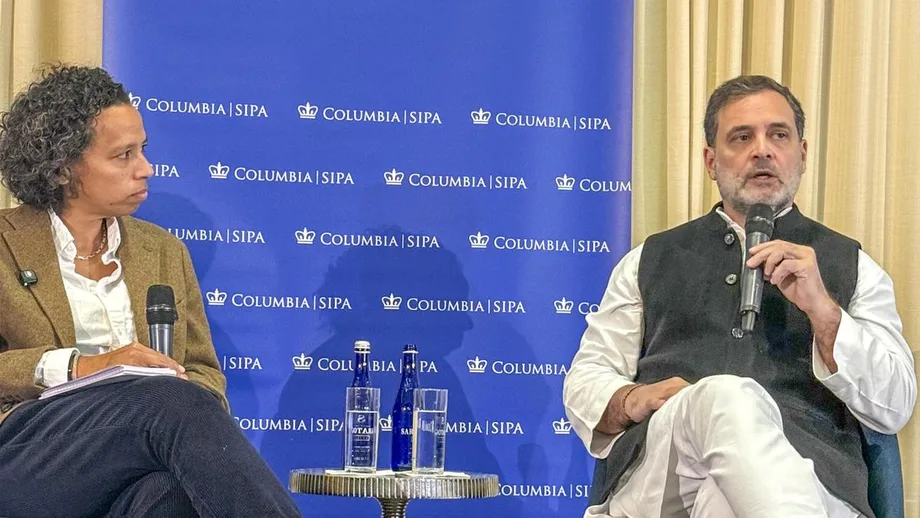
Rahul Gandhi, the Leader of the Opposition in India's Lok Sabha, warned at Columbia University in New York on November 17, 2026, that unemployment, weaknesses in education and a struggling manufacturing sector were pushing India towards an economic crisis. The ruling Bharatiya Janata Party responded by citing economic growth and accusing him of attacking India's image abroad.
Contents
- Jobs and education at the centre of Columbia warning
- Why a degree no longer feels like a promise
- Manufacturing and smaller businesses drive his argument
- Corporate concentration becomes a second line of attack
- Student protests fit a wider political argument
- Electoral allegations extend the dispute
- BJP answers with growth, reserves and a political rebuke
- A global jobs problem, with domestic priorities
- The visit and the priorities Gandhi set out
- Key Points
During an hour of conversation with journalist Lydia Polgreen before hundreds of students and faculty members, Gandhi argued that India's economic model had stopped delivering results almost a decade earlier. He criticised Make in India and Start-up India, saying the government initiatives had failed to repair the foundations needed to create enough jobs.
Gandhi, a Congress leader, framed the problem around the prospects facing young Indians:
The blunt thing is that India is sitting on an economic disaster. That's the reality of it. One can brush it aside, the media can brush it aside. But India has got a massive unemployment problem. India's got a massive problem with its education system.
The exchange exposed two different measures of economic success. Gandhi focused on access to work, the prospects of smaller businesses and the value of education. BJP leaders pointed to national output, foreign exchange reserves and India's standing among growing economies.
Why a degree no longer feels like a promise
Young people from educated, middle class families were central to Gandhi's argument. Asked about student frustration, he said some came from households that had once seen considerable promise in Prime Minister Narendra Modi but now struggled to see a future for their children.
Gandhi said even admission to India's prestigious Indian Institutes of Technology or Indian Institutes of Management could leave the central problem unresolved. He described students questioning the link between qualifications and employment:
So the idea that a university degree is going to actually get you a job is being questioned every day in India.
Parents and children were increasingly divided over career advice, he said. Young people were challenging the assumption that following an earlier generation's route through education would produce the same opportunities.
For families, his argument connects two practical concerns: whether they can afford higher education and whether that spending leads to a job. Gandhi called for education that was effective and affordable, alongside an economy capable of employing graduates.
Manufacturing and smaller businesses drive his argument
Small and medium businesses, agriculture and manufacturing formed the core of Gandhi's proposed economic priorities. He described smaller enterprises as engines of employment and said the government had weakened economic structures built over decades under Congress.
Gandhi said India needed to rebuild its capacity to produce goods rather than rely so heavily on services. Manufacturing means making physical products, while services include activities such as finance, software, transport and hospitality.
Gandhi argued that services could not provide work on the scale India needed:
You cannot give enough people jobs through services. It cannot be done. You can give 1%, 2%, 3%, 5%. You cannot give everybody a future with services. And we've just basically decided that we don't need manufacturing.
He used those percentages to argue for a different balance between sectors. His central demand was to put production, successful agriculture and smaller employers at the heart of economic policy. He also accused Make in India and Start-up India of failing to generate enough employment.
Corporate concentration becomes a second line of attack
Gautam Adani and Mukesh Ambani were repeated targets of Gandhi's criticism. He alleged that a handful of large business groups were expanding while smaller companies struggled, and questioned why private investment was not more widely spread.
Private investment is money businesses spend on activities such as building factories, buying equipment or expanding operations. Gandhi linked his concerns about investment to his broader allegation that economic power was becoming concentrated.
The Congress leader said:
You cannot have two businessmen controlling the entire architecture of a country and expect manufacturing.
Gandhi also asked why Tata was "literally being taken over" by Adani, without explaining the transaction or corporate relationship he meant. Business people were increasingly approaching him with concerns about the direction of the economy, he said.
Student protests fit a wider political argument
Student demonstrations in Delhi and other parts of India were, in Gandhi's telling, part of a much longer response to concentrated wealth and political authority. He placed them alongside protests by farmers, adivasis and dalits.
Adivasis are Indigenous communities in India. Dalits are communities that have historically faced exclusion and discrimination within the caste system. Gandhi alleged that these groups, minorities and farmers had experienced different forms of exclusion, including the taking of tribal land without consultation.
Gandhi described the protests as connected rather than isolated:
As power has been concentrating in India, different groups have been resisting at different levels in different places, and that has been going on for almost a decade now.
His argument joined economic opportunity to political influence: people facing insecure livelihoods or exclusion from decisions were, he said, resisting the same concentration of power. He also warned that the government might respond aggressively or violently if pressure continued to build.
Electoral allegations extend the dispute
Gandhi repeated his allegation of "vote chori", meaning vote theft, and said restoring the electoral system was necessary for wider political change. He called for the removal of Chief Election Commissioner Gyanesh Kumar as one step towards that goal.
He alleged that 140 million people who would have voted in 2024 had been removed from electoral rolls. Electoral rolls are the official lists used to determine who can vote. He said Congress had gathered substantial evidence of malpractice and that people within the system were now sharing information with the party.
Gandhi also alleged that BJP campaign spending had been 20, 30, 40 or 50 times greater during an election he discussed. He did not identify which election he meant or present supporting evidence during that exchange. The Election Commission's response to these specific Columbia allegations was not given.
His comments made electoral administration part of the economic debate. In his account, changing policy required first addressing the way political power was won and exercised.
BJP answers with growth, reserves and a political rebuke
Pradeep Bhandari, a BJP national spokesperson, rejected Gandhi's assessment and accused him of portraying India negatively whenever he travelled overseas. In a post on X, Bhandari said:
Rahul Gandhi has become the leader of anti-India propaganda. His inherent hate for India's progress & Indian democracy makes him speak ill about India every time he goes abroad!
Bhandari argued that India was recognised as the world's fastest growing economy and that its democracy commanded international respect. He contrasted Gandhi's appearances abroad with Modi's official visits, saying the prime minister upheld India's national interests.
BJP leader Dilip Ghosh also rejected the warning. He cited India's gross domestic product and what he described as record foreign exchange reserves, while accusing Gandhi of being motivated by a desire for power.
Gross domestic product, or GDP, measures the value of goods and services produced in an economy. Foreign exchange reserves are assets held by monetary authorities, including foreign currencies, that help meet international payment needs. Employment figures address a more immediate household concern: how many people can find work.
The political disagreement therefore reaches beyond the description of India as a growing economy. Gandhi argued that growth was failing to provide sufficient opportunities, while BJP leaders defended the government's record through national economic indicators. Neither side supplied a detailed statistical comparison during these exchanges.
A global jobs problem, with domestic priorities
India's difficulties were part of a wider international employment problem, Gandhi said. He raised the challenge of finding jobs for people doing manual and industrial work in India, the United States and France, and said the US, Germany and Britain faced more serious economic difficulties than India.
Gandhi cited India's lower costs and capacity to withstand hardship as reasons for optimism. His warning was about time being lost rather than a lack of potential.
US immigration restrictions affecting Indian students also came up. Gandhi acknowledged the benefits many Indians had gained from studying and working abroad, but said overseas opportunities reached a small share of the population. He argued that domestic agriculture, production and education deserved greater attention.
He also attributed Republican setbacks in the recent US midterm elections to rising fuel prices, connecting those prices to what he described as declining American power and Washington's inability to impose its will on Iran.
The visit and the priorities Gandhi set out
Gandhi's visit placed his criticism before university audiences in two US cities. The Columbia engagement was dated November 17, although some accounts placed the remarks on November 18, when the BJP response and his planned Chicago appearance were also described.
- November 17, 2026: Gandhi addressed students and faculty at Columbia University in New York.
- November 18, 2026: BJP leaders publicly challenged his comments on the economy and democracy.
- November 18, 2026: Gandhi was scheduled to visit the University of Chicago as part of his visit lasting two days.
Gandhi set out priorities rather than a detailed spending or legislative programme: rebuild manufacturing, support smaller businesses, make agriculture more successful and improve access to useful, affordable education. He paired those economic demands with calls for electoral reform.
Despite the severity of his warning, Gandhi ended his economic assessment with confidence in India's potential:
I am very optimistic about India. I worry that we are wasting time. I worry that another 10 years of this, five years of this, we'll really be in trouble. That's what I think.
Key Points
- Rahul Gandhi warned at Columbia University that unemployment, education problems and weak manufacturing threatened India's economic prospects.
- He called for greater attention to smaller businesses, agriculture and production.
- He linked student frustration to uncertain careers and questioned whether degrees were delivering jobs.
- Gandhi also alleged electoral malpractice and concentrated corporate power.
- BJP leaders rejected his assessment, citing economic growth and foreign exchange reserves.
- Gandhi was scheduled to continue his university engagements in Chicago on November 18.