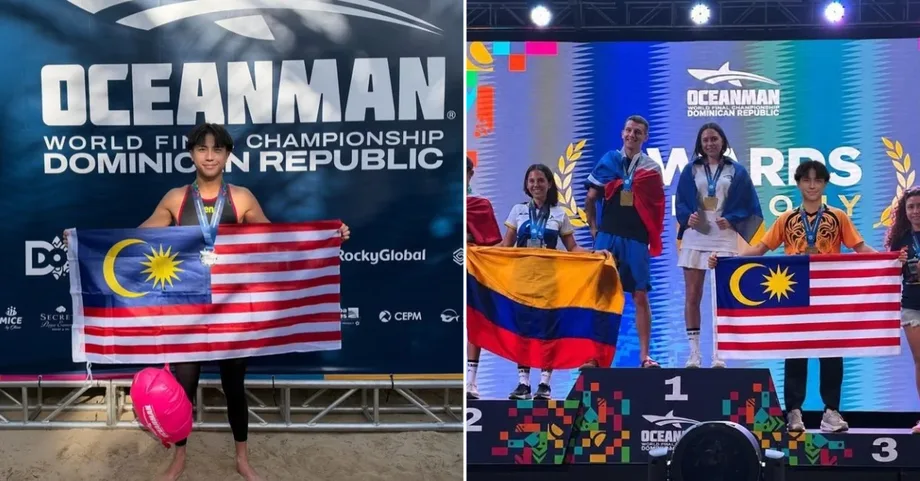
A Malaysian teenager reaches the podium in Miches
Malaysian swimmer Max Tang, 16, won bronze in the boys' 15–19 2km Sprint at the OCEANMAN World Championship Finals 2026 in Miches, Dominican Republic, finishing behind two older competitors. France's Pierre Souchon, 19, took gold, while Mexico's Emiliano Ramirez Renteria, 18, claimed silver.
Contents
- A Malaysian teenager reaches the podium in Miches
- Three gold medals opened the route to the finals
- How his season unfolded
- Why a 2km sprint demands more than speed
- From reluctant lessons to a return after COVID-19
- Six swimming sessions and a full school timetable
- Miches also brought success for the host nation
- The support behind Max's medal
- Key Points
The result, announced on 17 November, followed a successful qualifying campaign in Kota Kinabalu in July, where Max won three gold medals. He also served as Malaysia's flag bearer at the World Finals, giving the Year 11 student from Garden International School in Kuala Lumpur another responsibility alongside racing.
Max said representing his country and reaching the podium made the competition especially memorable:
Representing Malaysia at the World Finals was already an incredible honour, so to win a bronze medal for my country and stand on the podium proudly holding the Malaysian flag was a moment of immense pride.
His medal came in an age category spanning five years, placing him against swimmers closer to adulthood. Max said racing older, more experienced competitors from around the world made the achievement more meaningful.
Three gold medals opened the route to the finals
Kota Kinabalu provided the breakthrough that took Max to the Dominican Republic. At the July 2026 event, he won the 2km Sprint, the 5km Half OCEANMAN and the 3x500m mixed relay.
In both individual races, Max was also the champion across all age groups. His success therefore extended beyond his junior category: he finished at the top of the field in two different distances and secured qualification for the World Finals.
The 5km race covered two and a half times the distance of the 2km event. Winning both required him to sustain his effort over different race lengths, a useful foundation for a competition series built around swimming in open water.
Max described his reaction to those individual victories:
I did not expect to come out on top in both events. It was especially rewarding because all the early mornings, long training sessions and sacrifices suddenly felt worth it.
How his season unfolded
Max's route to Miches included national competition, qualification in Malaysia and preparation around school commitments. Before the World Finals, he had competed at the Malaysian National Age Group Swimming Championships and the 2026 Malaysia Games, known as SUKMA.
- Before qualifying: Max competed at national age group level and at SUKMA 2026.
- July 2026: He won three gold medals at OCEANMAN Kota Kinabalu, including the titles across all age groups in the 2km and 5km races.
- 31 October 2026: His preparations were described ahead of World Finals scheduled for 13–15 November in Miches.
- 17 November 2026: His bronze medal in the boys' 15–19 2km Sprint was announced.
- 2027: He is due to complete his remaining IGCSE subjects.
The account accompanying his medal described the championship as concluding on 17 November, while the advance schedule listed 13–15 November. A post-event report states that the official competitions took place from 13–15 November 2026; that report was published on 17 November, distinguishing its publication date from the competition dates. The exact day of his race and his finishing time were not given.
Why a 2km sprint demands more than speed
OCEANMAN is an international series of open water swimming competitions. Its races take swimmers beyond the controlled setting of a pool, where lanes and clear markings help guide them from one end to the other.
At sea, swimmers face waves, currents and changing conditions. They must also keep checking where they are going. This skill, called sighting, means looking ahead during the swim to stay on course rather than relying on a lane line beneath them.
Max prepared with pool sessions focused on endurance, speed and technique, alongside open water skills such as sighting and pacing. Pacing means choosing an effort a swimmer can maintain without tiring too soon.
Although OCEANMAN calls its 2km race a Sprint, the distance still requires sustained effort. Max said the uncertainty of open water was part of its appeal:
I enjoy that challenge because it makes the race more exciting and requires you to think strategically.
From reluctant lessons to a return after COVID-19
Max began swimming lessons at five after his eldest brother, Matthew, qualified to represent his state. Their mother enrolled Max too, although he initially found reasons to avoid going.
Success at beginner competitions gradually changed his attitude. Winning medals gave him a reason to test himself, and improving his personal times became a source of satisfaction. Even a small improvement offered a measurable reward for the work he had put in.
Max explained how his early reluctance turned into ambition:
The turning point came when I started winning medals at novice meets and realised that I wanted to challenge myself further.
The COVID-19 pandemic interrupted that progress. Max stopped training and lost interest in swimming despite having performed well between the ages of seven and nine. When he returned, he found that swimmers who had once been his peers had moved ahead.
Rebuilding took patience. He described having to start again from the bottom and learning that weeks of hard training did not always produce the competition result he wanted. His eventual return to national events and qualification for Miches followed that difficult restart.
Six swimming sessions and a full school timetable
Max trained about six times a week while preparing for major competition, sometimes completing two sessions a day during school holidays. Building endurance was particularly important for the 5km event.
His sporting commitments also included running club twice a week, cross country running and water polo. School, extracurricular activities, swimming and homework filled much of his day, leaving limited time for rest or leisure.
Max, who was pursuing 10 IGCSE subjects, described the pressure of preparing for SUKMA while keeping up with schoolwork:
There were days when I was physically exhausted after training but still had assignments and revision to complete.
He has earned two A* grades in his IGCSE examinations and is scheduled to complete his remaining subjects in 2027. His two older brothers helped convince him that strong academic results and serious sporting ambitions could fit into the same life.
For his family, the bronze medal carried the history of that effort. His mother, Yvette Kang, said their pride extended beyond the result, reflecting the journey from a child who did not particularly enjoy swimming to a teenager representing Malaysia on a world podium.
Miches also brought success for the host nation
Playa Esmeralda in Miches hosted the championship, with the event expected beforehand to bring together about 4,500 swimmers from Europe, Asia, the Americas and other regions. OCEANMAN runs approximately 38 events a year across 26 countries.
Dominican swimmer Juan Ramón Mejía Betances won the World Final title in the 10km race for competitors aged 60 to 69. He was the only Dominican swimmer to reach the World Final podium over that distance.
The programme also included Open races alongside the World Finals. Those races had their own categories and served as qualifiers for the 2027 world competition, with the first 10 finishers in each category earning places.
In the 2km Sprint Open, Maia Guerrero, Mirka Morales, Josué Romero and Augusto García Serra won their respective categories. Miguel Portes and Miguel José González took category victories in the 5km Half OCEANMAN Open, while Lisi Kristina Hershberger won her category in the 10km OCEANMAN Open.
Guillermo Medina won in Oceankids Open, and other Dominican children also reached the podium. Organisers recognised Rafael Miranda, OCEANMAN's representative in the Dominican Republic, for his role in coordinating the event.
The support behind Max's medal
Max credited the people who helped him combine training, competition and school. After winning bronze, he thanked the adults who had supported his progress:
I am extremely grateful to my coaches, teachers and family who have supported me throughout my swimming journey.
Australian swimmer Cameron McEvoy is another source of motivation. Max admires his willingness to reconsider his approach after disappointing results and change his training before returning stronger. That example connects with Max's own experience of rebuilding after the pandemic.
Max hopes to represent Malaysia at more international competitions. His advice to other young people centres on trying despite the possibility of failure and continuing when progress becomes difficult.
Before travelling to the World Finals, he offered this encouragement:
Sometimes, the biggest achievements come after the toughest challenges.
Key Points
- Max Tang, 16, won bronze in the boys' 15–19 2km Sprint at the OCEANMAN World Championship Finals in Miches.
- The official competitions took place from 13–15 November 2026, according to a post-event report published on 17 November.
- France's Pierre Souchon won gold, and Mexico's Emiliano Ramirez Renteria took silver.
- Max qualified after winning the titles across all age groups in the 2km and 5km races at Kota Kinabalu in July 2026.
- He also won mixed relay gold in Kota Kinabalu and carried Malaysia's flag at the World Finals.
- The Garden International School student has earned two IGCSE A* grades and is due to complete his remaining subjects in 2027.
- Open races held alongside the World Finals qualified the top 10 swimmers in each category for the 2027 world competition.