An egg that sat in a storeroom for 10 years
In 2000, workers at the Yingliang Group, a company that mines stone in Ganzhou, in Jiangxi Province in southern China, dug up a clutch of what looked like fossilised dinosaur eggs. The company suspected the rocks held eggs and packed them away. They stayed in storage for a decade.
Contents
The boxes were opened only when construction began on the Yingliang Stone Natural History Museum and staff started sorting through old finds. On the broken cross section of one egg, they saw bones.
Lida Xing of China University of Geosciences, Beijing, described the moment in a statement released with the research.
Museum staff identified them as dinosaur eggs and saw some bones on the broken cross section of one of the eggs.
Hidden inside that egg was an embryo, which the team nicknamed Baby Yingliang after the company that dug it up. The specimen is now held at the museum, and its description, published in the journal iScience, has been called the finest dinosaur embryo ever recovered.
What is Baby Yingliang?
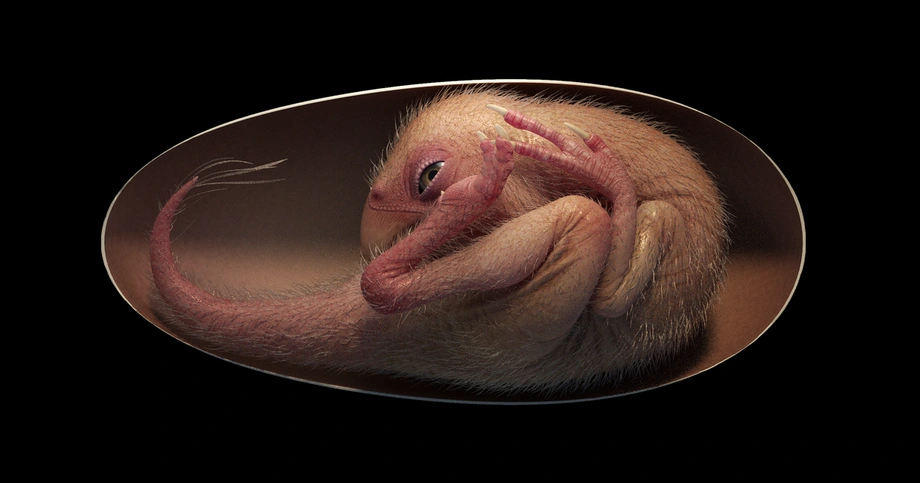
Baby Yingliang measures about 27 centimetres, or 10.6 inches, from head to tail. It lies curled inside an egg 6.7 inches (about 17 centimetres) long, a package small enough to hold in two hands.
Researchers identified the animal as an oviraptorosaur, a toothless member of the theropod group. The name oviraptorosaur means "egg thief lizards", a label given to feathered dinosaurs that lived in what is now Asia and North America during the Late Cretaceous period, between 100 million and 66 million years ago.
Theropod means "beast foot", though theropod feet usually resembled those of birds. Birds are descended from one lineage of small theropods, which is why a dinosaur embryo can tell scientists something about chickens and pigeons. The egg itself is estimated to be between 66 million and 72 million years old.
The pose that scientists did not expect
Baby Yingliang lies in a posture researchers call tucking, its back rounded and its head drawn down toward its body, tucked in tight. Modern bird chicks take a similar shape in the days before hatching, folding themselves into a compact bundle inside the shell, a position that helps them break out when the time comes.
Before this specimen, tucking had been recorded only in birds. The dinosaur in this egg did not fly, and it is the first animal unable to fly in which the posture has been seen.
Steve Brusatte, a professor at the University of Edinburgh and a member of the research team, ranked the fossil among the most striking he has handled.
This dinosaur embryo inside its egg is one of the most beautiful fossils I have ever seen. This tiny, prenatal dinosaur looks like a baby bird coiled in its egg, which is further evidence that many characteristics of today's birds first evolved from their dinosaur ancestors.
Brusatte also wrote on social media that the embryo appeared to be on the brink of hatching when it died and was buried.
A behaviour that may reach back to the dinosaurs
The find suggests that dinosaurs developed postures similar to those of birds before they hatched, and that the way modern birds prepare to leave the egg may have come from dinosaurs that never left the ground. That places a familiar piece of barnyard behaviour deep in the Mesozoic era.
Fion Waisum Ma, a researcher at the University of Birmingham in Britain who studied the embryo, said the behaviour of living birds appears to have started among their dinosaur ancestors.
This indicates that such behaviour in modern birds first evolved and originated among their dinosaur ancestors.
Ma called the specimen "the best dinosaur embryo ever found in history". Its value lies in the combination of a complete, articulated skeleton and a body position that matches what a chick does today. A dinosaur that walked on two legs, had feathers and no teeth, and curled up in the egg the way a chicken does pulls the history of hatching behaviour back past the origin of birds themselves.
Why dinosaur embryos are so rare
Fossilised dinosaur eggs have been collected for about 100 years. Embryos inside them are far harder to find. The bones of an unhatched animal are small and fragile, and the skeleton of a developing dinosaur often comes apart before it can be preserved.
Ma explained what researchers usually confront when they open an egg.
Most known non-avian dinosaur embryos are incomplete with skeletons disarticulated. We were surprised to see this embryo beautifully preserved inside a dinosaur egg, lying in a bird-like posture. This posture had not been recognized in non-avian dinosaurs before.
Baby Yingliang survived because the egg was buried in fine sediment that hardened around the shell and held the delicate bones in place. Even so, part of the dinosaur's body is still covered by rock, and the full skeleton has not yet been seen.
The specimen also shows how much can sit unnoticed in a museum store. The egg spent 10 years in a box before anyone looked closely, and it was a construction project, not a scientific expedition, that brought it to light.
What comes next for the specimen
Researchers plan to use advanced scanning techniques to build an image of the complete skeleton and to map the embryo's internal anatomy, including the parts still locked in stone. No date has been given for when the scans will be completed or published.
The team says the methods used on Baby Yingliang can be applied to other fossil embryos, a small and precious set of specimens that has the potential to show how different dinosaurs grew inside their shells.
The study appeared in iScience, a journal published by the Cell Press group, and combines work by researchers in China, Britain and elsewhere. The fossil is held at the Yingliang Stone Natural History Museum in China.
What the find changes
For palaeontologists, the embryo moves a behaviour once treated as a bird invention into the dinosaur world. Tucking was thought to be part of the toolkit that birds evolved on their own. Baby Yingliang shows an oviraptorosaur, an animal that could not fly, arranging itself the same way, which means the habit was already present among dinosaurs before birds existed.
The specimen also adds a Chinese find to a short list of oviraptorosaur material from Asia, a group known mostly from adult skeletons and from nests of eggs whose contents were rarely preserved.
One animal leaves questions open. The team has a single embryo, and how widely oviraptorosaurs used the tucking position is still unknown. Whether the posture appeared in other dinosaur lines is another question the specimen cannot answer on its own.
What the fossil does offer is a snapshot. A small dinosaur, close to hatching, folded itself into the same shape a chick takes today, 66 million years or more before anyone thought to look inside the egg.
Key Points
- An embryo nicknamed Baby Yingliang was found inside a fossilised dinosaur egg from Ganzhou, Jiangxi Province, in southern China.
- The egg was dug up in 2000 by the Yingliang Group mining company and stored for 10 years before museum staff spotted bones on a broken section.
- The animal is an oviraptorosaur, a toothless theropod dinosaur, and measures about 27 centimetres from head to tail inside an egg 6.7 inches long.
- The embryo is curled in a tucking posture seen in bird chicks shortly before hatching, the first time it has been observed in an animal that could not fly.
- Researchers estimate the egg is between 66 million and 72 million years old.
- The study was published in the journal iScience, and the fossil is held at the Yingliang Stone Natural History Museum.
- Part of the body is still covered by rock, and the team plans scanning work to image the full skeleton and internal anatomy.