A Density Ceiling Gives Way in Hefei
China's Experimental Advanced Superconducting Tokamak, known as EAST, has operated with plasma densities 1.3 to 1.65 times the Greenwald density limit. At the top of that range, the machine ran 65% above a boundary that has shaped tokamak designs for roughly four decades. The work was published in Science Advances and publicly detailed on Jan. 9, 2026.
Contents
- A Density Ceiling Gives Way in Hefei
- Why Density Changes the Fusion Equation
- How EAST Changed Conditions at the Plasma Edge
- What Two Experimental Series Revealed
- What This Changes for Future Reactor Designs
- Hefei Is Building the Supporting Hardware
- Key Dates in China's Fusion Program
- Private Companies and International Projects Add Pressure
- The Engineering Barriers Before Power Plants
- What to Know
The experiments took place in Hefei, Anhui Province, at the Institute of Plasma Physics under the Chinese Academy of Sciences, or ASIPP. Researchers found a way to delay the instability that usually appears as density rises, allowing stable plasma operation in conditions previously considered beyond the normal limit. The result has been presented as a possible route to much greater fusion power without simply building a larger reactor.
ASIPP worked with Huazhong University of Science and Technology and Aix-Marseille University, with support from the National Magnetic Confinement Fusion Project. EAST has been operating since 2006 and serves as an open test platform for Chinese and international scientists. The team did not disclose how long the highest density conditions lasted or provide a fusion power output for the experiment.
Why Density Changes the Fusion Equation
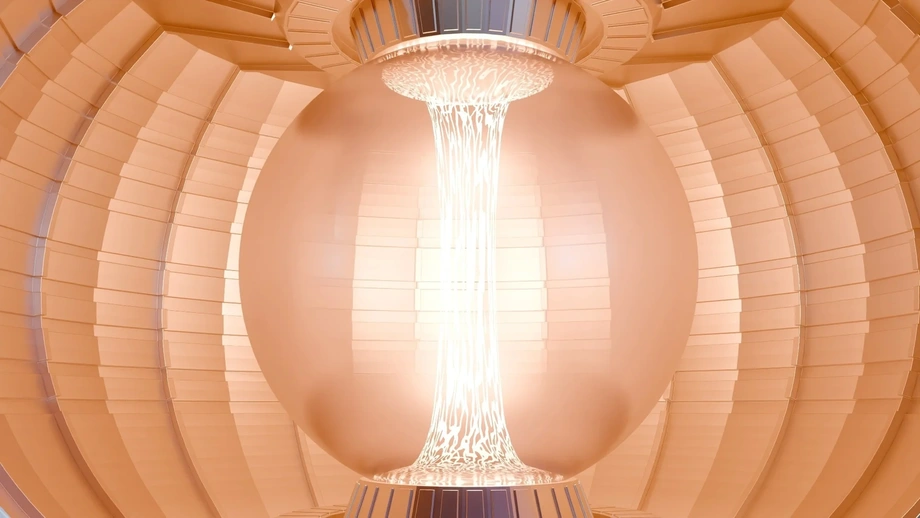
A tokamak uses powerful magnetic fields to hold plasma inside a chamber shaped like a doughnut. Plasma is a gas heated until electrons separate from atomic nuclei. Raising its temperature and density gives those nuclei more opportunities to collide and fuse, releasing energy in the process that powers the sun.
The Greenwald limit is an empirical boundary, meaning researchers derived it from observed machine behaviour rather than from a basic law of nature. It relates the maximum electron density to plasma current and machine size. Crossing that boundary often produces instability and a disruption, in which confinement is lost and energy can strike the inner wall of the machine.
The Lawson criterion explains why density matters so much. It combines density, temperature and energy confinement time to describe the conditions needed for fusion to produce net energy. Confinement time measures how effectively the plasma retains its heat. EAST's advance addresses one part of that combination, while temperature and heat retention still have to be managed.
Under otherwise identical conditions, the fusion reaction rate rises approximately with the square of density because nuclei have more potential collision partners. Across EAST's reported range, the density term alone rises from 1.3^2, or 1.69, to 1.65^2, or about 2.72. That arithmetic explains claims of nearly twice the power from a machine of similar size, although actual output also depends on temperature, fuel composition, confinement and the stability of the entire plasma.
How EAST Changed Conditions at the Plasma Edge
The Hefei team developed a model called boundary plasma wall interaction self organisation, or PWSO. It examines the region where the edge of the plasma meets material surfaces. The researchers identified boundary radiation as a central part of the process that triggers the density limit, connecting the behaviour of impurities, wall materials and plasma stability.
Electron cyclotron resonance heating, known as ECRH, was an essential tool. It uses electromagnetic waves that interact with electrons to heat the plasma and assist its formation. The team combined ECRH with ohmic heating, in which the plasma current itself provides heat, and used a coordinated startup with gas loaded into the chamber in advance.
Control of tungsten contamination provided another part of the method. EAST has a wall made entirely of metal, but plasma particles can knock atoms out of a surface through a process called sputtering. Tungsten entering the plasma increases radiation and carries energy away. By controlling conditions at the target plate and reducing sputtering dominated by tungsten impurities, the researchers produced a cleaner plasma and delayed the breakup associated with the conventional limit.
What Two Experimental Series Revealed
Researchers organised the work around a reference discharge using startup assisted by ECRH and ohmic heating. The toroidal magnetic field, which runs around the chamber, was 2.5 tesla, while ECRH supplied roughly 600 kilowatts. One experimental series changed the pressure of the neutral gas loaded before startup while keeping heating power constant. The other changed ECRH power while holding the initial gas pressure fixed.
Vertical interferometers and bolometers helped the team follow the discharge. Interferometers measure how the plasma affects beams passing through it, providing density information, while bolometers measure radiation. EAST's instruments for density, temperature, radiation and impurities, developed over recent years, allowed the researchers to compare the results with PWSO predictions.
The reported electron density, averaged along the measurement line, ranged from 1.3 to 1.65 × 10^19 particles per cubic metre. The typical operating range given for comparison was 0.8 to 1.0 × 10^19. In scientific notation, 10^19 means a 1 followed by 19 zeros.
Increasing the initial gas pressure raised the accessible density until the improvement reached saturation. That saturation was linked to the available ECRH power rather than an immovable density ceiling, suggesting that additional heating power could support still higher densities. Discharges with similar inputs nevertheless produced different limits, showing that wall materials and surface conditioning also affected the outcome. Stable operation at elevated density was associated with lower impurity radiation, a cleaner plasma and lower temperatures near the divertor target, the region that receives exhaust heat and particles.
What This Changes for Future Reactor Designs
For reactor designers, the result supplies a possible operating method involving heating, gas preparation and control of the plasma boundary. EAST's agreement with PWSO predictions also gives researchers a framework for examining why the old limit appears. The team said the experiments provided the first confirmation of a tokamak regime in which the usual density ceiling no longer applies in the same way.
The researchers also connected their findings to stellarators, another form of magnetic fusion device that uses a different arrangement of magnetic fields. In the research team's own words, the work has relevance beyond EAST and could inform progress toward ignition, the condition in which fusion heating sustains the plasma:
These results demonstrate the potential of a practical scheme for substantially increasing the density limit in tokamaks, which is also germane to the stellarator start-up ... the breaking of Greenwald density limit and the successful access to the density-free regime as demonstrated in this work opens a promising path advancing toward achieving the fusion ignition condition
Scientists still have to show how the method performs under the temperatures, fuel mixtures and sustained operating conditions required by a power plant. EAST's measurements establish a way to improve plasma startup and stability, while the density squared calculation illustrates the design opportunity rather than providing a measured electricity output.
Hefei Is Building the Supporting Hardware
China's wider fusion program extends well beyond EAST. Estimates of Chinese fusion investment since 2023 range from $6 billion to $13 billion, and the national plan covering the five years from 2026 designated fusion a national priority. Hefei hosts several projects intended to turn experimental results into larger machines and industrial capabilities.
The Burning Plasma Experimental Superconducting Tokamak, or BEST, is a $2.8 billion project under construction in the city. Completion is scheduled for late 2027, with a demonstration of fusion power planned around 2030. Its design places 16 coils around the plasma chamber. One coil was completed in August 2026, producing a component weighing 582 tons that was described as the world's largest fusion magnet.
Engineers at Hefei's CRAFT facility are working on materials, magnets and robots capable of performing maintenance remotely. The testbed covers 4.3 million square feet, or 400,000 square metres, and was completed in May 2026. These activities address practical needs that arise after a plasma experiment ends: manufacturing large components, testing whether materials survive extreme conditions and maintaining equipment inside complex machinery.
Key Dates in China's Fusion Program
The projects in Hefei and Shanghai cover two decades of operation, construction and planning:
- 2006: EAST began operation and later developed into an open platform for domestic and international fusion research.
- June 2024: HH70, built by Energy Singularity, achieved its first plasma.
- January 2026: EAST's results beyond the Greenwald limit were publicly detailed, with the research published in Science Advances.
- May 2026: The CRAFT testbed in Hefei was completed.
- August 2026: A coil weighing 582 tons was completed for BEST.
- 2027: BEST is scheduled for completion late in the year, while two private projects target demonstrations of net energy gain.
- Around 2030: BEST is planned to conduct a fusion power demonstration.
EAST therefore occupies the role of an established experimental platform, while CRAFT supplies engineering support and BEST is intended to test burning plasma conditions at a larger scale.
Private Companies and International Projects Add Pressure
Private companies are pursuing different ways to make fusion machines practical. Energy Singularity was founded in Shanghai in 2021. Its HH70 device was described as the world's first tokamak whose magnets all used superconductors designed for relatively high operating temperatures. Such superconductors still require intensive cooling, but they can carry large currents and support strong magnetic fields.
HH70 first produced plasma in June 2024. By early 2026, controls based on artificial intelligence had kept its plasma running for more than 13 seconds. The next machine from Energy Singularity and SPARC, being developed by Commonwealth Fusion Systems, both target demonstrations of net energy gain in 2027.
Net energy gain in these plans means producing more fusion energy than the energy supplied to heat the plasma. A working power station must also operate its magnets, pumps, heating systems and other equipment. EAST's work sits within this broader international effort, which also includes ITER in southern France and TAE Technologies.
Public reaction to the Chinese result mixed enthusiasm with scepticism. One viewer praised investment flowing back into infrastructure, while another joked that fusion was now only 35 years away. The exchange reflects the gap between a clear experimental advance and the longer process of building a reliable electricity plant.
The Engineering Barriers Before Power Plants
Three problems recur across the program: maintaining the machine, producing enough tritium fuel and protecting reactor walls from extreme heat. Tritium is a scarce radioactive form of hydrogen. A plant using deuterium and tritium fuel would need to breed tritium through reactions involving lithium and fusion neutrons, producing enough fuel while the reactor operates.
Wall conditions were already important in EAST's density experiments, but a power plant would expose materials to much harsher and longer operating conditions. Engineers must control impurities and exhaust heat while designing components that can be repaired or replaced. CRAFT's work on robots for remote maintenance addresses part of that requirement.
The next dated milestones are the private net energy demonstrations targeted for 2027, BEST's scheduled completion in late 2027 and its planned demonstration around 2030. No date for commercial fusion electricity was given.
What to Know
- EAST reached plasma densities of 1.3 to 1.65 times the Greenwald limit, placing the top result 65% above that boundary.
- ASIPP led the work in Hefei with Chinese and French university collaborators, and the results appeared in Science Advances.
- ECRH, controlled startup and reduced tungsten contamination helped researchers delay instability at the plasma edge.
- The reference experiments used a magnetic field of 2.5 tesla and roughly 600 kilowatts of ECRH power.
- Available heating power and wall conditions influenced the accessible density, while no duration or fusion power output was disclosed.
- Hefei's BEST project costs $2.8 billion, uses 16 coils and is scheduled for completion in late 2027.
- HH70 and SPARC are part of a wider private and international fusion effort, with net energy demonstrations targeted for 2027.
- Maintenance, tritium production and extreme heat at reactor walls remain major engineering tasks.