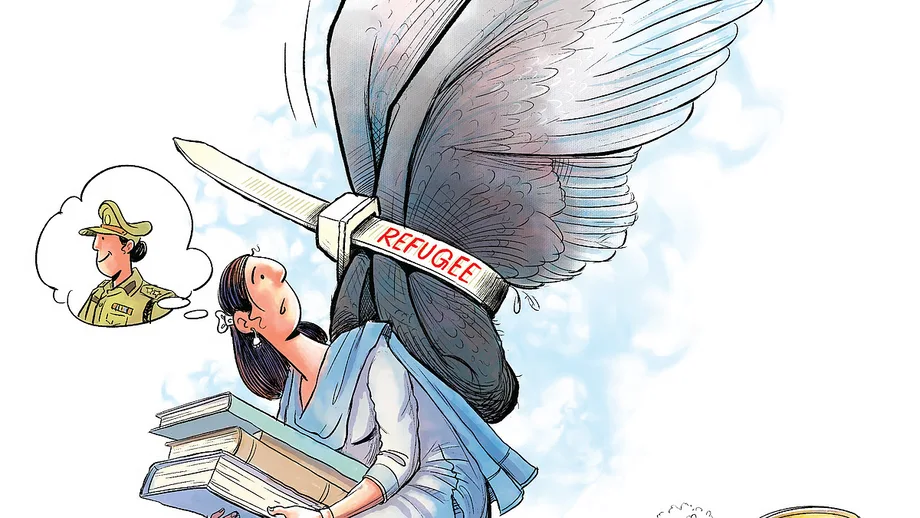
Childhood ends at the camp gate
Saieesan S arrived at Mandapam Camp in Ramanathapuram carrying his Class 8 textbooks. Those books marked the moment a comfortable family life in Jaffna became a refugee childhood in Tamil Nadu. His mother, once a government school teacher in Sri Lanka, took work at construction sites and fisheries, earning Rs 100 to Rs 150 a day.
Contents
- Childhood ends at the camp gate
- A timeline of flight, return and renewed uncertainty
- School results open one door, counselling closes another
- Why a job offer can still turn into a rejection
- The warning on the first day at college
- Born in India, still asked to prove a home
- Inside 10 by 10 foot homes, school becomes a lifeline
- War trauma meets current pressure
- A 22 minute film brings three generations into view
- What remains undecided for students, workers and families
- Key Points
As India marks Children's Day in November, the stories of Sri Lankan Tamil refugees in Tamil Nadu show how war reaches far beyond the fighting. It leaves lost school years, separated families, displacement, anguish and a weak sense of belonging. Young adults who arrived as children still carry fragments of childhood. Those born in Indian camps face a different problem: they know only India as home, but their legal status keeps asking them to prove where they belong.
Saieesan, who reached Mandapam Camp with his Class 8 books and later joined Tata Consultancy Services, described the change in his mother's work.
It was heartbreaking for me to see my mother, who had worked as a government school teacher in Sri Lanka, take up menial jobs at construction sites and fisheries. She earned Rs 100-Rs 150 a day. Having a good meal was a luxury.
For children in such homes, education becomes more than a classroom routine. It is the route their parents hope will restore dignity after a life turned upside down. In refugee lives, dignity often means stable work, legal papers, a safe home and the freedom to plan without asking permission at every step.
A timeline of flight, return and renewed uncertainty
The lives described here stretch across more than two decades, so the dates matter. They show how a war that ended years ago still shapes school admissions, job documents and family decisions.
- 2006: Sharmilan Vipokan arrived in Tamil Nadu on his sixth birthday and grew up around Puzhal Camp.
- 2009: After the war in Sri Lanka ended, returns to Sri Lanka continued for years.
- Last year: Returns were temporarily suspended after some returnees were reported to have been interrogated.
- August 2026: The Sri Lankan government issued a fresh announcement asking Sri Lankan Tamils living in India to return.
- September and October 2026: The United Nations High Commissioner for Refugees said only eight people returned to Sri Lanka from Tamil Nadu. About 30 more expressed willingness to return, with processing at different stages.
- November 2026: A documentary on refugee life won an international award, bringing new attention to camp residents whose ambitions often depend on documents they do not hold.
The United Nations High Commissioner for Refugees, often called UNHCR, handles travel arrangements and basic assistance for people returning. The number willing to return was about four times the number who returned in those two months. That gap matters. It shows that the decision to go back is shaped by safety, documents and family ties as well as by an official invitation.
School results open one door, counselling closes another
Saieesan's school record should have made the next step easier. He scored the second-highest marks among government school students in his district in the Class 12 examinations. In Indian admissions, counselling means the process that allots college seats after exam results. Through that process, he could not get an engineering seat, and he says he was not eligible for a medical seat.
His route ran through a scholarship instead. The STARS scheme, a scholarship path, helped him win a B.Tech seat at VIT in Vellore. He later secured a job with Tata Consultancy Services, a large technology company. For a young refugee whose mother once earned a daily wage at construction sites and fisheries, that path shows what education can do when a scholarship is available.
Saieesan, now a technology employee who has studied in India's higher education system, explained the document he had to submit at work.
I had to submit a self-declaration stating that I'm a refugee and do not have a work permit or a passport and would not be able to travel abroad.
A self-declaration is a written statement a person signs to confirm facts about themselves. In this case, it recorded the problem in an office file: no work permit, no passport and no ability to travel abroad, even after a college degree and a job offer.
Why a job offer can still turn into a rejection
Sharmilan Vipokan received offers from multinational companies, but the final stage became difficult. Onboarding is the process that turns an offer into employment by checking identity, qualifications and work documents. For Sharmilan, it meant visits to the Taluk office and Ezhilagam (Commissionerate of Rehabilitation and Welfare) to seek reference letters, recommendation letters or other supporting documents.
A passport is a travel document issued by a country. A work permit is official permission to take a job. Without either, a company's verification team may pause a file even when the applicant has cleared interviews. Sharmilan says he has to repeat the process whenever he considers changing jobs. That turns a normal career move into a fresh administrative task.
Sharmilan, a Puzhal Camp resident who has reached the final rounds of company recruitment, described what happens when documents are checked.
After reaching the final rounds of recruitment, my profile would be put on hold during the document verification process. I have been rejected several times solely because of my nationality.
His experience shows the practical cost of uncertain status. A student can study, a graduate can apply and a company can offer work, but the absence of recognised papers can still stop the person at the door.
The warning on the first day at college
Sharmilan arrived in Tamil Nadu on his sixth birthday in 2006. He had to learn a different dialect of Tamil, and Puzhal Camp and its surroundings gradually became his whole world. College seemed distant until Loyola College admitted him under a provision for refugee students and offered fee concessions, or reduced fees. He enrolled in BSc Computer Science.
The first day included an ice-breaking session, a common college activity where students introduce themselves. Until then, Sharmilan says, he had not experienced open exclusion. After he said he was a Sri Lankan refugee, a professor made a remark that stayed with him through college.
Sharmilan, who studied BSc Computer Science at Loyola College, recalled what the professor said in front of the class.
After I introduced myself as a Sri Lankan refugee, my professor told me in front of the entire class that I would be expelled if I ever got into any trouble.
Sri Lanka remained present in his memory through both fear and affection. He remembers gunshots near his home and also outings with grandparents and happy moments with friends.
Sharmilan, who left Sri Lanka as a young child, recalled the moment war entered his home.
I was five years old and playing with my mother when I heard war announcements, followed by loud gunshots in the backyard of our home.
That memory explains why school and work are never merely private goals for refugee families. Each achievement carries the weight of a childhood interrupted by events no child chose.
Born in India, still asked to prove a home
Nansika was born at Thenpallipattu Camp in Tiruvannamalai district. She has no clear memory of Sri Lanka. Her idea of the country comes from her parents' stories about land they once owned and from visits by relatives on her mother's side. For a child growing up in a camp, home can be a place on a register as much as a place on a map.
Nansika is 21, a karate player at the national level and a former karate teacher at schools. After graduation, she found work in the human resources department of a clothing store. She also wants to sit the UPSC examinations and become an IPS officer. The UPSC exams are India's national competitive exams for civil services; the IPS is the Indian Police Service.
Nansika, who was born in Thenpallipattu Camp and now balances work, sport and exam preparation, explained how she sees her goal.
Despite the uncertainty surrounding my citizenship status, my regular sports practice is also a way of preparing for my dream of taking the UPSC exams and becoming an IPS officer.
Every so often, Nansika and her parents must return to the camp for periodic verification. Her father works as a painting contractor in Ooty, and her mother works as a caretaker in Dharmapuri. They fear that if they miss a check, their names could be removed from the camp register. That register is the official list linking a family to camp facilities and aid, so a missed check can carry real consequences.
Inside 10 by 10 foot homes, school becomes a lifeline
V Nikitha was born at Thenpallipattu Camp too. At 17, she is studying B.Com at VELS University through a scholarship. She says many young people in the camps leave school after a certain point because work looks easier than continuing their studies. The pull is strong when a family has little space, few documents and urgent bills.
Nikitha, a B.Com student born at Thenpallipattu Camp, described the gap between being born in India and having full opportunity here.
We are born here but are denied access to many opportunities.
Her description of home is exact: the government houses measure 10 by 10 feet and can hold only two or three people. Such a room shapes daily life. It affects sleep, study, privacy and the chance to invite friends or relatives. After her degree, Nikitha hopes to study fashion design and open a boutique. She wants the camp to be a chapter that ends.
Nikitha, who has lived in a government camp house, explained what leaving would mean.
The houses we live in can accommodate only two or three people. We need to move out of the camps to live freely. Once we step out, there should be no looking back.
One of her classmates shows why dropping out can become a family decision rather than a personal choice. The boy lost his mother, his father was dealing with alcoholism and two siblings depended on him. He left school and took up painting work, then became willing to take any job that paid. The informal labour sector, where work is often casual and not registered, can be quicker to enter than formal employment, but it usually offers less protection.
War trauma meets current pressure
Refugee distress often begins with violence, loss and forced displacement. Research among Sri Lankan Tamil and Rohingya communities in India has found that the pressure continues through present conditions: legal uncertainty, limits on employment, poor camp conditions, stigma and barriers to healthcare. Stigma means people may be treated as less worthy because of their identity, which can make them avoid asking for help.
Protracted displacement is the term for a refugee situation that lasts for years and stretches across generations. In such a situation, children may grow up with parents who are still waiting for security. They may become adults with school certificates and job skills but without the documents that make those achievements useful.
The research proposes a practical response. It calls for training community members and health workers to notice signs of distress, offer basic support and connect people with professional mental health services. It also gives refugee leaders and trained local workers a central role in shaping care, because people are more likely to seek help when workers understand their language, camp life and fears about authorities.
For Tamil Nadu's camps, mental health support cannot be separated from papers, work and housing. A young person told to report for verification, a graduate told to sign a declaration about a missing passport and a family living in a small camp house all face stresses that are social and administrative as well as personal.
A 22 minute film brings three generations into view
Faceless People: The Journey of Sri Lankan Tamil Refugees in India won Best Documentary Short at the 8th International Film Festival The Hague (IFFH) in the Netherlands. The award was announced at the festival's closing ceremony in November 2026. The Tamil documentary runs 22 minutes and was filmed over a year across refugee camps in Tamil Nadu.
The film profiles six refugees from three generations. Some are young people born in India who have never visited the land their families call home. Others are older refugees who left Sri Lanka during the civil war more than three decades ago. Their accounts cover citizenship uncertainty, limited opportunities, identity and the feeling of being caught between two countries.
R.K. Radhakrishnan directed the film. A.S. Vijitharan wrote it, and Meena Mohan, Swathi Mohan and Michael Leo Valan produced it. It was also selected as a finalist at the European Short Film Festival in Oslo. The title refers to the invisibility many refugees feel when public discussion turns their lives into categories rather than people.
The recognition gives the same issues a different stage. Viewers outside Tamil Nadu can see what a verification visit means, what a camp room looks like and why a passport matters to someone who has never left India. That attention can widen the audience for refugee stories and keep the daily tasks of the families in view.
What remains undecided for students, workers and families
The young people described here are not waiting for ambition. Saieesan has a degree, a job and a scholarship route. Sharmilan has a college education and company offers. Nansika has work, sport and a plan for national exams. Nikitha has a university place and a business idea. What remains uncertain is whether their qualifications can be used freely.
Citizenship, passports, work permits and verification rules remain the unresolved questions. No date was given for a change in citizenship rules, work permit rules or the next verification round. For people planning exams, job changes or weddings, a rule with no timetable can be as disruptive as a refusal.
Returns to Sri Lanka are part of the same uncertainty. In August 2026, Sri Lanka called on Sri Lankan Tamils in India to return. In September and October, eight people did. About 30 others said they were willing, with processing at different stages. UNHCR manages arrangements and basic help for returnees, but the figures show how few people have taken that step since the pause after last year's interrogation reports.
For now, Tamil Nadu's camps remain homes, checkpoints and waiting rooms at once. Children's Day may be marked each November with games, speeches and promises about the future. For these young adults, the future is already under way in classrooms, offices, karate practice and small camp rooms. The fight for belonging is the daily work of studying without certainty, applying without papers and building a life while being asked, again and again, to explain where home is.
Key Points
- Saieesan S reached Mandapam Camp with Class 8 books, later studied at VIT through STARS and joined Tata Consultancy Services, but had to declare that he had no work permit or passport.
- Sharmilan Vipokan arrived in Tamil Nadu on his sixth birthday in 2006 and faced document checks, repeated permission letters and rejections tied to his nationality.
- Nansika was born at Thenpallipattu Camp, works in human resources, practises karate and wants to become an IPS officer despite citizenship uncertainty.
- V Nikitha, 17, studies B.Com at VELS University on scholarship and wants to leave a government camp house measuring 10 by 10 feet.
- Only eight people returned from Tamil Nadu to Sri Lanka in September and October 2026, while about 30 others expressed willingness.
- A documentary on Sri Lankan Tamil refugees won Best Documentary Short at the 8th International Film Festival The Hague in November 2026.
- Research on refugee communities in India links mental distress to legal uncertainty, work restrictions, poor camp conditions, stigma and barriers to healthcare.