A Single Morning Puts Five Counties on China's Rail Map
The first trains on three new lines in Anhui Province left their platforms between 10:01 am and 10:33 am on November 27, and with them five counties that had never been served by high-speed rail joined the network. The Chaohu to Ma'anshan, Huaibei to Bengbu and Huaibei to Fuyang lines entered service on the same day, adding about 364.5 km of new main line built for trains running at 350 km per hour.
Contents
- A Single Morning Puts Five Counties on China's Rail Map
- Which Lines Opened, and How Big Are They
- The Counties That Had Never Had a High-Speed Station
- What the Timetable Actually Delivers
- How the New Track Plugs Into the National Network
- Why the Delta Cares About 364 Kilometres of New Track
- The Winter Tourism Bet Behind the Opening
- Bridges, Tunnels and the Engineering Behind the Numbers
- What Is Not Settled Yet
- Key Points
China Railway Shanghai Group, which runs the network in the region, put tickets on sale from 19:30 on November 26, the evening before departure. Staff posed for photographs in front of train G9526, the first service on the Chaohu to Ma'anshan line, at Ma'anshan South station, while passengers wandered the new waiting hall with phones raised at the departure boards.
The numbers behind the morning are large. High-speed rail mileage across the Yangtze River Delta, the economic region made up of Shanghai and the provinces of Jiangsu, Zhejiang and Anhui, now exceeds 8,500 km. Total railway mileage in the region is above 15,800 km. Anhui alone has passed 3,300 km of high-speed line, reaching 16 cities and 44 counties.
Railway officials described the simultaneous opening as a first in the history of rail construction in the delta: three lines built in one push and put into use on one day.
Which Lines Opened, and How Big Are They
The three projects are short by the standards of China's long trunk corridors, but each fills a gap rather than duplicating an existing route. The Chaohu to Ma'anshan line, known locally as Chaoma, runs west from Chaohu East station to Ma'anshan East, about 61 km of new main line, with 24 bridges and six tunnels taking up 79.6 percent of the alignment. It has five stations, three of them new: Hanshan, Zhengpugang and Ma'anshan South.
The Huaibei to Bengbu line, or Huaibeng, heads south from Huaibei North through the cities of Huaibei, Suzhou and Bengbu to Bengbu South. Its new main line runs about 161 km, with 23 bridges and one tunnel making up 89.9 percent of the route. Four of its six stations are new: Huaibei West, Suzhou West, Shuangduiji and Guzhen South.
The Huaibei to Fuyang line, Huaifu, begins at Shuangduiji on the Huaibeng route and runs southwest through Mengcheng and Lixin in Bozhou and Yingquan in Fuyang to Fuyang West. About 142.5 km of new main line carries 14 bridges covering 88.98 percent of the route. Mengcheng, Lixin and Yingquan North are new stations, while Fuyang West has been expanded.
Initial service is modest on the shortest line and heavy on the busiest. Timetables list 8 trains a day on Chaoma, 46 on Huaibeng and 18 on Huaifu, all of them cross-line services that continue onto other routes rather than shuttling back and forth on the new track. That gives the three lines 72 daily trains between them from the first day.
The Counties That Had Never Had a High-Speed Station
He County, which sits under the city of Ma'anshan on the northern bank of the Yangtze, now has a station on the Chaoma line. Suixi County under Huaibei and Guzhen County under Bengbu are served by the Huaibeng line, while Mengcheng and Lixin counties under Bozhou sit on the Huaifu route.
For residents of these five places, the change is measured in minutes rather than kilometres. Trips to Shanghai, Hangzhou, Nanjing, Hefei and Suzhou that once meant a bus to a distant station and a change of train become direct journeys. Railway officials say the new lines create multiple fast paths linking the Hefei and Nanjing metropolitan areas with the central cities of the delta.
Anhui's high-speed map had long been shaped like a cross centred on Hefei, with the north of the province served thinly. The three lines thicken that picture, and the Huaifu route in particular closes a missing horizontal link across northern Anhui that had forced travellers onto slower track or long detours.
What the Timetable Actually Delivers
The travel times released with the opening give the clearest sense of what changes. Ma'anshan East to Hefei station takes as little as 1 hour 7 minutes, Zhengpugang to Hefei 47 minutes and Hanshan to Hefei 34 minutes, turning the provincial capital into a commutable destination for the eastern part of the province.
From Huaibei West, the fastest trains reach Nanjing South in 1 hour 37 minutes, Shanghai Hongqiao in 3 hours 6 minutes and Hangzhou West in 4 hours 3 minutes. Suzhou West, further south on the same line, does the same trips in 1 hour 21 minutes, 2 hours 49 minutes and 3 hours 46 minutes.
Northbound and westward connections have also shifted. Guzhen South to Hefei takes 57 minutes, Suzhou West to Hefei 1 hour 9 minutes and Huaibei West to Hefei 1 hour 26 minutes. Lixin and Mengcheng reach Hefei in 1 hour 26 minutes and 1 hour 15 minutes. Fuyang West to Huaibei West takes 1 hour 13 minutes, with Lixin at 52 minutes and Mengcheng at 37 minutes, and the same three stations reach Bengbu South in 1 hour 11 minutes, 50 minutes and 35 minutes.
The single biggest change for Huaibei is directional. Trains heading south from the city no longer have to swing east through Xuzhou in Jiangsu to find a north-south trunk line, a detour that had added distance and time to almost every journey toward the Yangtze.
How the New Track Plugs Into the National Network
None of the three lines stands alone. The engineering brief sets out where each one hands passengers on to older, longer corridors.
- Chaoma joins the Hefei to Hangzhou line at Chaohu East and the Nanjing to Anqing line at Ma'anshan East, giving Ma'anshan a direct link to Hefei.
- Huaibeng connects at Huaibei North to the Zhengzhou to Xuzhou line through a connector at Huaixiao, at Bengbu South to both the Beijing to Shanghai line and the Hefei to Bengbu line, and at Shuangduiji to the Huaifu route.
- Huaifu meets the Shangqiu to Hefei section of the Beijing to Hong Kong corridor and the Zhengzhou to Fuyang line at Fuyang West, and links to Huaibeng at Shuangduiji.
Yang Xiuzhi, an engineer with China Railway Shanghai Group, summed up what the junctions do for the wider grid. "The openings of the three lines reduce travel time between cities and tighten links of existing high-speed routes," Yang said.
The practical effect is redundancy. Passengers between northern Anhui and the Yangtze cities can now choose among several paths rather than a single route, which matters when a line is closed for maintenance or a busy holiday timetable strains capacity.
Why the Delta Cares About 364 Kilometres of New Track
The Yangtze River Delta accounted for nearly a quarter of China's GDP in 2025 and hosts 26 national advanced manufacturing clusters. Its industrial strengths run across integrated circuits, new energy vehicles, biomedicine, aviation equipment and new materials.
Each city on the new lines fits into that economy differently. Hefei brings science and technology research, Huaibei works in aluminium-based materials, Fuyang in green food processing, and Ma'anshan in steel and smart manufacturing. Faster rail is meant to let factories, suppliers and skilled workers move between them without a full relocation.
Railway planners describe the projects as work to fill gaps and strengthen links in the delta network, and officials expect them to deepen integration by giving smaller county cities the kind of fast connection to major hubs that larger cities already had. Anhui's northern cities have long supplied labour and raw materials to the coast; the new lines give them a way to compete for investment that would otherwise settle closer to Shanghai or Nanjing.
The Winter Tourism Bet Behind the Opening
Local governments around the new stations have already added direct bus shuttles from rail hubs to tourist sites, an attempt to catch passengers before they hire cars or give up on a trip. The timing, at the start of the winter season, is deliberate.
Anhui's new lines thread together the revolutionary history of the north of the province, the Zhuangzi cultural tradition associated with Mengcheng, and the river landscape around Ma'anshan, a city known for its poetry. Ten new stations were designed on what the railway calls a one station, one scenery principle, with architecture tied to local landscape, history and revolutionary heritage.
Similar effects are being reported on routes that opened two months earlier. The Xikang and Hayi high-speed lines have been pulling winter visitors into the Qinba mountain area, where passenger volumes rose sharply compared with a year earlier and operators have put hot spring and folk experience packages on sale for travellers who avoid peak dates. In Yichun in Heilongjiang, snow and ice tourists have been arriving earlier than usual, and operators have brought new attractions forward before the high season.
Nationwide, more than 1,900 km of new railway lines have been put into service this year, according to the latest figures from the national railway operator, with investment in rail construction still growing.
Bridges, Tunnels and the Engineering Behind the Numbers
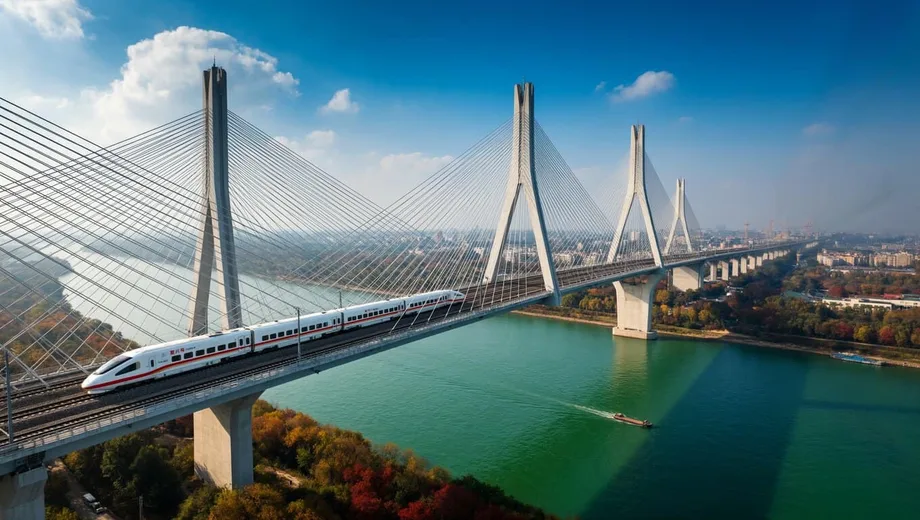
The proportion of each line carried on bridges or through tunnels explains why 364.5 km of track took years to build across mostly flat farmland. On Chaoma, 79.6 percent of the route runs over bridges or through tunnels, including the crossing of the Yangtze on the Ma'anshan road and rail bridge. On Huaibeng and Huaifu the shares rise to 89.9 percent and 88.98 percent, because elevated track avoids cutting farmland and local roads into small pieces and keeps the alignment straight enough for 350 km per hour running.
The construction units reported that the work required new techniques, new processes and new equipment to get through the technical problems on the routes, and railway authorities present the projects as a test bed for newer construction methods as much as a transport scheme.
What Is Not Settled Yet
Fares are not fixed. The railway will apply a flexible, market-based pricing system with discounts on the three lines, with actual prices to be checked on the 12306 booking site and app. No figure has been published for a standard full fare.
The timetable will also change. Railway authorities say more trains will be added on all three lines according to demand when the national schedule is adjusted in the first quarter of next year, so the initial count of 8, 46 and 18 daily trains is a starting point rather than a ceiling.
Key Points
- Three lines opened in Anhui on November 27: Chaohu to Ma'anshan, Huaibei to Bengbu and Huaibei to Fuyang, adding about 364.5 km of new main line at a design speed of 350 km per hour.
- Five counties gained high-speed rail for the first time: He County under Ma'anshan, Suixi under Huaibei, Guzhen under Bengbu, and Mengcheng and Lixin under Bozhou.
- Yangtze River Delta high-speed rail mileage passed 8,500 km, and total railway mileage in the region passed 15,800 km; Anhui now has more than 3,300 km of high-speed line across 16 cities and 44 counties.
- Initial service is 8 trains a day on Chaoma, 46 on Huaibeng and 18 on Huaifu, all cross-line services.
- Ma'anshan East to Hefei takes as little as 1 hour 7 minutes; Huaibei West to Nanjing South 1 hour 37 minutes, Shanghai Hongqiao 3 hours 6 minutes and Hangzhou West 4 hours 3 minutes.
- Huaibei no longer needs to route southbound trains through Xuzhou, and Fuyang and Bengbu strengthen their roles as regional hubs.
- Tickets went on sale from 19:30 on November 26, with flexible discounted pricing and prices listed on the 12306 platform.
- More trains are due at the first-quarter timetable adjustment next year; no date has been given for that change.
- China has put more than 1,900 km of new railway lines into service this year, and the Xikang and Hayi lines opened about two months earlier are drawing winter tourists.