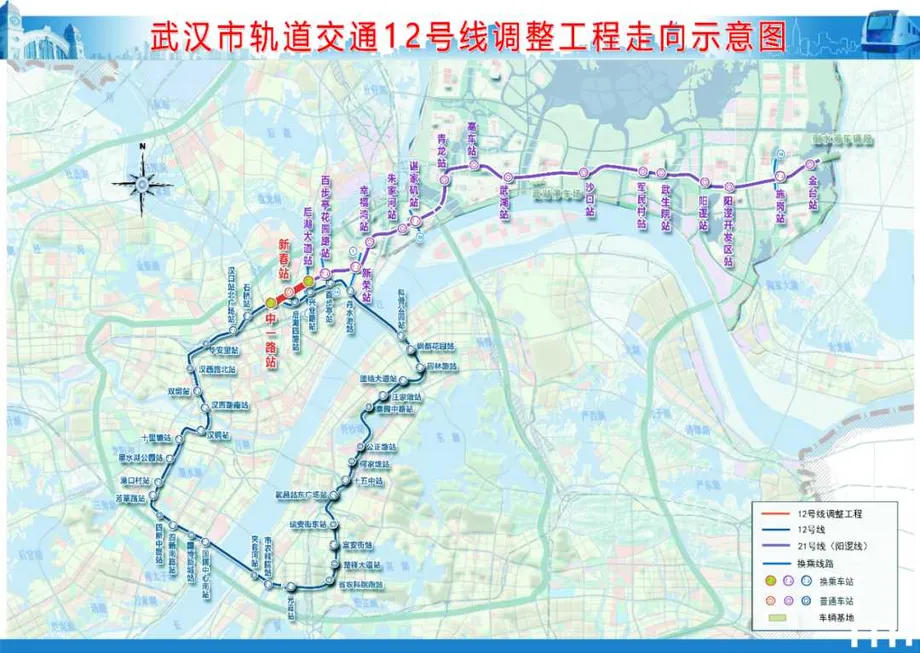
A 59.9 kilometre circle joins Wuhan's divided city
Wuhan opened the full length of Metro Line 12 at 9:29 a.m. on October 29, 2026, completing a 59.9 kilometre underground loop that connects seven central districts and two major railway stations. Its 37 stations give passengers new routes across a city divided by the Yangtze and Hanjiang rivers.
Contents
- A 59.9 kilometre circle joins Wuhan's divided city
- Two openings, followed by a new timetable
- Seven districts gain a shared route
- Thirteen interchange stations, with different transfer arrangements
- Hankou passengers can now leave from the north
- The Yangluo Line reaches the central loop
- Building beneath rivers and operating railways
- Automation reaches beyond driving the trains
- A special train uses carbon fibre and smart windows
- Key Points
The China Association of Metros identifies Line 12 as China's longest metro loop. Wuhan's transport authorities also describe it as Asia's longest and the world's second longest. A complete circuit takes about 96 minutes, with connections to 11 other operating metro lines.
The opening brought the city's operating metro network to 581 kilometres and 351 stations, according to the Wuhan municipal government's Line 12 opening announcement. A connecting section opened on the same day, extending the Yangluo Line into the central network.
For passengers, the biggest change is the shape of the journey. Routes that previously required travel toward the city centre, followed by a transfer and another river crossing, can now use the loop to travel between outer parts of the central city. People arriving by train at Hankou or Wuchang can join the same metro line to reach districts on different riverbanks.
Two openings, followed by a new timetable
Line 12 entered service in stages. The first section opened on May 1, 2026, while the 24.64 kilometre second phase completed the circle on October 29. The two sections now operate together as one route.
The first phase measured about 35.3 kilometres, nearly three fifths of the completed line. The October opening supplied the remaining two fifths and, crucially, connected both ends of the earlier section.
- May 1, 2026: The first section of Line 12 began carrying passengers.
- October 29, 2026, at 9:29 a.m.: The second phase opened, completing the loop. The connecting section to the Yangluo Line opened simultaneously.
- October 30, 2026: The published weekday and rest day operating schedules took effect.
Seven districts gain a shared route
Line 12 runs through Qiaokou, Jianghan, Jiang'an, Qingshan, Hongshan, Wuchang and Hanyang. It is the first Wuhan metro line to connect all seven central districts, bringing residential neighbourhoods, business areas and the Hankou and Wuchang railway hubs onto a single route.
Wuhan's three main urban areas, Hankou, Wuchang and Hanyang, lie around the meeting of the Yangtze and Hanjiang. A trip that looks short on a map may still require a river crossing and a choice between several bridges, tunnels or metro routes. Line 12 crosses beneath the Yangtze twice and the Hanjiang once, making those crossings part of a continuous circuit.
The loop also changes how existing lines work together. Lines running outward from central areas can exchange passengers through Line 12, allowing some journeys to avoid busy central transfer stations. Wuhan authorities expect fewer transfers, shorter commutes and some relief on crowded sections during peak periods.
No measured figures for journey time savings or changes in crowding were released with the opening announcement. The immediate practical benefit is a wider choice of routes, with direct travel between more stations on different sides of the rivers.
Thirteen interchange stations, with different transfer arrangements
Line 12 has 13 interchange stations connecting with 11 operating lines. Eight interchange stations belong to the newly opened second phase and five to the first phase. Passengers need to check the transfer arrangement at their chosen station because some connections require leaving the paid area and entering another station.
Five second phase stations provide transfers through passages inside the station: Kepu Gongyuan, or Science Park, to Line 5; Zhongyi Road to Line 8 and the Yangluo Line; Shiqiao to Line 6; Shuangdun to Line 3; and Shilipu to Line 4.
The other three second phase interchanges use transfers outside the paid area: Danshuichi connects with Line 1, Xingye Road with Line 3, and Hankou Station North Square with Line 2. These are described as virtual transfers, meaning the fare system can recognise an eligible exit and reentry as a continuing journey.
The first phase provides connections at Guobo Centre South to Lines 6 and 16, Guangxia to Line 5, Wangjiadun to Line 8, and Yuanlin Road to Line 4. At Wuchang Station East Square, passengers can transfer inside the station to Line 11, while connections to Lines 4 and 7 use virtual transfers.
The longer term network plan gives Line 12 connections to 18 existing and planned lines. For journeys at the opening, the useful figure is 11 operating lines; the larger figure includes connections dependent on future network development.
Hankou passengers can now leave from the north
Hankou railway station's north square exit opened alongside the completed metro loop. The north square had previously allowed passengers to enter the railway station but not leave it. Arriving passengers can now exit there and reach Line 12, while the south square connects with Line 2.
The Wuhan Transport Bureau's opening day update explains the arrangements. Passengers heading toward areas such as Houhu, Qingshan and Hanyang can choose the north exit for Line 12 rather than leave through the south square and then travel around the railway station.
Line 2 and Line 12 occupy opposite sides of Hankou railway station, without an internal metro passage between them. Passengers transferring between the two must use the same ticket, card or travel code and exit one station and enter the other within 45 minutes to receive continuous fare calculation.
The railway station's north and south square entrances normally remain open around the clock, although the south square underground entrance retains its 7 a.m. to 7 p.m. hours. Railway exits open during train operating hours. The north square ground entrance had already switched to 24 hour opening on September 20; October 29 added the ability to exit there.
The Yangluo Line reaches the central loop
A 3.12 kilometre connecting section opened on October 29 with two underground stations, Zhongyi Road and Xinchun. It operates together with the Yangluo Line, extending that route westward and bringing its total length to 38.12 kilometres with 18 stations.
The extension gives Yangluo New City and the Wuhan Yangtze River New Area a more direct connection to the central metro network. At Zhongyi Road, passengers can change to Line 12 and continue toward Wuchang railway station, Hanyang or Qingshan with fewer transfers.
Zhongyi Road uses a twin island platform arrangement for Line 12 and the Yangluo Line, allowing transfers across the platform. An island platform has tracks on both sides, so a passenger can leave one train and walk across to another instead of changing floors or following a long corridor. The announced transfer time to Line 8 is no more than three minutes.
From October 30, Line 12 operates from 6 a.m. to 11 p.m. on weekdays and from 6:30 a.m. to 11 p.m. on rest days. The Yangluo Line, including the connecting section, starts at 6 a.m. on weekdays and 6:30 a.m. on rest days. Its final departures are at 10 p.m. from Jintai and 10:30 p.m. from Zhongyi Road. Separate schedules will be announced for national holidays and other special circumstances.
Building beneath rivers and operating railways
Line 12's river crossings required construction through ground exposed to high water pressure, water bearing sand and changing layers of rock. The route also passes beneath Shahu Lake and through densely built central districts, where excavation had to be controlled around buildings and existing transport infrastructure.
The roughly four kilometre tunnel between Science Park and Danshuichi provides a direct connection between Qingshan and Jiang'an on opposite sides of the Yangtze. The State Council's State owned Assets Supervision and Administration Commission identifies it as China's longest metro tunnel crossing the river. A crossing tunnel on the route reaches a lowest point 71.4 metres below the river surface.
China Railway 14th Bureau Group built the Science Park to Danshuichi tunnel. Dense sand wore down cutting tools, while mudstone could clog the cutting head of the tunnel boring machine. These machines dig underground while supporting the ground around the excavation. Teams adapted the equipment and monitored conditions near river embankments, railway lines and other structures.
Another section, built by China Railway 11th Bureau Group, passed beneath elevated roads, an existing railway and three operating metro lines. At the closest point, a new tunnel came within 2.65 metres of an existing metro tunnel. Eight tunnel boring machines worked at different locations along that section.
Construction teams tracked ground movement in real time and carefully controlled excavation and grouting, the injection of material to fill gaps or strengthen the ground. Ni Zhengmao, who oversees shield tunnelling for the company responsible for Line 12's construction and operation, identified the launch and arrival of tunnelling machines as particularly risky stages. Checks covered reinforced ground, entrance seals and monitoring arrangements.
Automation reaches beyond driving the trains
Line 12's trains can automatically start up, run checks, leave the depot and return after service, according to the design team at CRRC Changchun Railway Vehicles. Staff at the control centre can also take remote control of trains.
Xiong Chaohui, the project's chief designer and deputy chief engineer at China Railway Siyuan Survey and Design Group, described how automation shaped the design:
From the design stage, we built full automation into every operating scenario,
Designers refined 11 automated operating scenarios to suit heavy passenger flows, frequent departures and closely timed transfers. The system can adjust the intervals between trains during peak periods, giving operators a way to respond to demand.
A central monitoring centre combines information from trains, signalling, communications equipment and platform doors. Maintenance staff can diagnose faults and use remote restart devices at the centre and equipment hubs along the line.
Dong Ming, an operations technician, explained the work those devices replace:
In the past, when equipment had a problem, maintenance staff members had to take a taxi to the site in the middle of the night to restart it,
A special train uses carbon fibre and smart windows
One train introduced at the opening combines carbon fibre construction with interactive windows and wireless charging. It is the only carbon fibre train among Line 12's fleet of fully automated trains.
Carbon fibre is used in the bodies of the two end cars and in selected interior components throughout the train, including seats, handrails, ceiling sections and the driver's console. The design is expected to reduce the train's weight by three tonnes. An energy monitoring system tracks consumption during operation.
The train also carries OLED smart windows that can display journey information and multimedia content. OLED is a display technology that produces images using light emitting materials. Electrical monitoring and intelligent maintenance systems collect information on key components and provide warnings of developing faults.
The opening attracted passengers interested in both the route and its technology. Meng Danxiang travelled from Xuzhou with his mother specifically to experience the completed loop. Having missed the first phase opening in May, he planned to visit distinctive stations, including Hangang, and had already seen Wuchang Station East Square.
For regular passengers, the lasting change is simpler: a closed circle now connects seven districts, two railway hubs and routes reaching farther into the city. The new river crossings, interchange arrangements and Yangluo connection give Wuhan residents more ways to complete everyday journeys.
Key Points
- Wuhan Metro Line 12 opened in full on October 29, 2026, completing a 59.9 kilometre loop with 37 underground stations.
- The China Association of Metros identifies it as China's longest metro loop. A full circuit takes about 96 minutes.
- The route connects seven central districts, Hankou and Wuchang railway stations, and 11 other operating metro lines.
- Hankou railway station's north square now allows arriving passengers to exit directly toward Line 12.
- A new 3.12 kilometre connecting section extends the Yangluo Line to Zhongyi Road, where passengers can transfer to the loop.
- Wuhan's operating metro network now totals 581 kilometres and 351 stations.