A 1.5 mm ant overturns an invasion
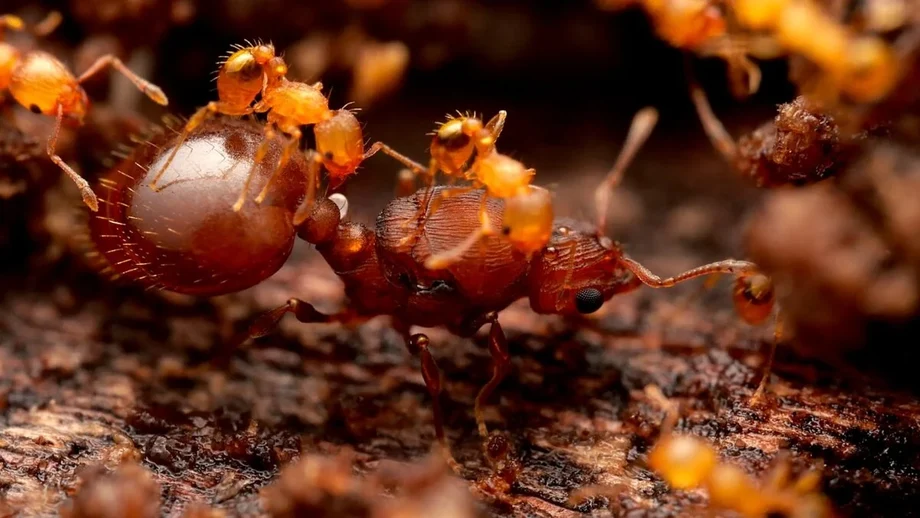
In Shantou and Enping, two cities in China's Guangdong province, an ant about 1.5 mm long has been gaining ground on a rival whose workers can reach 5.1 mm. The little fire ant survives attacks by becoming motionless, then joins lethal group assaults after its numbers rise. Researchers say that behavioural switch, paired with a stronger response to warmth, helps explain its gradual displacement of the red imported fire ant, Solenopsis invicta.
Contents
- A 1.5 mm ant overturns an invasion
- A year of fieldwork and 151 encounters
- How playing dead keeps the smaller ant alive
- Why reinforcements change the fight
- Warm weather tilts the contest
- A brief refuge followed by native losses
- Why the loss of native ants matters
- What the findings change for control efforts
- What to Know
Ecologist Defu Chen led the work with Zhuoquan Liao and colleagues at South China Agricultural University and East China Normal University. Their paper, Thermal asymmetry and density-dependent behavioural shifts drive competitive displacement between two globally invasive ants, appeared in Proceedings of the Royal Society B: Biological Sciences. A Nature research highlight published on 20 November 2026 compared the struggle to human histories of migration, war and empire building. Its citation lists the underlying paper as Chen, D. et al., Proceedings of the Royal Society B 293, article 20261951 (2026).
The little fire ant is now called Allomerus auropunctatus, although the experiments and paper used its former name, Wasmannia auropunctata. New genomic analyses prompted its reclassification in 2026. Originally from South and Central America, the honey coloured insect has spread through North America, Europe, Africa, Asia and Australia. Its sting has reportedly caused corneal injuries in animals far larger than itself, including elephants, helping earn it the alternative name electric ant.
A year of fieldwork and 151 encounters
Chen's team combined outdoor surveys with controlled encounters in laboratory dishes. The fieldwork covered agricultural and urban settings in Southeast China. In Shantou, researchers compared places without either invader against sites occupied by the red imported fire ant alone, the little fire ant alone, or both species together. They also monitored 10 sites in Enping, recording how invasive and native ant numbers changed through the seasons.
Several dates frame the research:
- September 2024: Monitoring began at the 10 Enping sites.
- August 2025: The full year of Enping observations ended, allowing seasonal changes to be compared.
- 2026: The study appeared in volume 293 of Proceedings of the Royal Society B, with DOI 10.1098/rspb.2026.1951.
Both invaders can form enormous supercolonies, networks of nests that can occupy extensive areas. Chen described the larger red imported fire ant's behaviour in direct terms when explaining why he wanted to investigate the two species.
They are highly aggressive. They will immediately attack you.
Chen said both species hurt and kill native ants. The central question was what happens when two such invaders meet, and whether their relationship remains stable as their populations and the temperature change.
How playing dead keeps the smaller ant alive
Preliminary laboratory work placed one worker from each invasive species in a small dish for five minutes. Across 36 repetitions, the researchers counted 151 encounters. Intense aggression erupted only nine times, and the little fire ant initiated every one of those attacks. In the other cases, the red imported fire ant was the aggressor, while its smaller opponent responded by feigning death.
Scientists call this behaviour thanatosis. A worker becomes motionless instead of continuing a dangerous fight, and the attacking red ants then stop their assault. Yijuan Xu, head of South China Agricultural University's Laboratory of Quarantine and Invasive Pests, and his colleagues explained that avoidance and threat displays also occurred, but the team measured thanatosis separately.
While intermediate interactions (avoidance, threat displays) were observed, our analysis specifically quantified the frequency of thanatosis to confirm it as a primary defensive node.
Survival experiments showed how valuable that response could be during the early stage of an invasion, when red imported fire ants still held the numerical advantage. Researchers exposed one little fire ant to groups of two, four, six or eight red ants and recorded survival for an hour. They repeated the test with Solenopsis jacoti, a native ant of similar size that does not feign death.
Almost 100 percent of the native comparison ants were dead after 60 minutes, regardless of how many red ants attacked them. Little fire ant mortality remained below 15 percent throughout the observation period. Its survival rate also changed very little as the number of attackers increased. Stillness gave a small pioneering population a way to endure encounters that were almost always fatal for the native comparison species.
Why reinforcements change the fight
The researchers then reversed the numerical balance. A single red imported fire ant surrounded by a group of native S. jacoti did not die in these trials. Groups of little fire ants produced a very different result: red ant deaths increased as more little fire ants joined the encounter and as the insects spent longer together. In groups of eight little fire ants given the longest observation period, more than 90 percent of the red ants died.
Chen's team found that the little fire ants launched devastating lethal attacks once they were roughly four times as numerous as their rivals. The exact experiments used groups of two, four, six and eight, showing a progression rather than a single universal rule for every nest or landscape. Chen summarized the eventual outcome of the rivalry.
The two may coexist in the short term, but ultimately, one side will defeat the other.
A small little fire ant population can therefore survive by avoiding escalating fights. Once reinforcements arrive, the same species gains a second advantage through numbers. Early invasion and later domination call for different behaviour, and the little fire ant can supply both.
Warm weather tilts the contest
Temperature supplied the other mechanism. During the monitoring period, little fire ant numbers rose sharply under warmer conditions. Red imported fire ant abundance showed no clear response to temperature under the conditions studied. Warmer weather consequently helped the smaller invader expand its ranks and move closer to the numerical advantage needed for mass attacks.
The researchers suggested that continued warming could make this sequence more consequential. The red imported fire ant might serve mainly as a pioneer that disrupts native ant defences. The little fire ant, which benefits from the warmer conditions, could then replace it and become the dominant invader. The team presented this as a possible outcome of the different temperature responses, without giving a timetable for a wider takeover.
A brief refuge followed by native losses
Field observations revealed an unexpected stage before the little fire ant's takeover. Fierce competition between the two invaders initially created what the researchers called an ecological buffer. Native ants persisted at higher numbers where both invaders occurred together than in areas dominated by one invader, because the rivals were expending effort against each other and jointly exploiting fewer native resources.
The refuge never restored conditions at uninvaded sites. Native ant abundance remained lower at invaded locations even during this initial stage. As the little fire ant progressively displaced its rival, the buffer weakened and native ants began disappearing from sites occupied by both invasive species. In the paper's older nomenclature, W. auropunctata refers to the little fire ant. Chen, Liao and their colleagues described the final part of that sequence.
Over time, however, this buffer decays as W. auropunctata progressively displaces S. invicta, precipitating the extirpation of native ants.
Extirpation means disappearance from a local area, rather than the global extinction of a species. By the end of the year of monitoring, indigenous ant diversity at sites that had hosted both invaders was almost completely lost.
The findings complicate the idea known as invasional meltdown, in which several invasive species accelerate ecological damage through their interactions. The Guangdong ants did cause severe damage, but their relationship changed with time. Initial antagonism provided limited shelter, followed by what the authors call asymmetric temporal displacement: one invader increasingly replaced the other instead of both simply adding their separate effects together.
Why the loss of native ants matters
Corrie Moreau, dean of collections at the American Museum of Natural History and an entomologist who was not involved in the study, explained why native ant losses can spread through an ecosystem.
Ants play such critical roles, like dispersing seeds, being scavengers, turning soil. They're also food for other organisms, right? They're a fundamental piece of the fabric of any ecosystem.
Seed movement, scavenging and soil turnover connect ants to plants, nutrients and other animals. When invasive ants displace local species, those jobs can change or disappear alongside the native communities. Moreau also noted that conservation decisions and eradication programmes require an understanding of how species relationships develop through time, rather than a snapshot of which invader appears strongest on one day.
What the findings change for control efforts
Chen recommended intervening early, before invasive ants turn their full attention to native communities. The temporary buffer created by fighting between the invaders offers time for action, but it fades as little fire ant numbers increase. Early detection and rapid response could therefore focus on preventing this heat favoured invader from reaching the numerical stage at which group attacks become lethal.
Monitoring needs to include both invaders and the native ants around them. A useful management plan would track changing numbers, temperature responses and local native losses, then adjust as the relationship shifts. The authors also see value in improving ecological models so that conservation scientists can anticipate stages of a shared invasion instead of treating each introduced species as an isolated problem.
Moreau cautioned against applying every management lesson directly to all landscapes. The fieldwork included urban and agricultural environments, while many conservation programmes target places with less human disturbance.
They're doing this in a city. Often where we really want to make these conservation efforts is in places that are less touched by humans.
Her wider conclusion was that protecting biodiversity requires careful predictions about how interactions will develop. For farm, city and conservation managers in Guangdong, the immediate signals are concrete: count both invasive species, watch whether little fire ants are approaching a numerical advantage, and act while native ants still remain.
What to Know
- Little fire ants about 1.5 mm long are displacing red imported fire ants whose workers can reach 5.1 mm in Guangdong, China.
- Across 151 encounters in 36 preliminary trials, only nine became intensely aggressive, and the little fire ant started all nine.
- When outnumbered, little fire ants feigned death. Their mortality stayed below 15 percent, compared with almost 100 percent after 60 minutes for the native comparison ant.
- Groups of little fire ants killed increasing numbers of red ants as numbers and exposure time rose. Eight attackers in the longest trials caused more than 90 percent mortality.
- Fieldwork combined Shantou habitat surveys with monitoring at 10 Enping sites from September 2024 to August 2025.
- Little fire ant numbers increased with warmer conditions, while red imported fire ant numbers showed no clear temperature response under the studied conditions.
- Rivalry between the invaders briefly buffered native ants, but the protection faded and indigenous ant diversity was almost completely lost at sites with both invaders by the end of the monitoring year.
- Researchers recommend early intervention and management that adjusts as invader populations and their interactions change.