A stone lion, 254 dead and a new look at an old army
A unit of 300 Theban soldiers, said by Plutarch to be 150 pairs of male lovers, is being examined again through a documentary and a fresh study of bones from a mass grave in central Greece. The Other 300: Army of Lovers began screenings in Athens and at Oxford University in 2025. Its subject is the Sacred Band, which helped defeat Sparta at Tegyra in 375 BC and Leuctra in 371 BC before being destroyed at Chaeronea in August 338 BC by the army of Philip II of Macedon and his son Alexander, then 18. Its members were hoplites, armored infantry who fought in close formation.
Contents
- A stone lion, 254 dead and a new look at an old army
- Why Thebes placed lovers in the same ranks
- Tegyra: when 300 men charged a larger Spartan force
- Leuctra: fifty ranks that broke Spartan power
- The Macedonian hostage who returned as a conqueror
- Chaeronea: the final stand in August 338 BC
- Philip's tears and a lion without an inscription
- What archaeologists found beside the lion
- Notebooks and cleaned bones are yielding new evidence
- Why the army of lovers remains debated
- Key Points
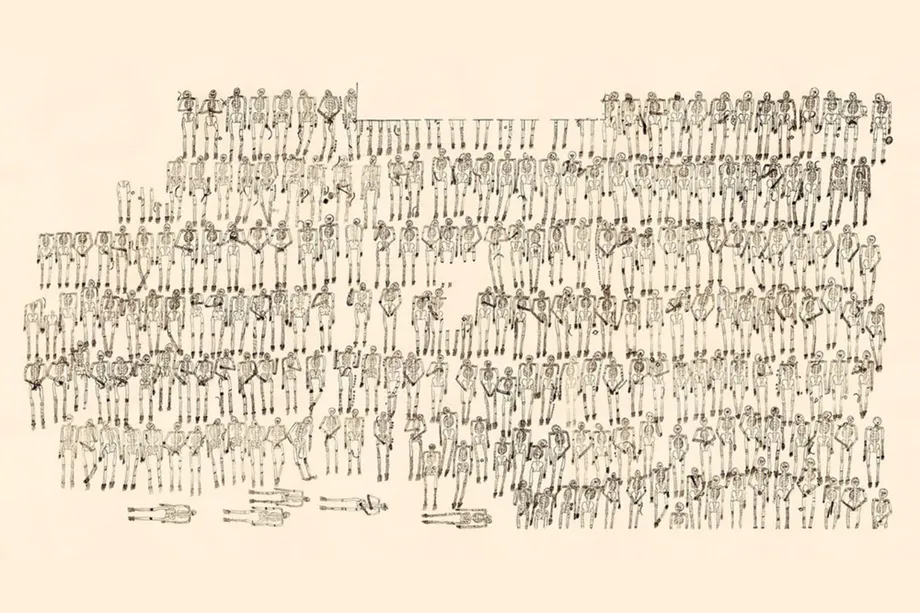
This was another Greek force of 300, distinct from the Spartans who defended Thermopylae in 480 BC. Its history joins an ancient argument about courage to an unusually physical archaeological record. The Archaeological Museum of Thebes dates excavation of the grave beside the Lion of Chaeronea to 1879 and records 254 skeletons. Since 2022, researchers have been studying rediscovered notebooks, ceramics, weapons and human remains, looking for evidence of the battle, the health of the soldiers and their lives before it.
Plutarch, who came from Chaeronea, supplies the fullest written account, yet he wrote more than four centuries after the unit's final battle. The earliest surviving use of its name comes much closer to the events. In 324 BC, the Athenian speechwriter Dinarchus named Pelopidas as its leader in Against Demosthenes and connected it with Epaminondas and the defeat of Sparta at Leuctra. That reference appeared just 14 years after Chaeronea.
Why Thebes placed lovers in the same ranks
Sparta seized the Cadmea, the citadel of Thebes, in 382 BC and supported a friendly government there. Theban exiles expelled the garrison in 379 BC. The Sacred Band is usually dated to 379 or 378 BC, during the effort to secure that recovered independence. Plutarch and the military writer Polyaenus credit the commander Gorgidas with founding it, while several other ancient writers give that role to Epaminondas.
Gorgidas selected 300 men for ability rather than social class, according to Plutarch. The city paid for their training and food, and they were stationed in the Cadmea, which explains the alternative name City Band. Their exercises included wrestling and dance. James G. DeVoto estimated that recruits became full members at age 20 or 21 and served until about 30, although no ancient text preserves those ages.
Plutarch describes each pair as an older erastes, or lover, and a younger eromenos, or beloved. Those terms belonged to relationships shaped by age, mentorship and local custom, a different social setting from modern partnerships between men. He cites Aristotle for the claim that couples exchanged vows at the tomb of Iolaus, the companion of Heracles, giving the unit its sacred name. The practical theory was that each man would be ashamed to show cowardice before his partner and would risk danger to protect him. Plutarch even tells of a mortally wounded soldier asking his killer to strike his chest so that his beloved would not see a wound in his back.
Plato's Symposium offers a similar idea without naming Thebes. Speaking through the character Phaedrus, Plato imagines an army of lovers rather than describing an existing regiment:
When fighting at each other's side, although a mere handful, they would overcome the world.
Xenophon's Symposium treats the matter differently. Its Socrates disapproves of placing lovers side by side in Thebes and Elis, while presenting the practice as unsuitable for Athens. Together, the passages show that the connection between affection and military conduct was being debated in the band's own era.
Tegyra: when 300 men charged a larger Spartan force
Gorgidas initially spread the selected men among the front ranks of ordinary infantry units. Command passed to Pelopidas, one of the exiles who had helped recover the Cadmea. In 375 BC, after moving against the Spartan position at Orchomenus, he was returning with about 300 infantry and a small cavalry force when he encountered two Spartan regiments coming back from Locris near Tegyra.
Plutarch preserves three estimates for the Spartan total: 1,000 from Ephorus, 1,400 from Callisthenes and 1,800 from Polybius. Those figures made the enemy roughly three to six times the size of the 300 infantry led by Pelopidas. Diodorus gives a different engagement, with 500 Thebans facing 1,000 Spartans.
An unnamed Theban soldier saw the danger and warned Pelopidas, the Theban commander, that they had fallen into enemy hands. Plutarch records their brief exchange:
We have fallen into the enemy's hands!
Why not they into ours?
Pelopidas sent in his cavalry and formed the 300 into a dense body for a direct charge. The Thebans broke through, and the Spartan commanders Gorgoleon and Theopompus were killed. Plutarch presented the result as unprecedented: Sparta had lost to a smaller force. Pelopidas then stopped dividing the band among other troops. At Leuctra it would fight as one unit at the decisive point, with the task of striking enemy leaders and their best soldiers.
Leuctra: fifty ranks that broke Spartan power
A Greek phalanx was a block of armored infantry whose shields and spears depended on cohesion. Commanders usually put their strongest troops on the right. At Leuctra in 371 BC, the Theban commander Epaminondas reversed that convention. He concentrated his main weight on the left and advanced at an angle toward the Spartan right, where King Cleombrotus I stood.
Xenophon, a contemporary writer, says the Theban formation was not fewer than 50 shields deep. In practical terms, that meant at least 50 ranks driving into one part of the enemy line. Plutarch adds that Pelopidas led the Sacred Band forward at a run while the Spartans were still adjusting their formation. Cleombrotus was killed and the Spartan army collapsed.
About 10,000 hoplites are commonly placed on the Spartan side, though only around 700 were Spartiates, the full citizens at the core of Spartan power. The Thebans had about 6,000 hoplites. Roughly 1,000 men on the Spartan side died, including about 400 Spartiates. Those 400 deaths amounted to more than half of the estimated 700 citizens present, a blow far greater than the raw total suggests.
The victory made Thebes the leading military power in Greece for a time. Its two best known commanders did not long outlive that success. Pelopidas died in 364 BC, and Epaminondas was killed in 362 BC.
The Macedonian hostage who returned as a conqueror
Pelopidas later intervened in a Macedonian royal dispute and took the young Philip back to Thebes as a hostage, along with 30 other sons of prominent Macedonians. Philip stayed in the house of the Theban general Pammenes. Plutarch says Philip was thought to have taken Epaminondas as a model and admired his effectiveness in war.
Decades later, Philip II used diplomacy, threats and military campaigns to divide his Greek opponents. The Athenian orator Demosthenes warned about his ambitions. Thebes, once a supporter of Philip, joined Athens when the Macedonian king advanced south in 338 BC. After Greek forces blocked the route at Thermopylae, Philip moved toward Boeotia, the region around Thebes.
The main dates show how quickly the Theban force rose and fell:
- 379 or 378 BC: The Sacred Band is usually placed at its foundation, after Thebes expels Sparta's garrison.
- 375 BC: Pelopidas wins at Tegyra.
- 371 BC: Thebes defeats Sparta at Leuctra.
- 364 and 362 BC: Pelopidas and Epaminondas die.
- August 338 BC: Philip defeats Athens and Thebes at Chaeronea.
- 335 BC: Alexander destroys Thebes after the city revolts.
Chaeronea: the final stand in August 338 BC
Philip brought about 30,000 infantry and 2,000 cavalry to Chaeronea. The combined Greek force is often put at about 35,000 men. Diodorus gives a more even battle, with roughly 30,000 men and 2,000 cavalry on each side. Philip stationed himself on the Macedonian right opposite the Athenians. Alexander commanded on the left, facing the Thebans and the Sacred Band.
The Macedonian infantry carried the sarissa, a spear about 4 to 6.5 metres long (13 to 21 feet), roughly twice the length of the pikes used by their Greek opponents. That reach is central to one explanation of the battle: Diodorus describes a direct collision in which experienced Macedonian phalanxes overpowered the Greeks.
Nicholas G. Hammond established another reconstruction in the 1930s, later supported by Ian Worthington, by combining ancient accounts. Polyaenus says Philip pretended to retreat before the Athenians and drew them out of position. In this version, movement in the Greek centre opened a gap near the Thebans, and Alexander led the Companion cavalry through it. Plutarch's Life of Alexander is more cautious, saying Alexander is said to have been the first to break through the Sacred Band.
Both reconstructions end with the Theban unit surrounded. Theagenes is named as its last commander. The men refused to surrender and were killed where they held their ground; according to the tradition Plutarch records, the band had never before been beaten. Philip's victory ended effective military opposition to him in Greece. When Thebes revolted under Alexander three years later, the city itself was destroyed.
Philip's tears and a lion without an inscription
Plutarch says Philip came across the 300 Thebans lying together after the battle, still in the place they had defended. When he learned that they were the band of lovers, the Macedonian king wept and delivered a judgment on anyone who despised them:
May those who think that these men did or suffered anything shameful die miserably.
Pausanias, a travel writer of the second century AD, later described a communal tomb for the Theban dead outside Chaeronea. It carried no names or inscription, only a stone lion. He interpreted the silence as a sign that the men's courage had not received matching good fortune, and suggested that the animal expressed their spirit.
The monument eventually disappeared into the ground. In June 1818, the English architect George Ledwell Taylor was riding near ancient Chaeronea when his horse struck what proved to be part of the sculpture. Taylor and his companions uncovered a lion's head nearly six feet high, about 1.8 metres. He had been reading Pausanias's Description of Greece and recognized the possible connection with the ancient monument.
What archaeologists found beside the lion
The museum's excavation timeline, published by the Archaeological Museum of Thebes, identifies Panagiotis Stamatakis of the Athens Archaeological Society as the excavator in 1879. It records 254 skeletons and personal belongings. The Museum of Cycladic Art gives a more detailed total of 252 skeletons and two cremation deposits. Drawings show seven orderly rows. Some remains had spearheads embedded in them, and some pairs were found with their elbows linked.
The grave goods were modest. Museum descriptions list 17 local ceramic vessels, buttons and at least 92 iron strigils, the curved tools Greek athletes used to scrape oil and sweat from their skin. The dead had been buried without their weapons. Their bones carried fatal wounds associated with new Macedonian weapons.
The lion above them is not an untouched survival from 338 BC. Restoration began in 1902 under the sculptors Lazaros Fitalis and Lazaros Sochos, working with the engineer Nikolaos Balanos, and much of the visible monument is modern material. Stamatakis also began excavating another communal military grave in 1882, that of the Thespians killed at Delion in 424 BC.
Georgios Sotiriadis excavated a separate Macedonian burial at Chaeronea in 1902. The same museum timeline says bones, iron weapons and personal items lay seven metres deep among the ashes of the funeral fire. The two finds preserve different sides of the battle: a carefully arranged Theban grave beside the lion and a mound containing the ashes of Philip's own dead.
Notebooks and cleaned bones are yielding new evidence
Maria Liston, an anthropology professor at the University of Waterloo, described the current project in a keynote lecture on 29 February 2024 at Cotsen Hall in Athens. The American School of Classical Studies at Athens and the Museum of Cycladic Art presented it for the conference Chaeronea, August 338 BC: A State of the Question. The school's lecture announcement says skeletal samples removed from the grave are preserved in the National Archaeological Museum in Athens.
The collaboration, running since 2022, combines excavation notebooks, drawings, weapons, ceramics, historical accounts and skeletons. Those records have allowed isolated bones to be matched again with individuals and their original positions in the grave. A single complete skeleton that had been encased in plaster has now been excavated and restored. Thorough cleaning and reconstruction exposed new evidence of trauma and health conditions, adding to wounds already visible.
Liston's research includes skeletal trauma and infectious disease, and the collection offers a rare opportunity to document injuries suffered by hoplites in battle. The project also addresses conditions before the soldiers fought, turning a row of famous casualties into evidence about illness and physical life. The lecture notice gave no date for a final report.
Why the army of lovers remains debated
The excavation yielded 254 dead, while the literary unit had 300 members, a discrepancy at the centre of the identification debate. In a 2008 paper in the Journal of Hellenic Studies, the classicist John Ma argued that the grave held Theban dead and was very likely that of the Sacred Band. He also dated the lion monument itself substantially later than the battle.
Plutarch's distance from the events creates another difficulty. He wrote centuries later and often qualified individual stories. In 2002, David Leitao's study The Legend of the Sacred Band asked whether the army of lovers was an ideal developed through ancient writing. Questions have also been raised about whether every excavated soldier belonged to that unit.
James Romm, a classics professor at Bard College and the documentary's historical adviser, published The Sacred Band in 2021. Its reconstructions use Markley Boyer's work with the original grave drawings, which marked wounds on the bodies. In an Athens lecture in 2024, Romm examined Plutarch's repeated use of it is said and the problem of trusting his account.
Chaeronea was a real defeat, the grave contains men who suffered violent wounds, and an elite Theban unit was named within 14 years of the battle. The exact composition of 150 couples and several famous speeches depend much more heavily on later literature. New research can sharpen the account of how these men lived, fought and were buried while leaving the monument's date and the precise identity of every occupant unresolved.
Key Points
- The Sacred Band was a Theban force of 300 men, described by Plutarch as 150 pairs of lovers.
- It defeated a larger Spartan force at Tegyra in 375 BC and helped break Spartan power at Leuctra in 371 BC.
- The army of Philip II and Alexander destroyed it at Chaeronea in August 338 BC.
- Stamatakis excavated 254 dead beside the Lion of Chaeronea in 1879; the difference from 300 remains unexplained.
- A project begun in 2022 is using notebooks and bones to identify wounds, health conditions and burial positions.
- Scholars still debate the monument's date, the identity of the dead and how literally to read Plutarch's account.