A second Chinese name on the prize roll
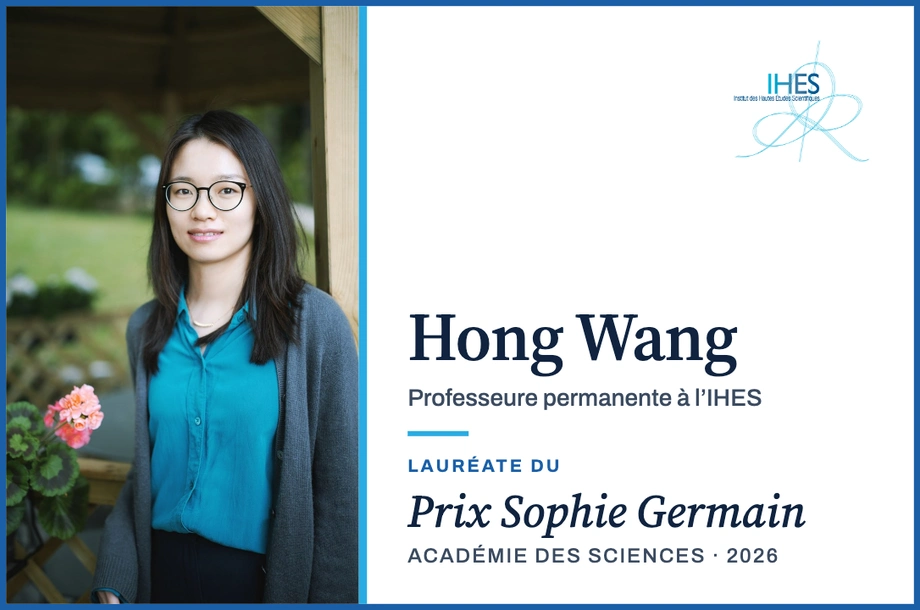
Hong Wang, a permanent professor at the Institut des Hautes Études Scientifiques (IHES) in France and a Silver Professor at New York University's Courant Institute of Mathematical Sciences, has received the 2026 Sophie Germain Prize. IHES announced the award on November 25. The presentation had already taken place on October 24 beneath the dome of the Institut de France in Paris, when Wang was 35.
Contents
- A second Chinese name on the prize roll
- What happened beneath the Institut de France's dome
- Who has won it before
- How harmonic analysis turns complexity into waves
- The needle problem behind her breakthrough
- Philadelphia, four Fields Medals and a call from Macron
- Five honours and the dates that connect them
- Ma Xiaonan's path from Paris to Nankai
- Two routes from the same university cohort
- Key Points
Wang is the second Chinese mathematician to receive the prize. The first was Ma Xiaonan, who won in 2017 while serving as a mathematics professor at Paris Diderot University. Nine years separate their awards. Wang's latest honour also extends an exceptional year: it is the fifth major prize announced for her during 2026, following distinctions that included the Fields Medal and the Qiu Shi Outstanding Scientist Award.
The institute where Wang holds her French professorship identified harmonic analysis and geometric measure theory as the foundations of her work. It also summed up its assessment of her standing in mathematics in a single sentence:
Wang is one of the most brilliant mathematicians of her generation.
Wang will continue to hold her positions at IHES and NYU. The prize announcement did not describe a new appointment or a change in her research affiliation.
What happened beneath the Institut de France's dome
The October 24 ceremony formed part of the French Academy of Sciences' presentation of its 2026 science awards. Nearly 80 prizes covered basic and applied science. The Academy presented the Sophie Germain Prize to Wang during that programme, placing her work alongside research spanning much of French science rather than mathematics alone.
The Institut de France created the prize in 2003, with funding provided by the Sophie Germain Foundation. It is conferred annually by the Institut on the recommendation of the French Academy of Sciences, which handles the scientific assessment and nomination process. The prize recognises mathematicians who have made outstanding contributions to fundamental research and usually goes to one scholar each year. It is among the Academy's highest distinctions for mathematics.
Its name commemorates Sophie Germain, a French mathematician of the nineteenth century who pioneered work in elasticity theory and number theory. Elasticity theory examines how materials deform under forces, while number theory investigates the properties of integers and related structures. The prize's purpose therefore reaches beyond a single mathematical specialty: it rewards basic research whose value lies in advancing knowledge itself.
Who has won it before
The earlier winners include several influential figures in modern mathematics. Claire Voisin, the inaugural recipient, later won the Shaw Prize and the Crafoord Prize. Jean-François Le Gall received the Sophie Germain Prize in 2005 and is also a Wolf Prize winner. Ngô Bảo Châu won it in 2007, three years before receiving the Fields Medal in 2010. Their careers illustrate the range of research recognised by the award, from geometry and probability to the deep connections among mathematical fields.
Another recent French Academy award provides additional context. In 2025, the Academy gave its Jacques Herbrand Prize to Yilin Wang, another Chinese mathematician born in the 1990s. Past recipients of that prize include mathematicians who went on to win Fields Medals. Hong Wang's Sophie Germain Prize and Yilin Wang's Herbrand Prize are separate honours, awarded for different selections of research, but both bring attention to Chinese women working at the highest levels of mathematics.
How harmonic analysis turns complexity into waves
Harmonic analysis studies how functions can be broken down into basic waves. In mathematics, a function is a rule connecting inputs with outputs, and it can represent phenomena such as sound, heat or an image. A musical chord offers a useful comparison: although heard as one sound, it can be separated into individual notes. Harmonic analysis performs a related operation on mathematical objects, allowing researchers to examine each component and then understand the whole.
Wang combines this approach with geometric measure theory, which supplies ways to measure length, area, volume and dimension for sets that are too irregular for ordinary school geometry. Some of these sets have intricate structures at increasingly small scales. The field gives mathematicians precise language for discussing how large they are, how much space they occupy and what dimension should be assigned to them.
This combination is central to Wang's prize citation. Her research does not simply decompose waves or calculate dimensions in isolation. It uses geometric information to answer difficult questions in analysis, including questions about the arrangements of lines and needles contained within highly unusual sets.
The needle problem behind her breakthrough
The Kakeya problem can be pictured with a needle of fixed length. Imagine a set in space with three dimensions that contains the needle pointing in every possible direction. The set can be arranged in extremely complicated ways. The central question is how thin or sparse such a set can be while still meeting that requirement.
Wang and her collaborator Joshua Zahl proved that, however cleverly the set is constructed, its Hausdorff dimension must be 3. Hausdorff dimension is a mathematical measure of the effective dimension of an irregular set. A value of 3 means that the set has the full dimension of the surrounding space by that measure, even if its geometry appears exceptionally sparse or intricate.
Their work settled the Kakeya conjecture in three dimensions, a problem that had resisted mathematicians for almost a century. When the International Mathematical Union later selected Wang for the Fields Medal, its citation specifically mentioned her major progress on this problem. The Sophie Germain Prize now gives separate French recognition to the broader body of research in harmonic analysis and geometric measure theory surrounding that achievement.
Philadelphia, four Fields Medals and a call from Macron
On July 23, Wang received the Fields Medal at the opening ceremony of the International Congress of Mathematicians in Philadelphia. She became the third woman to win the medal in its history spanning 90 years. At the Philadelphia ceremony, Wang and Yu Deng also became the first Chinese citizens to receive the honour, as well as the first two mathematicians who completed their undergraduate education in mainland China to win at the same ceremony.
Wang and Deng made up two of the four recipients. The others were John Pardon, an American mathematician at Stony Brook University who was 37, and Jacob Tsimerman, a Canadian mathematician at the University of Toronto who was 38. Their work ranged across waves, gases, geometric spaces and numbers. With two medallists at one congress, China became the fifth country to achieve that result, after the United States, France, Britain and Russia.
Wang's medal carried another distinction beyond her age and nationality. Both she and Deng began their undergraduate studies in Peking University's 2007 cohort, although they followed very different educational routes. Their awards also recognised different mathematics: Deng's research connects the motion of individual particles with the equations used to describe gases, while Wang's citation included her Kakeya breakthrough.
French President Emmanuel Macron telephoned Wang after the Fields Medal result was announced. The French president congratulated her with these words:
This is an honour you deserve. It is truly remarkable.
Five honours and the dates that connect them
The five major honours announced for Wang in 2026 are the New Horizons in Mathematics Prize associated with the Breakthrough Prize, the Clay Research Award, the Fields Medal, the Qiu Shi Outstanding Scientist Award and the Sophie Germain Prize. Each has its own selection process. Together, they place her work before organisations based in the United States, France and Hong Kong, as well as before the international mathematical community gathered in Philadelphia.
The Hong Kong Qiu Shi Science and Technologies Foundation announced its 2026 winners in October. Wang and Wang Guozhen received the awards in mathematics, while Ye Jun and Jia Jinfeng received the physics awards. The foundation's announcement came in the same month as the Sophie Germain ceremony in Paris.
- July 23: Wang received the Fields Medal at the International Congress of Mathematicians in Philadelphia.
- October: The Qiu Shi Science and Technologies Foundation named Wang among its 2026 Outstanding Scientist Award winners.
- October 24: The French Academy of Sciences presented the Sophie Germain Prize at the Institut de France.
- November 25: IHES publicly announced Wang's latest prize on its website.
The Sophie Germain Prize and the Fields Medal measure achievement on different timetables. The French prize is annual, usually recognises one scholar and rewards fundamental research. The Fields Medal is awarded every four years to between two and four mathematicians younger than 40, recognising major discoveries and the promise of further achievement. Each Fields recipient receives a gold medal bearing an image of Archimedes and 15,000 Canadian dollars. No cash value was stated in the announcement of Wang's Sophie Germain Prize.
Ma Xiaonan's path from Paris to Nankai
Ma Xiaonan's victory in 2017 made him the first Chinese scientist to receive the Sophie Germain Prize. He was then a professor at Paris Diderot University, also known as Paris 7 and now part of Université Paris Cité. His recognised research included analytic torsion, Bergman kernels and geometric quantization. These advanced tools connect the study of geometric spaces with mathematical analysis and aspects of quantum theory.
Ma spent many years working in France. During that period, he also helped Chinese universities establish Sino-French classes intended to strengthen mathematics education. In 2024, he gave up his permanent teaching position in France and joined Nankai University full time as a chair professor.
In April 2026, Ma became director of Nankai's Chern Institute of Mathematics, the institute founded by the influential geometer Shiing-Shen Chern. Guo Shaoming serves as deputy director. Ma's career adds an institutional dimension to the nine-year interval between the two Chinese Sophie Germain winners: the first recipient now leads a major mathematics institute in China, while Wang continues her research through appointments in France and the United States.
Two routes from the same university cohort
Wang grew up in Guilin in southern China and entered Peking University to study earth and space sciences. She later transferred to mathematics, drawn by mathematical analysis rather than by the competition system that shaped the early careers of many celebrated Chinese mathematicians. Her path included a period of uncertainty about her academic direction before she returned to mathematics. She subsequently studied in France and earned her doctorate at the Massachusetts Institute of Technology in 2019.
Deng followed a contrasting route from the same Peking University cohort. He grew up in Shenzhen, won gold medals in major Chinese and international mathematics competitions and transferred from Peking University to MIT. He completed his doctorate at Princeton University in 2015 and is now a professor at the University of Chicago. One future Fields medallist changed subjects after entering university; the other arrived through an established competition pathway.
Wang's present positions connect those educational beginnings with research institutions in Paris and New York. Her Sophie Germain Prize adds French national recognition to that career without altering its institutional base. Its clearest research connection remains the work cited throughout her exceptional year: the decomposition of functions into waves, the measurement of irregular geometric sets and the proof that Kakeya sets in space with three dimensions must have Hausdorff dimension 3.
Key Points
- IHES announced on November 25 that Hong Wang had received the 2026 Sophie Germain Prize.
- The French Academy of Sciences presented the award on October 24 beneath the dome of the Institut de France.
- Wang, 35, is the second Chinese mathematician to win, after Ma Xiaonan in 2017.
- The prize was created in 2003 and is conferred annually on the Academy's recommendation for outstanding fundamental research.
- Wang and Joshua Zahl settled the Kakeya conjecture in three dimensions by proving that the relevant sets have Hausdorff dimension 3.
- Wang received the Fields Medal on July 23, becoming its third female recipient and, with Yu Deng, one of its first two Chinese citizen winners.
- Her five major honours announced in 2026 also include the New Horizons in Mathematics Prize, the Clay Research Award and the Qiu Shi Outstanding Scientist Award.
- Ma Xiaonan returned to Nankai University in 2024 and became director of its Chern Institute of Mathematics in April 2026.