Vietnam Adds a Connection From Space
Viettel Telecom began offering Starlink satellite internet in Vietnam on November 26, 2026, giving households and companies a connection that does not need a fiber cable or mobile base station at the place where it is used. The operator put equipment prices from VND9.3 million and monthly plans from VND1.59 million, so the first month with hardware starts at VND10.89 million. Starlink's own Vietnamese website had already opened orders on August 13 with a different price set and a 30 day trial.
Contents
- Vietnam Adds a Connection From Space
- What Customers Pay in Vietnam
- How the Pilot Was Approved
- Key Dates in the Rollout
- Why Fiber and 5G Still Matter
- Where the Connection Changes Daily Life
- A Backup Route During Storms and Landslides
- What Viettel Adds to the Starlink Sale
- Where Vietnam Fits in the Global Network
- Key Points
Starlink works by linking a small dish or terminal to satellites in low Earth orbit. These satellites fly much closer to Earth than older satellite TV satellites, so the signal has a shorter journey. Viettel said downloads can exceed 400 Mbps, or millions of bits per second, under suitable conditions. Latency, the time data takes to travel to the network and back, is 20 to 50 milliseconds. Lower latency makes video calls and remote control feel smoother.
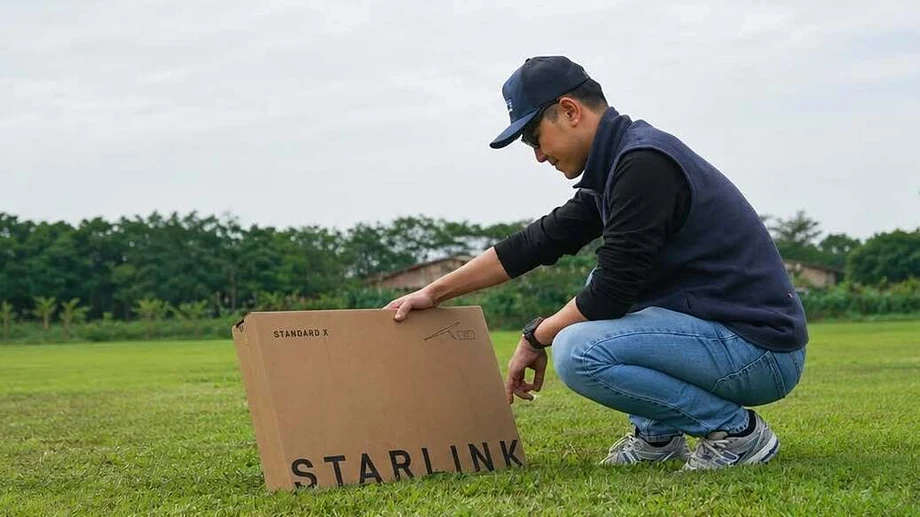
The devices in the unboxing description are the Mini and Standard X receivers. They support data rates up to 400 Mbps, include Wi-Fi 5 or Wi-Fi 6, and are designed for quick setup. A typical setup has a dish, a router and a power source. The user points the dish at the sky, connects power and follows the app instructions, rather than waiting for a cable crew.
The practical change is clearest in places with weak ground coverage. A mountain classroom, an island clinic, a remote farm and a ship beyond the coast can all use the same space based link. In Vietnam's rollout, that means satellite internet is being sold as an extra route for work, study, health care and contact with the mainland, not as a replacement for the fiber lines and mobile towers already serving cities.
What Customers Pay in Vietnam
Starlink's website opened to Vietnamese customers on August 13 with a Vietnamese interface and address checks. Its Family 100 Mbps plan cost VND1,131,990 a month, while the Family maximum speed plan cost VND1,711,100 a month. Business plans were priced by data volume. The site advertised speeds above 340 Mbps, offered no contract, required identity information and said equipment would arrive in one to two weeks. Payment could be made by bank card or Zalopay.
Two hardware choices were listed. The Mini cost VND8,655,300, weighed 1.1 kg and used 25 to 40 W of power, with an integrated router. The Standard 4X cost VND10,269,900, weighed 2.9 kg and used 75 to 100 W, and came with Router 3 supporting Wi-Fi 6. Both were described as able to work in winds above 96 km/h and to resist water. Starlink's checkout page gave an estimated total of VND10,848,800 including tax before the final address check.
Viettel's offer, announced after the company signed a commercial cooperation agreement with Starlink Services Vietnam Co., Ltd. on September 21, uses different entry prices. Equipment starts at VND9.3 million and subscriptions start at VND1.59 million a month. The VND1.59 million monthly price is VND458,010, or about 40%, above the VND1,131,990 direct Family 100 Mbps price. Buyers need to compare the speed tier and data rules as well as the headline monthly fee.
Earlier launch expectations in Vietnam pointed to about US$85 a month, about VND2.2 million, and about US$350 for equipment. The published monthly prices were lower than VND2.2 million, while the device prices sat around that earlier hardware estimate. A survey of 8,500 people found 74% did not plan to use Starlink because ground telecom services already met their needs, 15% said they were interested and 11% were considering it.
How the Pilot Was Approved
Vietnam authorised Starlink Services Vietnam Co., Ltd. after the Authority of Telecommunications under the Ministry of Science and Technology issued licences for satellite based telecom services with network infrastructure. The Radio Frequency Department separately approved spectrum and radio equipment. The initial plan allows up to four gateway stations, ground sites that link satellite traffic to the wider internet, and up to 600,000 user terminals nationwide.
The legal base is the Prime Minister's Decision No. 659/QD-TTg dated March 26, 2025, which allows a five year pilot of low Earth orbit satellite telecom services. The pilot can run without foreign ownership limits, but it must respect national defence and security requirements and end before January 1, 2031. A March 23 date is also associated with the trial approval; the numbered decision carries the March 26, 2025 date.
Vietnam set conditions on where the traffic goes and what providers must do with user information. Traffic from satellite users in Vietnam must pass through a local gateway and connect to the domestic telecom network. User data must be stored in Vietnam. Providers must meet cybersecurity requirements, including steps to prevent malware and harmful content. These rules give the state a way to test the technology while keeping spectrum use and data handling inside a defined framework.
Nguyen Anh Cương, deputy director of the Authority of Telecommunications, said Starlink must follow price management and competition rules like other telecom businesses. He said price changes, especially cuts that look like unfair competition, would face closer supervision. He also said the 600,000 subscriber ceiling is about 2.5% of Vietnam's existing fixed broadband subscribers, making the pilot a narrow addition to the market.
Key Dates in the Rollout
The path from policy decision to a customer order ran through several licences and corporate steps. The dates below show how the service moved from a controlled pilot to a product sold through both the Starlink website and Viettel.
- March 26, 2025: Prime Minister's Decision No. 659/QD-TTg opens a five year low Earth orbit satellite pilot, due to end before January 1, 2031.
- February 2026: Regulators license Starlink Services Vietnam Co., Ltd. and approve spectrum and radio equipment for the service.
- August 13, 2026: Starlink's Vietnamese website shows availability and starts taking orders, with a 30 day trial and delivery in one to two weeks.
- September 21, 2026: Viettel Telecom and Starlink Services Vietnam Co., Ltd. sign a commercial cooperation agreement.
- November 16, 2026: The Hanoi Department of Science and Technology grants Viettel licence No. 10666/GP-SKHCN for nationwide telecom resale without its own network infrastructure.
- November 26, 2026: Viettel announces it is offering Starlink in Vietnam. Some launch coverage is dated November 27 after the company's Thursday statement.
Why Fiber and 5G Still Matter
Vietnam already has wide ground coverage. More than 70 million people use the internet, and Viettel, VNPT and MobiFone have rolled out 5G. Speedtest data placed Vietnam 35th globally for fixed broadband at 164.77 Mbps and 19th for mobile internet at 144.5 Mbps. The government said 4G coverage reached 99.8% of the population and set a target of 99% 5G coverage by 2030.
Affandy Johan, an analyst at Ookla, the company behind Speedtest and Downdetector, said satellite broadband should sit alongside those networks. He described Starlink as an added layer for places where geography makes ground buildout slow or costly.
Starlink can offer value in Vietnam, but its role will be supplemental rather than replacing existing domestic connectivity services.
Johan tied the strongest use to mountains and coastal areas. He also noted examples from the region: satellite internet has supported telemedicine on remote islands in Indonesia, while Starlink has supported private 5G networks at construction sites in mountainous parts of Japan.
Doan Quang Hoan, vice chairman of the Radio and Electronics Association of Vietnam, said Starlink can quickly cover blackspots, meaning places with poor or no communication. He also said those places are limited in number and often lie in mountains or on islands without access to the national power grid. A survey result and the 2.5% pilot ceiling point in the same direction: satellite service has a clear job, but it is not the main national broadband network.
Where the Connection Changes Daily Life
Mountain areas and islands are the first target. Viettel said schools can use online learning resources, clinics can link with higher level hospitals, farms can monitor production from a distance and remote resorts can offer guests a more reliable connection. Advanced farms, forest sites and small communities can use satellite links when laying fiber would be expensive or difficult.
The equipment can run from portable batteries, solar panels or generators, which matters where the power grid is weak. That gives survey teams, outdoor event organisers and reporters at a field site a way to send video, messages and data without waiting for a temporary tower. Construction sites can use the connection for camera monitoring and remote management of work.
At sea, the service is aimed at offshore fishing vessels, cargo ships, cruise ships and oil and gas platforms. Crews can make video calls home, receive weather updates and contact the mainland. Shipping companies can track vessel routes, watch cargo conditions and exchange data with operations centres. Viettel said these uses can improve safety and running efficiency on journeys where mobile coverage ends.
A Backup Route During Storms and Landslides
Storms, floods and landslides can cut fiber lines or damage mobile towers. A satellite terminal has a different path because it connects to the sky rather than to a local cable or tower. For factories, hospitals, banks and company operations centres, that can mean keeping data links alive when the usual route fails.
A representative of the Authority of Telecommunications described Starlink as a backup channel for network failures in disasters. The comment explains why the regulator built data routing and cybersecurity duties into the pilot rather than treating the service like a simple retail gadget.
Starlink is an effective backup channel when the ground network encounters problems in situations of natural disasters or catastrophes.
Viettel said local authorities and rescue teams could use the service to keep contact, send images from an affected area and coordinate emergency work. The company also said customers can buy extra data, upgrade plans, install the terminal themselves or pay for technical help at their site. It promised warranty handling, product exchanges, returns, financial invoices and Vietnamese language support 24/7.
What Viettel Adds to the Starlink Sale
Viettel's role is not to build the satellite network. The company sells genuine Starlink equipment, gives advice on devices and plans, handles installation help and provides customer support through its nationwide staff. Customers buying through Viettel receive licensed service, clear prices and invoices, while warranty and troubleshooting requests go through Viettel instead of an unknown seller.
Vu The Binh, vice chairman and secretary general of the Vietnam Internet Association, called the pilot a good signal for Vietnam's internet. He said it gives the country another broadband choice, especially where fiber has not reached, in remote areas and on islands.
A Viettel Telecom representative said the launch was meant to expand what people can do with a connection, not merely add another product to a price list. The representative described the goal in terms of customer choice.
For customers, the value of technology does not lie simply in having another connection method, but in the opportunities technology opens in work and life. By providing Starlink, Viettel can meet connectivity needs that were previously very difficult to meet. We want every customer, wherever they are and whatever they do, to be able to choose a connectivity solution that suits their needs.
Some details remain unsettled for buyers. No launch material gave a nationwide address by address service map, a subscriber count for Viettel's channel, or an end date for the promotional equipment price. The 400 Mbps figure applies under suitable conditions, and customers need an address check before confirming an order. The pilot itself has a clear outer date: it must finish before January 1, 2031.
Where Vietnam Fits in the Global Network
Starlink is developed by SpaceX and operates about 6,750 satellites around the world. It serves about five million users in more than 125 countries and territories. Vietnam's licensing materials place it as the fifth Southeast Asian market for the service, after the Philippines, Malaysia, Indonesia and Timor-Leste. An earlier regional listing put Vietnam fourth after the Philippines, Malaysia and Indonesia, leaving Timor-Leste out.
That regional pattern helps explain the policy choice. Satellite broadband can reach border areas, islands and disaster zones where ground networks are thin or damaged. Vietnam is allowing that capacity in through a pilot with terminal limits, local data storage and security conditions, while its domestic operators continue to expand fiber, 4G and 5G.
Key Points
- Viettel began offering Starlink in Vietnam on November 26, 2026, with equipment from VND9.3 million and plans from VND1.59 million a month.
- Starlink uses low Earth orbit satellites to provide internet without cables or a local base station, with advertised downloads above 400 Mbps and latency of 20 to 50 milliseconds.
- Vietnam's pilot allows up to four gateways, 600,000 terminals and must end before January 1, 2031.
- The service is aimed at remote areas, islands, vessels and backup links, while existing fiber, 4G and 5G remain the main options in well covered areas.