Two small chips anchor a bigger technology push
Viettel presented two chips designed for 5G base stations at FrancoTech 2026 in Phnom Penh, putting Vietnamese semiconductor engineering before international leaders visiting the exhibition on November 15. The DFE and RFIC chips, both developed using 28 nanometre technology, handle digital processing and wireless transmission inside mobile network equipment.
Contents
- Two small chips anchor a bigger technology push
- What the DFE and RFIC actually do
- A return appearance after Barcelona
- From individual components to complete networks
- Private networks offer a route into industry
- Metfone brings the Cambodian customer connection
- An education agreement links business and public policy
- A national display with a wider digital message
- What Phnom Penh adds to Viettel's expansion
- Key Points
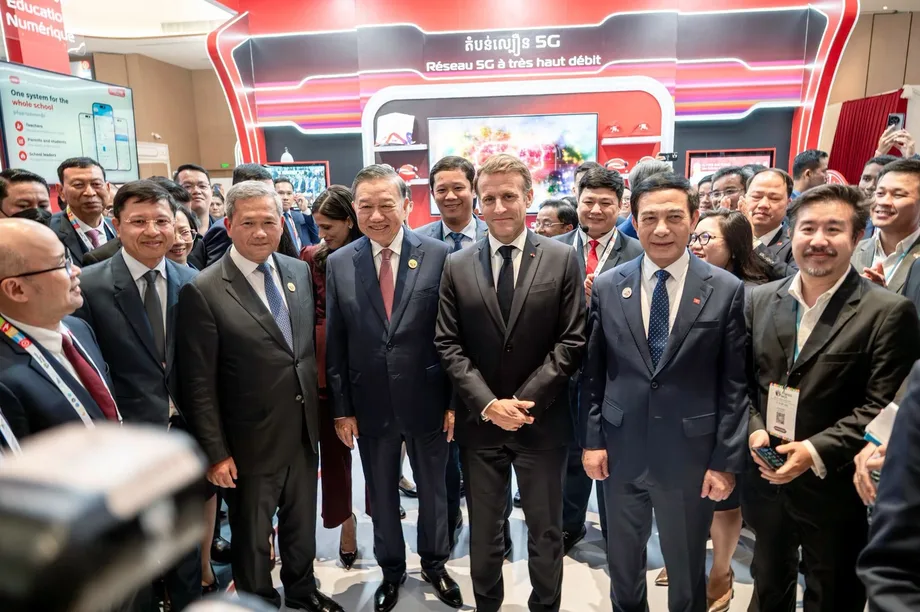
Vietnam's Ministry of Science and Technology confirmed the pair's specifications in its national pavilion account. Visitors included Vietnamese Communist Party General Secretary and State President To Lam, French President Emmanuel Macron, Cambodian Prime Minister Hun Manet, Bulgarian President Iliana Iotova and Romanian President Nicusor Dan.
The chips connect two parts of Viettel's business: developing the equipment that makes mobile networks work and operating networks that deliver services to customers. In Cambodia, its Metfone business also presented applications for finance, healthcare, education and logistics, alongside an agreement intended to support digital technology in higher education.
A substantial discrepancy exists in the published DFE performance figures. Technical descriptions accompanying the Phnom Penh presentation put its capacity at 1 trillion calculations per second; Viettel's official announcement at Mobile World Congress in March 2024 stated 1,000 trillion calculations per second. The difference is a factor of 1,000, and no explanation was given.
The firmer common ground is the chips' purpose. Viettel is developing components for the base stations that connect phones and other devices to a 5G network, extending its work beyond running telecom services into the design of the hardware behind them.
What the DFE and RFIC actually do
The DFE, short for digital front end, performs calculations needed to process 5G signals. Viettel describes it as handling 5G algorithms, controlling the radio transmission and reception block, and communicating with other processing components inside the system. An algorithm is a set of instructions for completing a task, in this case preparing and managing signals that carry information.
The RFIC, or radio frequency integrated circuit, handles the wireless side of that work. Described by Viettel as Vietnam's first wireless transceiver chip, it can operate at frequencies of up to 6 gigahertz and supports bandwidth of 200 megahertz.
Frequency describes how quickly a radio wave oscillates. Bandwidth describes the width of the radio channel available to carry information. Together, the chips help bridge digital calculations inside a base station and the radio signals travelling between that station and connected devices.
The 28 nanometre figure identifies the semiconductor manufacturing process used for the chips. Viettel says its engineers control the entire design process. The announcements did not identify the fabrication plant, production volumes, chip prices or a timetable for widespread installation of the pair in commercial networks.
A return appearance after Barcelona
Viettel had already introduced both chips internationally at Mobile World Congress 2024 in Barcelona. Its March 2024 announcement described the DFE as Vietnam's first complex chip and claimed performance equivalent to 5G chips from the world's 10 leading semiconductor companies.
Information released around that earlier presentation also said the DFE met 5G standards developed by 3GPP, the international partnership that produces technical specifications for mobile networks. Common specifications give equipment makers a shared set of requirements when building systems intended to communicate with one another.
Viettel's development history stretches back more than a decade:
- 2009: Metfone began providing telecommunications services in Cambodia.
- 2015: Viettel established a research and development team for its mobile network technology work.
- 2019: Viettel began domestic trials of its 5G network.
- By the end of 2023: Viettel High Tech transferred a private 5G system to India's QuadGen.
- March 2024: Viettel presented the DFE and RFIC chips at Mobile World Congress in Barcelona.
- November 14 to 16, 2026: FrancoTech brought the chips and related digital services to an international audience in Phnom Penh.
From individual components to complete networks
Viettel's work extends across several layers of a 5G system, including radio base stations, transmission equipment, core network systems and billing systems that calculate charges as services are used. Designing chips adds another layer to that equipment portfolio.
A base station provides the nearby radio connection. Transmission equipment carries traffic onward, while the core network manages connections and directs information to its destination. Developing products across these layers gives Viettel more scope to design how the parts work together.
At Mobile World Congress 2024, Viettel demonstrated a complete standalone 5G system inside a box weighing 40 kilograms. Standalone 5G uses a dedicated 5G core network, rather than depending on a core built for an earlier mobile generation. The demonstration combined core, access and radio network functions at the exhibition booth.
Viettel also presented software for managing 4G and 5G networks, including improving operation, reducing energy use and automatically resolving application problems. In its 2024 announcement, the company said this system was being deployed in Vietnam and 10 countries where it had investments.
Private networks offer a route into industry
Viettel High Tech's transfer of a private 5G system to QuadGen in India by the end of 2023 provides a concrete example of its equipment reaching an overseas partner. A private network serves a particular organisation or location, such as a factory or warehouse, rather than the general public.
Such networks can give businesses greater control over connections used by machines, staff and production systems. Viettel's 2024 presentation focused on security, fast connections and low latency, meaning a short delay between sending information and receiving a response.
Le Ba Tan, identified at the time as Viettel Group's technical director, described the potential customers at Mobile World Congress 2024:
Opportunities not only lie in the telecommunications sector but also open up new customer segments, such as in the Logistics sector for building smart warehouses, or electronic equipment manufacturing plants needing 5G technology to operate the system, speeding up the process,
The India transfer and the Cambodia exhibition show two different channels for expansion. One involves supplying network technology to a partner; the other uses an established local telecom business to introduce a wider range of digital services.
Metfone brings the Cambodian customer connection
Metfone began commercial telecommunications services in Cambodia in 2009. By FrancoTech 2026, it had spent more than 17 years building a nationwide network and expanding into information technology and digital services.
To Lam, Macron and Hun Manet visited the Metfone exhibition, where company representatives presented services in telecommunications, digital finance, healthcare, education and logistics. General Phan Van Giang, identified as Vietnam's deputy prime minister and defence minister, also joined the delegation.
The range of products reflects a shift in what the company wants to provide. Connectivity remains the foundation, while payment services, education systems and other applications give people and organisations more reasons to use that connection.
Metfone belongs to Viettel Global's overseas investment network. According to Viettel Global's explanation of its third quarter 2026 business results, revenue in Cambodia rose 6% from the same period a year earlier. Across Viettel Global's markets, net revenue for the first nine months exceeded 38.073 trillion dong, an increase of nearly 20%. The Cambodian growth figure and the group revenue total cover different scopes.
An education agreement links business and public policy
Metfone signed a memorandum of understanding with the Agence Universitaire de la Francophonie (AUF) and Cambodia's Ministry of Education, Youth and Sport to promote digital transformation in higher education. The agreement connects a telecom company, an international university organisation and the Cambodian ministry responsible for education.
To Lam cited that partnership in his November 15 opening address as an example of cooperation among government, researchers and businesses. His proposal was to connect those three groups more closely so that research could move into practical production and services.
He also proposed studying the organisation of a Francophone ministerial conference on the digital economy. The intended focus would be policy coordination and legal arrangements supporting digital trade and investment. Hun Manet, Macron and Canadian Prime Minister Mark Carney attended the opening event.
For the education partnership, the next practical step is turning the memorandum into specific projects for universities. The announced agreement set out a direction for cooperation, while implementation details will determine which institutions and users receive new services.
A national display with a wider digital message
Vietnam's national pavilion at the Koh Pich Convention and Exhibition Centre was organised by the Ministry of Science and Technology with the Ministry of Finance, Vietnam's embassy in Cambodia and other bodies. It presented science, technology, innovation and digital transformation as priorities under Politburo Resolution No. 57-NQ/TW.
The ministry reported that 5G coverage had reached 93.4% of Vietnam's population. That measures the population living within network coverage. It also listed Vietnam at 43rd among 139 economies in the 2026 Global Innovation Index and 71st among 193 countries in the E Government Development Index.
Other figures at the pavilion illustrated the scale of the domestic technology sector: estimated digital technology industry revenue of about $250 billion in the first 10 months of 2026 and more than 83,000 digital technology businesses. Vietnam's IPv6 adoption rate was listed at 67.68%, ranking seventh globally in December 2025. IPv6 is an internet addressing standard that provides space for far more connected devices.
Viettel appeared alongside VNPT, which displayed fibre access equipment, Wi-Fi 7 products, mesh Wi-Fi, smart cameras and home technology. Vietnam Post presented a logistics control centre, automated parcel collection systems and research into drones for logistics. Together, the exhibits connected chip design with the networks, delivery systems and services that people use.
What Phnom Penh adds to Viettel's expansion
FrancoTech 2026 was the forum's second edition, following its first event in France in 2024. Held alongside the 20th Francophonie Summit, it brought together representatives of more than 90 governments, 200 exhibition stands and about 5,000 attendees under the theme of a Francophone community sharing a digital future.
For Viettel, the setting brought semiconductor design, network equipment, an established Cambodian operation and a new education partnership into the same conversation. The practical opportunity is to turn that breadth into equipment sales, partnerships and services for customers, with Metfone already providing a local business base.
Key Points
- Viettel displayed its DFE and RFIC chips for 5G base stations at FrancoTech 2026 in Phnom Penh.
- Both use 28 nanometre technology; published DFE calculation figures differ by a factor of 1,000.
- The RFIC supports frequencies up to 6 gigahertz and bandwidth of 200 megahertz.
- Both chips had previously appeared at Mobile World Congress 2024 in Barcelona.
- Metfone signed an agreement with AUF and Cambodia's education ministry on digital transformation in higher education.
- Viettel Global reported 6% revenue growth in Cambodia during the third quarter of 2026 compared with a year earlier.