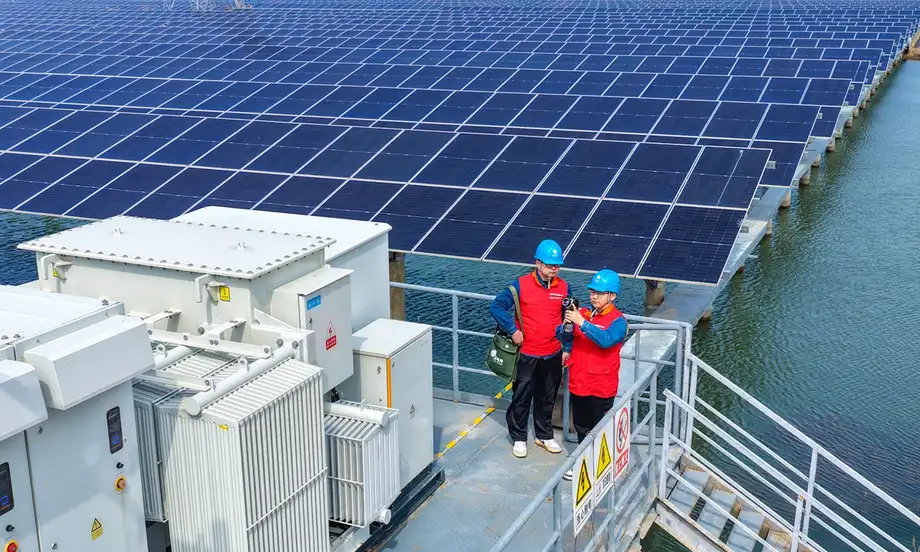
A Single Bid Opens a New Market
China launched its first green power trade linking the northwest and eastern regions on Nov. 26, 2026, a step State Grid said turns two separate markets into one platform with one set of rules. The opening session cleared 6.2 billion kilowatt hours of green electricity, drawn from wind and solar projects, with 1,615 market participants taking part. State Grid said the trade could avoid nearly 5 million tonnes of carbon dioxide emissions by replacing fossil fuel generation.
Contents
- A Single Bid Opens a New Market
- What the First Trade Actually Moved
- Why Two Market Windows Became One
- Who Gets Access to More Green Power
- Why the Northwest and East Fit Together
- What Makes the Electricity Green
- The Policy Rulebook Behind the Trade
- How the Wider Market Is Being Built
- What Changes for Generators and Buyers
- What Happens Before the Model Goes National
- Key Points
The trade ran through the Beijing Power Exchange Center, which State Grid uses to operate the platform. It covered 10 provincial jurisdictions: Shanghai, Jiangsu, Zhejiang, Anhui, Fujian, Shaanxi, Gansu, Qinghai, Ningxia and Xinjiang. The launch meeting was held in Beijing. State Grid described the platform as the world's largest green power market by trading scale, a claim tied to the size of the first session and the number of participants.
The immediate change is simple. Buyers and sellers can submit one price and volume request, instead of filing separate bids in a market between provinces and a market within provinces. The platform then matches renewable supply and demand across the two areas and forms one price. For a shopper, it is closer to one counter that can search several shelves than two counters with different queues.
What the First Trade Actually Moved
State Grid put the total cleared volume at 6.2 billion kilowatt hours. The detailed transaction breakdown gives 1.95 billion kilowatt hours moving from the northwest to the east and 4.22 billion kilowatt hours matched within provinces, or 6.17 billion before rounding. The volume weighted average price, which gives more importance to larger trades, was 0.204 yuan per kilowatt hour.
The trade brought together 1,188 power generators and 427 power retailers and electricity users. Those 427 buyers matched with generators through the one quote, joint trading process. The emissions figure, nearly 5 million tonnes of carbon dioxide, is an estimate of emissions avoided when renewable electricity takes the place of electricity that would otherwise be produced by burning fossil fuels.
Those figures show the scale of the pilot. A single session brought more than a thousand generators into contact with hundreds of buyers across ten jurisdictions, while also giving a public price for a large block of renewable electricity. That price gives future buyers and sellers a reference point for comparable deals.
Why Two Market Windows Became One
Before the launch, green power trading was split into two layers. One layer covered deals between provinces and regions, while the other covered deals inside a province. A generator or buyer often had to declare, quote and clear in both, with clearing meaning the moment bids are matched and prices are set. It also had to work out how much power should travel through an interregional channel and how much should be consumed locally.
Zhang Xian, director of the market department at Beijing Power Exchange Center, said the old arrangement made a unified price signal hard to form. He likened it to standing in two queues at two trading windows and explained that the merged platform now lets wind and solar power from the northwest and east meet demand under the same rules.
lining up at two different trading windows.
A single price matters because it tells buyers and sellers what the whole pool of green electricity is worth under current supply and demand. Under the older setup, separate prices could send mixed messages. The new platform works within transmission limits but lets the market see available channel space and local demand together before striking deals.
Who Gets Access to More Green Power
Zhang Jian, BASF China Asia Pacific general manager, said the opening gives industrial buyers a wider pool of renewable power, not just another trading channel. He said customers can now reach resources that were harder to combine when markets were separate.
From the user's perspective, this is not just a new, efficient trading window; it tangibly expands the range of green power we can access and choose.
One example from the Beijing platform shows how the process works in practice. A Jiangsu manufacturer that sells mainly to overseas markets filed one application and bought green power from Xinjiang and other outside sources as well as from renewable generators inside Jiangsu. For exporters, the practical gain is a simpler way to buy renewable power from several origins in one transaction.
Power users in eastern China, including export factories and data centres, no longer need to judge whether the power they want comes from a cross region channel or from local supply. They can state how much green power they need, when they need it and what price they are willing to pay. The platform searches both areas for a match.
Why the Northwest and East Fit Together
The northwest has large wind and solar bases, including projects in Shaanxi, Gansu, Qinghai, Ningxia and Xinjiang. The east includes large electricity consuming centres such as Shanghai, Jiangsu, Zhejiang, Anhui and Fujian. The joint trade connects these areas by matching power where it is generated with demand where factories, offices and computing facilities use it.
Liu Shuo, director of the new energy trading department at Beijing Power Exchange Center, said the joint trade connected the two levels of the green power market and made fuller use of spare space on cross province and cross region transmission channels. In plain terms, when a power line has spare capacity, more renewable electricity can be sent instead of being curtailed, a term used when available clean power is not taken.
The flow was not one way only. The session matched 4.22 billion kilowatt hours within provinces, compared with 1.95 billion kilowatt hours moving from the northwest to the east. That means most of the first trade came from local matches inside the 10 jurisdictions, while nearly a third used cross region routes. The combined design lets both kinds of supply compete in the same clearing process.
What Makes the Electricity Green
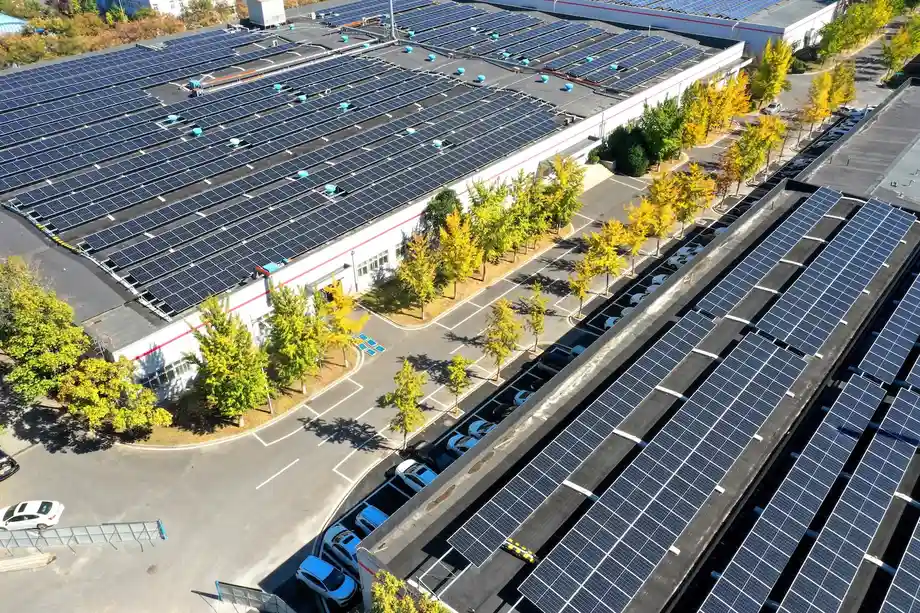
Green power in China means electricity generated from renewable sources such as wind and solar. In this market, the electricity is traded together with its environmental value. A green certificate, a record that recognises the renewable origin and environmental claim of the power, is transferred with each transaction. That transfer lets the buyer claim renewable energy consumption and gives clean generation an extra source of value.
China's green power trading market opened in 2021. Since then, pilots have been approved at power exchange centres in Beijing, Guangzhou and Inner Mongolia. The new northwest and east trade builds on that experience by widening the matching area and putting the environmental attribute into a larger, single rule book.
The policy goal sits beside China's dual carbon goals: peak carbon dioxide emissions before 2030 and reach carbon neutrality before 2060. Carbon neutrality means net emissions are balanced by removals or offsets. A market that prices both electricity and its environmental claim gives companies a practical way to support those goals while making ordinary purchasing decisions.
The Policy Rulebook Behind the Trade
The policy foundation is the national market opinion, published by the State Council General Office on Feb. 8, 2026. It says that by 2030 China should basically establish a unified national electricity market, with all types of power sources and all users except protected users taking part directly, and market based trading making up about 70 percent of national electricity consumption. It also calls for cross province, cross region and provincial trading to move gradually toward a model where one quantity and price request is split and matched across the country. It pushes spot markets to be basically in formal operation by 2027.
The opinion asks regulators to improve the national green certificate market, expand green power consumption, and promote multiyear contracts and aggregated trading. It encourages the use of green power deals to carry out interprovincial plans for priority renewable generation. The National Development and Reform Commission and the National Energy Administration are assigned responsibility for coordination, supporting policies and pushing implementation.
A separate State Council notice says a fully unified national electricity market should be in place by 2035. It lists unified rules and technical standards, a national market credit system, stronger links between power planning and market operation, and an evaluation system. Those pieces form the structure that the first northwest and east trade is testing in practice.
How the Wider Market Is Being Built
The green power launch came as China speeds up other parts of electricity market reform. Spot markets, where electricity is bought close to delivery and prices move with immediate supply and demand, have formally started in the southern regional market and in Hebei southern grid, Anhui, Shaanxi and Fujian. The National Energy Administration said formal spot market operation now covers 15 provinces.
Rule making has also widened. More than 600 local market rules have been placed in a unified rule library, while basic rules for spot and retail markets are being revised. Interprovincial spot trading has been upgraded, regional mutual aid trading has started, and market trading now runs continuously by natural day, meaning each calendar day. Transmission rights trading on the Yunxiao direct current line is moving ahead; a transmission right is permission to use a defined share of a line.
National Energy Administration data released on Nov. 26 show that power trading institutions completed 6,497.1 billion kilowatt hours of market based trading in the first 10 months of this year, up 18.3 percent from a year earlier. Green power trading reached 283 billion kilowatt hours, up 7.7 percent. During the 14th Five Year Plan period, market based trading volume grew by an average 16.0 percent a year; 2025 volume was 109.7 percent higher than at the end of the 13th Five Year Plan period, and market based trading had exceeded 60 percent of total electricity use for four straight years.
What Changes for Generators and Buyers
The combined market changes the daily calculations of renewable generators. They no longer need to spend as much effort guessing whether a price between provinces or a price inside a province will be higher, or how to split remaining output between a transmission channel and local consumption. They submit one volume and price request and enter a market that covers both levels.
Revenue now puts more weight on how well a project runs. It depends more on plant performance, cost control and risk management, and less on moving power between separate trading strategies. State Grid said the change can broaden the space for absorbing renewable power, stabilise generator income and give buyers with green power needs more choices.
Cao Haidong, chief accountant at China Huadian Corp., said the group brought 75 renewable projects with 21.58 gigawatts of installed capacity and nearly 50 green power buyers into the declaration process. He said future rounds should expand the scale and move more multiyear contracts forward to protect the value of green electricity.
We will further expand the scale of the transaction, further promote multiyear transactions, and further protect green value.
What Happens Before the Model Goes National
State Grid said the northwest and east green power trade will move into regular organisation after the first session. It will gradually widen the participating area and extend contract periods so renewable power can be allocated across a larger pool. No date was given for the next trading session or for when the same model will be used in every region.
Song Hongkun, deputy director of the National Energy Administration, described the current stage as a move from an initially built market toward a basically built one. He said the northwest and east trade carries a testing mission. The sequence he set out starts with green power before ordinary electricity energy, and medium and long term contracts before spot trading, so the mechanism can be tested, participating entities can expand and workable rules can be copied elsewhere.
Ren Yuzhi, National Energy Administration spokesperson and director of the development planning department, has said that during the 15th Five Year Plan period, the goal is a basically built unified market and work should focus on market channels, trading cycles and governance. For the northwest and east pilot, that means checking whether one quote can keep working as more generators, buyers, contract periods and provinces join. The official goals set timelines, while the pilot's operating calendar will be set by the market organiser.
Key Points
- On Nov. 26, China launched its first green power trade linking the northwest and east under one set of rules through the Beijing Power Exchange Center.
- State Grid said 1,615 participants cleared 6.2 billion kilowatt hours and avoided nearly 5 million tonnes of carbon dioxide emissions.
- The detailed split was 1.95 billion kilowatt hours moving cross region and 4.22 billion kilowatt hours matched within provinces, at an average price of 0.204 yuan per kilowatt hour.
- One quote replaced separate bids, matching 427 power retailers and users with 1,188 generators across 10 provincial jurisdictions.
- Each trade transfers a green certificate, giving buyers a way to claim renewable energy consumption.
- The national policy targets a basically unified electricity market by 2030 and a fully built one by 2035, with market based trading near 70 percent of electricity use by 2030.
- State Grid plans regular sessions, a wider trading area and longer contract periods, including more multiyear deals.