A mismatch, measured in milliseconds
A dog's brain showed a stronger electrical response when its owner's facial expression and voice conveyed different emotions than when they matched, a study of three pet dogs in Japan found. The difference appeared 250 to 500 milliseconds after the voice began, less than half a second later.
Contents
The finding offers an early clue that dogs may notice when human signals conflict, such as a smiling face paired with an angry tone. It does not yet show exactly what dogs make of that mismatch. The response could reflect attention, the work of combining a face and a voice, or surprise at an unexpected pairing.
The team, led by Takatomi Kubo, an associate professor at the Nara Institute of Science and Technology, carried out the work with researchers including Hitomi Koike of Azabu University, the study's first author. The results were published in Scientific Reports.
Three dogs, seven sensors
The experiment involved a 10 year old male standard poodle, a 5 year old female standard poodle and a 6 year old male Brittany spaniel. Each dog saw a photograph of its owner showing happiness or anger, then heard a recording of that owner's voice in a happy or angry tone.
The photograph appeared for three seconds, with the audio played about halfway through, 1.5 seconds after the image began. The recordings used a short, familiar expression that could sound happy or angry depending on the speaker's tone. A panel of 28 people rated the photographs and recordings before the dog tests to check that the emotional signals came across as intended.
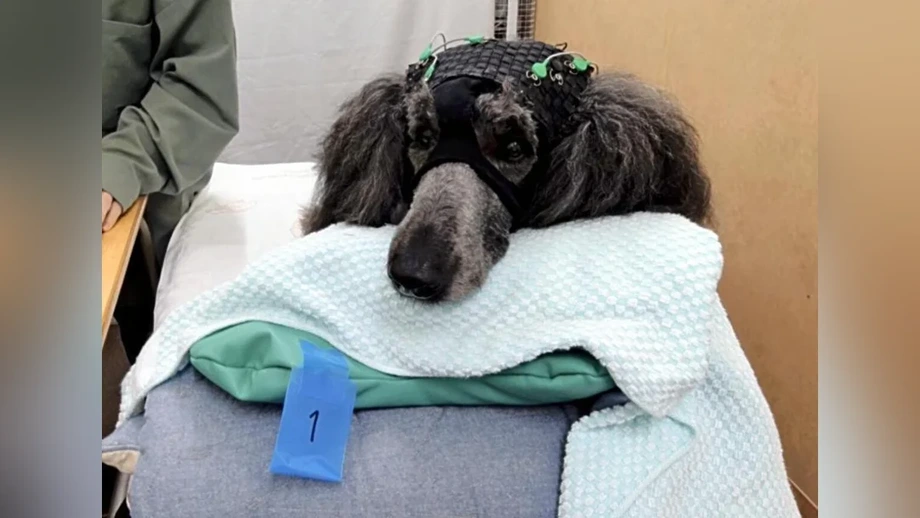
The dogs were trained to stay still on a mattress with their chins supported while wearing fitted caps holding seven sensors. They were not physically restrained and received rewards for remaining still. The researchers analyzed trials in which a dog was looking at the screen, and spaced short test sessions apart to reduce the chance that the dogs would become used to the mismatched signals.
The study period ran from January 2025 through May 2026:
- January 2025: The research period began.
- May 2026: The research period ended.
What did the brain signal show?
When the emotion in the voice did not match the face, the measured brain response was larger in the 250 to 500 milliseconds after the audio began. The difference was most consistent at a sensor over the left front of the head. Researchers found no reliable difference in the first 250 milliseconds.
The precise location of the response was not the same for every dog. The 10 year old poodle, for example, showed a response higher on the head rather than at the front. The two kinds of mismatch, a happy face with an angry voice and an angry face with a happy voice, also produced somewhat different patterns.
An electroencephalogram, or EEG, records electrical activity from the brain through sensors on the scalp. The team recorded 1,000 readings per second, allowing it to track changes far quicker than brain imaging methods used in earlier dog research. The result is a time pattern in electrical activity, not a direct translation of what a dog is thinking.
Does a stronger response mean the dog understood the emotion?
The mismatch response is consistent with dogs noticing that the face and voice do not fit together. Combining two signals might help a dog work out what a person is feeling, but the same brain response could also arise because the pairing was unexpected or caught the dog's attention.
The study was a pilot, with only three dogs. All the faces and voices belonged to the dogs' own owners, so the experiment cannot show whether dogs respond in the same way to unfamiliar people. Still photographs also differ from real faces, which change as people speak and move.
Researchers borrowed the time windows used to analyze the signals from human studies. It is not yet known whether a dog's response during those same periods reflects the same mental process as a human's. The different response locations across the three dogs also show why results from a larger group are needed.
Why use EEG for this question?
Brain imaging can show where activity is happening, but it is less suited to tracking very rapid changes. A dog's response within a fraction of a second could be missed by slower methods. EEG sensors make it possible to follow the timing of the electrical signal as a voice starts.
That timing matters in this experiment because a face and a voice arrive close together. The team could compare the dogs' responses to matching pairs, such as a happy face with a happy voice, and mismatched pairs, such as a happy face with an angry voice. The comparison revealed a difference during a specific interval after the sound began.
The left frontal response is an observation about where one signal was strongest, not proof that dogs process language in the same way people do. In humans, the left side of the brain often has a central role in language. Whether dogs use the same arrangement is not known.
What could the findings mean for life with dogs?
Kubo, a neuroscientist whose field is biological signal processing and who is also a neurologist, said the results point to the possibility that dogs use several kinds of information to respond to people. He described dogs as long standing companions that may process clues such as facial expressions and voices when responding to human feelings.
Kubo said further testing could help researchers understand how human communication affects dogs in care and training. He put the aim this way:
With further validation, our approach could help researchers understand how human communication affects dogs in everyday care and training.
That knowledge may matter in settings where people depend on dogs, including rescue work and therapy. Understanding which signals dogs notice could help people shape care and training conditions in ways that let dogs work without unnecessary stress. The current experiment is an early step toward that goal, rather than a guide to how any one dog will react.
What researchers need to test next
Larger studies could show whether the response appears across many dogs and whether it changes when the face and voice belong to a stranger rather than an owner. Tracking where each dog looks during a test could also help researchers interpret the brain signals, since the current analysis focused on trials when a dog looked at the screen.
Further work could also test whether the response is specific to emotional signals or reflects a more general reaction to an unexpected combination. Researchers have suggested examining other cues, including smell, because dogs can detect information about human emotional states through odors. No next study date was given.
Key Points
- Three pet dogs took part in a study led by Nara Institute of Science and Technology researcher Takatomi Kubo.
- The dogs' brain responses were larger when their owners' facial expressions and voice tones expressed different emotions.
- The clearest difference appeared 250 to 500 milliseconds after the voice began, with no reliable difference in the first 250 milliseconds.
- The results are preliminary and cannot yet show whether the dogs were combining emotional information or reacting to an unexpected signal.
- The findings were published in Scientific Reports and point to the need for tests with more dogs and unfamiliar people.