Discovery of a Hidden Reptile
Researchers working near the China-Nepal border have officially identified a new species of underground snake, expanding what scientists know about regional wildlife diversity. The discovery centers on a single specimen collected in August 2025 within Gyirong Town, Gyirong County, located in China's Xizang Autonomous Region. Scientists formally detailed the finding in a research paper published on September 17, 2026. The animal belongs to the family Typhlopidae, which represents the most species-rich and broadly distributed group of blind snakes.
Contents
Bing Lyu, Songwen Tan, Zhichao Zhao, Van Wallach, Qin Liu and Peng Guo conducted the study that brought the animal to light. Their findings were published in the academic journal ZooKeys under the title Indotyphlops gyirongensis, documenting pages 261 through 273 of volume 1292. This newly described reptile adds a fresh entry to the catalog of regional fauna, distinguishing itself through distinct physical and genetic traits.
Understanding the Fossorial Lifestyle
Blind snakes spend almost their entire lives hidden beneath the soil, living a lifestyle that scientists call fossorial. Unlike snakes that slither through grassy fields or climb trees in forests, these creatures move through earth and deep layers of fallen leaves. Their eyes are greatly reduced in size and remain covered by protective scales, meaning they rely on touch and chemical cues rather than sight to navigate their dark surroundings. This underground habit makes encountering them a rare event for researchers and locals alike.
The type locality where the specimen was found sits at coordinates 28.31 degrees north and 85.33 degrees east, at an elevation of 2,262 metres. The surrounding habitat features evergreen broad-leaved forests characterized by deep humus and a thick carpet of decaying foliage. Beneath a stone in this damp, hidden layer, the researchers located the animal carrying the holotype specimen catalog number YBU 251031.
Physical Characteristics and Anatomy
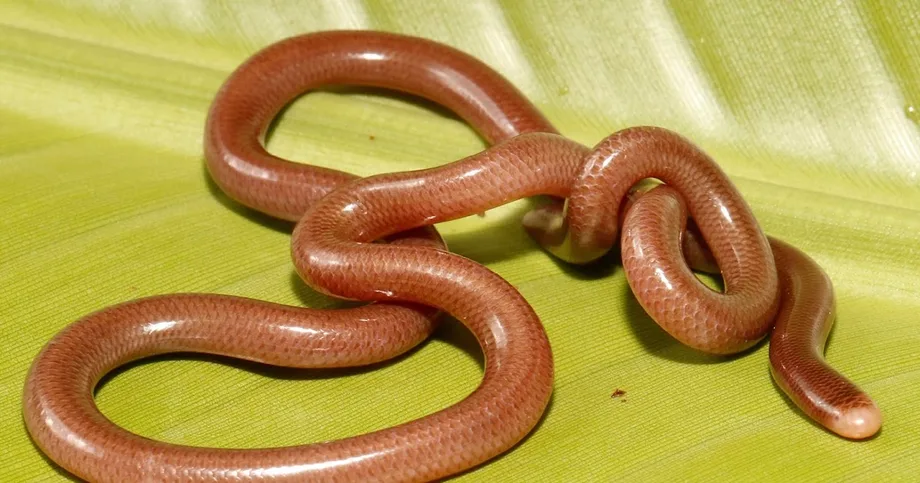
Anatomical examination revealed an adult female measuring 265 millimetres in total length. The creature possesses an extremely slender body, measuring just 3.5 millimetres in diameter at its midpoint, while its tail accounts for 7.5 millimetres of the total length. These proportions give the animal an earthworm-like appearance that helps it burrow through tight spaces underground.
Taxonomists differentiate blind snake species by counting and measuring specific body parts that remain consistent within a group. This specimen features 18 rows of smooth, glossy scales circling its midbody, a total of 432 middorsal scales running down its back, 17 subcaudal scales beneath the tail, and two infralabial scales along the lower jaw. Furthermore, the snake lacks the pointed terminal spine at the tip of its tail that appears in many other related species. Another notable feature is its light-coloured head cap, which provides a visual contrast against its darker body and separates it from similar regional species.
Molecular Analysis and Taxonomy
Physical appearance alone is often not enough to confirm a new reptile species because many blind snakes share very similar body shapes. The research team combined traditional physical examination with molecular and genetic analysis to establish the snake's true standing. Their genetic testing focused on the mitochondrial cytochrome c oxidase subunit 1 gene, commonly abbreviated as CO1, which helps scientists measure evolutionary distances between different animal groups.
Results from the genetic comparison showed an uncorrected CO1 p-distance exceeding 18.3 percent when compared with the closest known relatives within the Indotyphlops genus. This large genetic gap confirms that the specimen represents a distinct evolutionary lineage. The researchers also noted a specific arrangement of overlapping scales around the upper lip, describing it as a T-V pattern, which aids in its formal diagnosis.
Common Names and Etymology
Naming a newly discovered animal involves both a formal scientific designation and vernacular names used by the public. The researchers proposed the English common name Gyirong blind snake based on the location of its initial discovery. In Chinese, the species is known by the common name 吉隆盲蛇, which translates phonetically to Jilong mangshe. The specific scientific epithet gyirongensis functions as a noun in apposition, honoring Gyirong Town where the holotype was collected.
While the specimen was recovered in Xizang, China, researchers noted that the animal likely inhabits adjacent forested regions across the border in Nepal. Dense forests and similar elevations span across the international boundary, creating continuous subterranean habitats where these burrowing reptiles can thrive without human detection.
What Remains Unknown
Discovering a new species opens the door to many questions that require further field study and observation. Scientists have not yet determined the overall geographic distribution of the Gyirong blind snake beyond its single discovery site. Population sizes, reproductive rates, and exact dietary habits remain unstudied because observing live animals with such secretive habits is exceptionally difficult.
Researchers did not state when subsequent field expeditions will take place to search for additional specimens or monitor local population health. Understanding the evolutionary history of these subterranean reptiles will require more genetic samples from surrounding areas. For now, the single specimen remains a testament to the hidden biodiversity waiting in remote mountain ecosystems.
The Essentials
- The newly identified reptile is officially named Indotyphlops gyirongensis, with the English common name Gyirong blind snake.
- Researchers described the species in a study published on September 17, 2026, in the academic journal ZooKeys.
- The holotype specimen catalog number is YBU 251031, representing an adult female collected in August 2025.
- The discovery site is located in Gyirong Town, Xizang, China, at coordinates 28.31 degrees north and 85.33 degrees east, and an elevation of 2,262 metres.
- Physical traits include a 265 millimetre total length, 18 rows of midbody scales, 432 middorsal scales, and an uncorrected CO1 p-distance exceeding 18.3 percent.