Unlocking the Mysteries of Quantum Systems
Physicists have long studied how quantum many-body systems reach a state of thermal equilibrium, behaving much like a hot gas diffusing across a room until everything settles into a uniform mix. Under certain conditions, however, these systems defy normal thermal behavior and become trapped in non-ergodic states, meaning they fail to explore all available physical configurations over time. Researchers at the University of Science and Technology of China tackled this complex challenge by examining how individual particles interact within structured atomic arrays. Led by academician Guang-Can Guo and professor Wei Yi, the research team published their breakthrough theoretical findings on November 18, 2026, in the academic journal Physical Review Letters, Vol. 137, Iss. 21.
Contents
The study focuses on neutral atom arrays, which are platforms where individual atoms are trapped by laser beams and arranged in precise geometric patterns. These systems allow scientists to manipulate quantum states and tune long-range interactions between atoms with high precision. When atoms are excited into high energy levels known as Rydberg states, they exert powerful forces on neighboring atoms, preventing them from being simultaneously excited in a phenomenon called Rydberg blockade. Previous theoretical models captured some of these constraints, but scientists lacked a comprehensive framework for understanding how adjustable energy mismatches and long-range forces reshape the underlying quantum architecture.
The Concept of Hilbert-Space Fragmentation
In quantum mechanics, the state of a complex many-body system is described by a vast mathematical space known as Hilbert space, where every possible configuration of the system corresponds to a unique dimension. Normally, particles moving and interacting allow the system to explore this entire space freely over time. When specific kinetic constraints are imposed, the particle interactions can shatter this space into many disconnected compartments, preventing the system from moving between them. This phenomenon is known as Hilbert-space fragmentation, representing a radical form of quantum traffic jam where parts of the system remain permanently isolated from others.
Scientists previously studied these constraints primarily through a simplified framework called the PXP model, which exhibits weak fragmentation and leads to simple periodic oscillations when starting from certain initial conditions. Moving beyond this simplified model requires accounting for tunable Rydberg state detuning, which measures the energy offset between the laser excitation frequency and the atomic transition frequency. By adjusting this detuning alongside arbitrary long-range interactions, the research team sought to map out the exact structural hierarchy that emerges in one-dimensional atomic chains.
Mapping the Energy Gaps and Subspaces
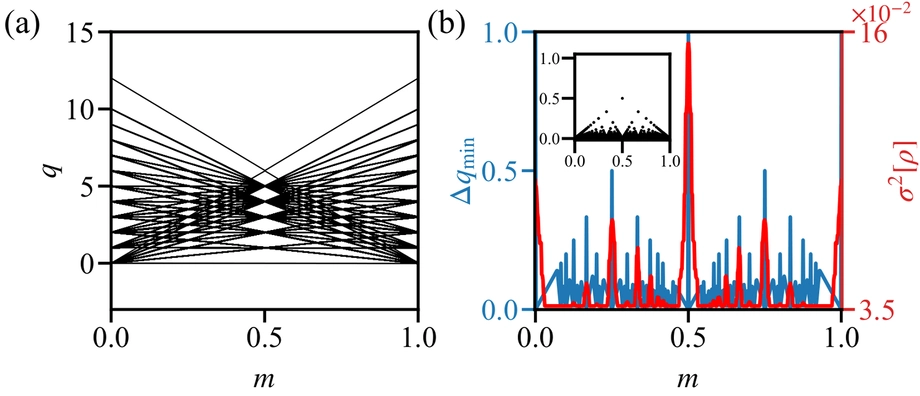
Wen-Jie Geng, Zhenming Zhang, and Wei Yi examined a one-dimensional chain of neutral atoms featuring lattice translation symmetry to see how energy offsets and long-range forces dictate system behavior. Their mathematical analysis revealed that the ratio between the energy detuning and the interaction strength strictly determines whether the Hilbert space develops finite energy gaps in the thermodynamic limit. The researchers proved an analytical correspondence between the minimum energy gap of these systems and a mathematical construct known as the Thomae function, which is a classic mathematical function characterized by its intricate, fractal-like distribution of rational and irrational values.
This mathematical bridge demonstrates that subspaces separated by finite energy gaps emerge within the Hilbert space only when the ratio of detuning to interaction strength forms a rational number. Without this rational ratio, the system blends differently, altering how quantum information and energy propagate through the atomic lattice. The funding for this research was provided by agencies including the National Natural Science Foundation of China and the Ministry of Science and Technology.
Pinpointing Discrete Dynamical Points
Beyond identifying static subspaces, the research team investigated how non-trivial quantum dynamics unfold within each isolated compartment. Their calculations showed that motion and evolution do not occur uniformly across all parameter settings, but instead appear exclusively at a series of discrete dynamical points. The precise analytical form of these dynamical points depends jointly on the mathematical nature of the long-range interactions and the chosen detuning parameters.
To make sense of these constraints, the authors introduced auxiliary fermions, which are theoretical mathematical particles that help translate complex kinetic restrictions into emergent local conservation laws. This theoretical machinery allowed the researchers to construct a unified framework describing how the connectivity structures, fragment dimensions, and effective models operate inside each subspace. Consequently, identical physical systems initialized in different quantum states can exhibit radically contrasting behaviors, ranging from entirely frozen configurations to restricted periodic oscillations.
Uncovering Strong Fragmentation Mechanics
The study further demonstrates that under a broad category of dynamical points, the atomic array undergoes strong Hilbert-space fragmentation. In this regime, the relative size of the largest connected fragment shrinks toward zero as the overall system size scales up toward infinity. This mathematical scaling behavior indicates that the fragmentation becomes increasingly dominant in larger systems, locking vast fractions of the quantum states into localized, non-communicating sectors.
These theoretical insights bridge a major gap in modern quantum physics by extending the understanding of constrained many-body dynamics far beyond the traditional PXP model. By establishing the exact micro-mechanisms governing these phenomena, the work provides a blueprint for experimentalists using programmable quantum simulators. Researchers can now better design specific kinetic constraints, manipulate complex many-body quantum states, and probe novel non-equilibrium phases of matter using neutral atom hardware.
The findings carry practical significance for the burgeoning field of quantum simulation, where researchers race to build reliable quantum processors and simulators free from unwanted thermalization. By demonstrating how to deliberately induce or avoid fragmentation through laser tuning and atomic spacing, the work gives experimental laboratories a new set of dials to control quantum information flow. As experimental groups adopt these principles in physical hardware, the theoretical boundaries established by the USTC team will guide the development of fault-tolerant quantum devices designed to maintain coherent non-equilibrium states over extended durations.
The research paper, titled Emergent Kinetic Constraints and Subspace Fragmentation in Rydberg Arrays, lists Wen-Jie Geng and Zhenming Zhang as co-first authors, alongside corresponding author Wei Yi. The team operates out of the Laboratory of Quantum Information, the Anhui Province Key Laboratory of Quantum Network, the CAS Center for Excellence in Quantum Information and Quantum Physics at the University of Science and Technology of China, and the Hefei National Laboratory.
The Bottom Line
- Researchers at the University of Science and Technology of China revealed how Rydberg-state detuning and long-range interactions cause Hilbert-space fragmentation in neutral atom arrays.
- The findings were published on November 18, 2026, in Physical Review Letters by corresponding author Wei Yi and co-first authors Wen-Jie Geng and Zhenming Zhang.
- Mathematical proof links the minimum energy gaps of these systems to the Thomae function, showing subspaces form when detuning-to-interaction ratios are rational numbers.
- The team introduced auxiliary fermions to establish a unified theoretical framework, proving that strong fragmentation occurs where largest fragments shrink to zero relative scale in large systems.
- The research expands constrained quantum dynamics beyond the PXP model, offering new tools to control many-body quantum states in programmable simulators.