Launch from Hainan lights up skies across the region
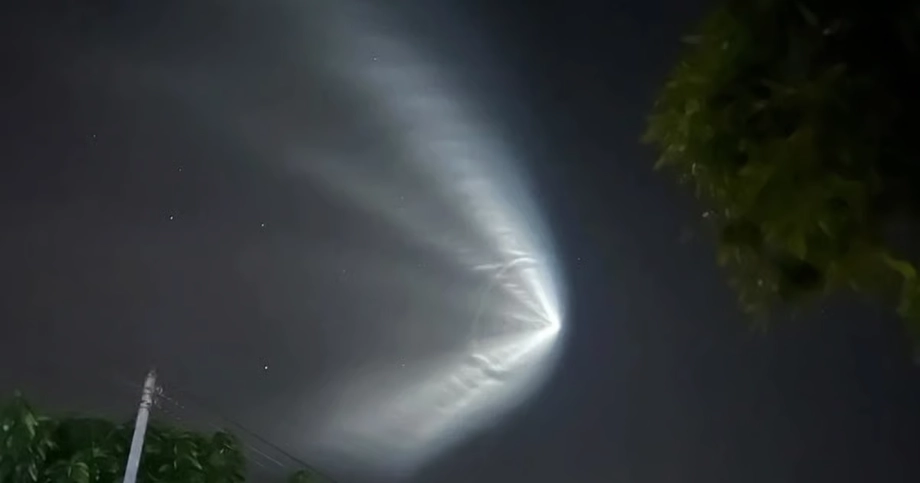
A Chinese rocket launched at 4:24 a.m. on November 9, 2026, caused the bright, jellyfish shaped light seen over Sabah, Malaysia's Ministry of Science, Technology and Innovation confirmed through the Malaysian Space Agency (MYSA). Across the sea, Philippine authorities identified a possible debris drop zone approximately 25 nautical miles from Puerto Princesa, Palawan, and 19 nautical miles from Tubbataha Reefs Natural Park.
Contents
- Launch from Hainan lights up skies across the region
- What people saw in Sabah and Palawan
- How a rocket creates a space jellyfish
- The sequence from launch to confirmation
- Why the waters near Palawan matter
- Philippine Navy raises its readiness
- Separate naval report on January rocket sighting
- What the Long March 12 carried
- Why the warning continues after the launch
- What residents should do if they find debris
- Key Points
The Long March 12 lifted off from the Hainan International Commercial Launch Centre in Wenchang, southern China, carrying the 29th group of satellites for China's internet constellation in low Earth orbit. The satellites entered their designated orbit.
MYSA's confirmation on Wednesday, November 11, followed sightings from fishermen, residents and Philippine naval personnel early on Monday. A fisherman recorded the light over Kunak, Sabah, at about 4:40 a.m., while naval personnel in Puerto Princesa had observed a luminous trail several minutes earlier.
The Philippine Space Agency (PhilSA), in its Long March 12 advisory published on November 9, placed the expected debris zone within Philippine archipelagic waters. MYSA described the location more generally as Philippine territorial waters.
MYSA said it had received no official reports of debris from the launch being found within Malaysian sovereign territory. PhilSA warned that discarded rocket parts could endanger vessels and aircraft, float toward nearby shores, or contain toxic fuel remnants. Its advisory described where debris was projected to fall; no confirmed recovery location was announced.
What people saw in Sabah and Palawan
A fisherman aboard a boat at sea recorded the moving light over Kunak at about 4:40 a.m. The footage circulated on Facebook, prompting questions about its identity before authorities issued their explanation. Residents in Kota Kinabalu also shared sightings online.
In Puerto Princesa, Philippine naval personnel observed a bright, cone shaped vapor trail at 4:33 a.m. It moved from northwest to southeast alongside a bright red and orange streak and remained visible for about one minute and 29 seconds.
Observers reported a loud explosive sound at about 4:37 a.m., followed by two quieter sounds at about 4:38 a.m. and subsequent rumbling. The Philippine Navy assessed the sounds as potentially connected to the rocket's ascent and atmospheric flight.
The observations give a sequence stretching from the launch in Hainan to sightings around Palawan and Sabah. China, Malaysia and the Philippines use the same clock time for these locations, allowing the reported times to be compared directly.
How a rocket creates a space jellyfish
The Philippine Navy attributed the unusual glow to what is commonly called the space jellyfish effect. Rocket exhaust spreads out at high altitude, where the surrounding air is much thinner than it is near the ground.
Sunlight can illuminate that expanding cloud while people below remain in darkness. Before sunrise, the Sun may still be below the horizon for an observer on land or at sea, yet its light can already reach material much higher in the sky.
The result can resemble a glowing jellyfish, with a bright center and broad, translucent trails. The Naval Command West said this kind of visual effect is commonly associated with launches during the hours before dawn or around twilight.
The light and the debris warning concern different parts of the same launch. Exhaust high above Earth produced the visible display, while discarded rocket hardware created the need for warnings to people traveling through the projected drop zone.
The sequence from launch to confirmation
November 9 brought observations from several locations within minutes of liftoff. Malaysia's public confirmation followed on November 11. The main reported events were:
- November 9, 4:24 a.m.: The Long March 12 launched from Wenchang, Hainan, carrying internet satellites.
- 4:33 a.m.: Naval personnel in Puerto Princesa saw the luminous trail, which remained visible for about one minute and 29 seconds.
- About 4:37 to 4:38 a.m.: Observers heard a loud sound, two quieter sounds and rumbling.
- About 4:40 a.m.: A fisherman recorded the light over Kunak, Sabah.
- November 9: PhilSA published its advisory identifying the expected debris zone.
- November 11: MOSTI, through MYSA, confirmed the connection between the Sabah light and the Chinese launch.
PhilSA said government agencies and relevant authorities had received a report before the launch. Details of the drop zone were also disclosed through a Notice to Airmen, or NOTAM, an operational notice used to alert aviation personnel to activities or hazards affecting flights. The notice warned of an "aerospace flight activity."
Why the waters near Palawan matter
PhilSA identified one expected drop zone using its approximate distance from two landmarks: 25 nautical miles from Puerto Princesa and 19 nautical miles from Tubbataha Reefs Natural Park. Those distances are roughly 46 kilometers and 35 kilometers, respectively.
A nautical mile is a distance unit commonly used at sea and in aviation. Identifying a zone this way helps maritime and aviation authorities relate a launch warning to the waters and routes under their watch.
PhilSA said debris was not projected to fall on land or inhabited areas. Its warning focused on ships, fishing boats, aircraft and other craft passing through the designated waters.
PhilSA, the Philippine government agency responsible for space matters, explained why discarded hardware requires a safety warning even when its projected destination is the sea:
Unburned debris from rockets, such as the booster and fairing, are designed to be discarded as the rocket enters outer space. While not projected to fall on land features or inhabited areas, falling debris poses danger and potential risk to ships, aircraft, fishing boats, and other vessels that will pass through the drop zone.
A booster supplies thrust during part of a rocket's flight. A fairing is the protective covering around its cargo during ascent. Once these components have completed their jobs, they can separate from the vehicle.
Philippine Navy raises its readiness
The Philippine Navy's Naval Command West placed its units and assets on heightened alert as a precaution. The command said the measure was intended to maintain readiness and support rapid reporting and assessment of possible incidents.
Personnel at Lawak and Patag stations reported white luminous trails about 60 to 70 nautical miles east of their locations. At Likas Station, personnel saw a faint white light roughly 100 nautical miles to the northeast.
At Rizal Reef Station, personnel reported a white luminous trail about 80 nautical miles east southeast, moving southeast before disappearing. They estimated its altitude at 4,500 to 5,500 feet above sea level. Personnel at Tubbataha Station saw a bright object approximately 19 nautical miles away.
The command maintained coordination with government agencies, coastal communities and local fishermen to support reports of suspected rocket debris, falling objects and related incidents at sea or in the air. For fishing communities, those reporting arrangements provide a direct way to alert authorities if unfamiliar material appears in their working waters.
Separate naval report on January rocket sighting
In a separate incident on January 19, 2026, the Armed Forces of the Philippines' Western Naval Command (WNC) confirmed that a suspected Chinese Long March 12 rocket traversed Palawan airspace. WNC personnel observed it at about 3:59 p.m. and captured it on video during routine real-time monitoring operations.
The footage showed a visible trail consistent with a rocket transit. WNC said earlier pre-launch advisories had identified possible debris drop zones approximately 20 to 160 nautical miles off Palawan's eastern coast, including areas near Puerto Princesa City and Tubbataha Reefs Natural Park.
Monitoring was coordinated with the Western Command (WESCOM), Tactical Operations Wing-West (TOWWEST), Philippine Coast Guard, Provincial Disaster Risk Reduction and Management Office, Puerto Princesa City Disaster Risk Reduction and Management Office, and Philippine National Police Maritime Group. As of 5:00 p.m. on January 19, no injuries, property damage or debris impact on land had been reported.
"All concerned agencies remain on heightened alert and continue to closely monitor the situation," the WNC said in a statement.
The command advised the public to remain vigilant and immediately report unusual sightings or suspected debris to local authorities.
"The WNC remains committed to safeguarding the country's maritime and aerial domains, ensuring public safety, and upholding national sovereignty through continuous monitoring, inter-agency coordination, and timely information dissemination," it said.
What the Long March 12 carried
The mission delivered the 29th group of satellites for China's internet network in low Earth orbit. A satellite constellation is a collection of satellites working together, in this case to provide internet connectivity.
The Long March 12 is about 62 meters long and uses two stages. Its engines burn kerosene with liquid oxygen, which must be kept extremely cold. Stages allow a rocket to discard hardware during ascent and continue with a lighter vehicle.
The rocket can carry about 12 tonnes to low Earth orbit. It also has a stated capacity of at least 6 tonnes to a sun synchronous orbit at an altitude of 700 kilometers. A sun synchronous orbit allows a satellite to pass over locations at approximately the same local solar time, providing consistent lighting for observations.
Those figures describe the vehicle's carrying capacity. The mission was identified as the 676th flight in the Long March rocket series, and the Long March 12 is China's first rocket with a single main body in the diameter class of four meters.
Why the warning continues after the launch
PhilSA warned that some debris could float around the projected fall area and wash toward nearby coasts. A launch warning therefore matters to coastal residents as well as crews working in the designated waters.
The agency also said an uncontrolled return to the atmosphere by the rocket's upper stages remained possible. An upper stage is the part of a rocket that continues carrying its payload toward orbit after earlier stages separate.
PhilSA called for international partners to explore coordinated regional procedures and capabilities to protect spacecraft and people on the ground. Its concern covers hardware discarded during launches as well as larger rocket components returning from space.
The agency said accelerating global launch rates meant debris shed during staging and the uncontrolled re-entry of large rocket upper stages posed growing hazards to other spacecraft, civil aviation and populations on the ground.
Previous incidents have brought similar concerns to several regions. Chinese rocket debris has fallen near Northern Luzon, a metal object found in the Australian outback was traced to a Chinese rocket, and remnants from a Chinese rocket breakup fell over Texas in 2023. The recurring practical task for authorities is to warn traffic, assess sightings and arrange safe handling when material is found.
What residents should do if they find debris
PhilSA advised the public to report suspected debris to local authorities and avoid retrieving or approaching it. The agency warned that fragments may contain remnants of toxic substances, including rocket fuel.
MYSA directed people in Malaysia who discover suspicious objects believed to be connected to the launch to contact the Space Regulatory Division immediately. The telephone number is 03-8885 8685, and the email address is [email protected].
Malaysia's position at the time of its statement was that no official debris discoveries had been reported within its sovereign territory. The explanation for the bright sky display was established, while authorities continued to ask communities to report any suspected physical remains.
Key Points
- MYSA linked the bright light over Sabah to a Long March 12 launch from Hainan at 4:24 a.m. on November 9, 2026.
- The rocket delivered the 29th group of satellites for China's internet constellation in low Earth orbit.
- Sunlight illuminating expanding rocket exhaust produced the space jellyfish effect described by the Philippine Navy.
- PhilSA identified a projected debris zone about 25 nautical miles from Puerto Princesa and 19 nautical miles from Tubbataha Reefs Natural Park.
- The Philippine Navy placed units under Naval Command West on heightened alert.
- MYSA had received no official reports of debris discoveries in Malaysian territory when it issued its statement.
- Suspected debris should be reported to authorities and left untouched because it may contain toxic fuel remnants.