A new search engine with a visible advertising boundary
Tencent launched Yuanbao Search on November 11, bringing AI answers, public WeChat content and academic literature into a standalone search service connected to 157 sources it describes as authoritative. Its central advertising promise is straightforward: paid promotions appear in a separate module, carry a label identifying them as related advertisements and can be collapsed by the user.
Contents
- A new search engine with a visible advertising boundary
- What Tencent means by keeping ads apart
- AI answers alongside access to original information
- WeChat access brings useful material, with uneven freshness
- Academic tools translate papers into accessible explanations
- What the large index numbers actually describe
- One search foundation for consumers and businesses
- Speed and automated improvement face practical tests
- Key Points
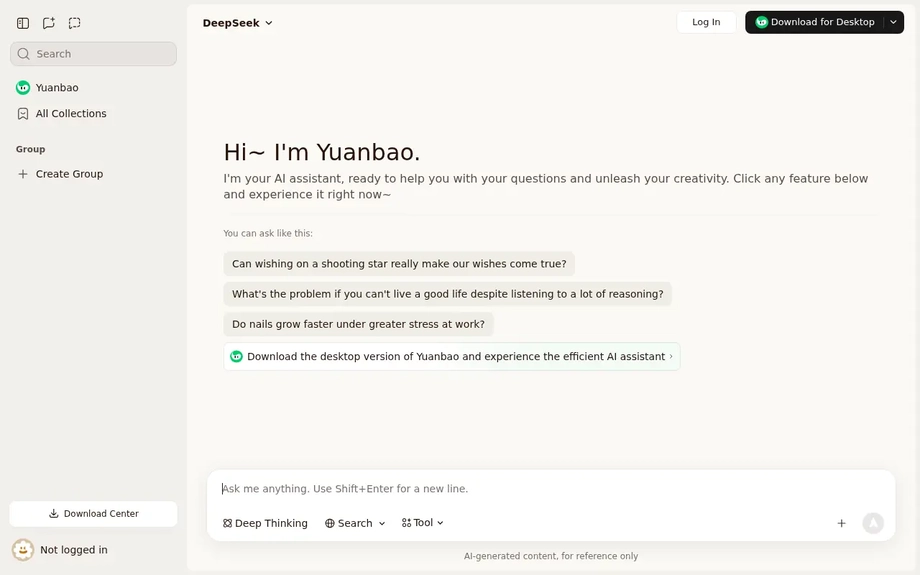
The service is available through so.qq.com in a browser. Users of the latest version of QQ Browser can also select Yuanbao Search in the browser's search engine settings. Searches can begin with typed text, speech or a photograph, while results can include AI summaries, conventional webpage links, cards and charts.
Tencent says the product rebuilds the full search process around Yuanbao's large model, from understanding a request to finding information, ranking results and assembling an answer. Its reach includes public webpages, WeChat official accounts, WeChat Video Accounts and research papers.
The launch follows an October 20 expansion of Tencent's search service for businesses and developers. Both products use the same underlying retrieval and AI capabilities, but serve different audiences: one gives people a search page, while the other lets software request information automatically.
For users, the immediate change is a single place to move between an AI explanation and the material behind it. For Tencent, the launch brings technology already used within its businesses into a public search product, with advertising separation and access to its content ecosystem as prominent selling points.
What Tencent means by keeping ads apart
Li Ruizhang, head of the Yuanbao Search web product, said Tencent accepts advertising as part of the business but wants search results to remain useful in their own right. In remarks translated from Chinese, he described the boundary this way:
We do not reject advertising, but users should not have to look for answers in advertisements.
Li said advertisements should occupy a clearly identified area rather than appear disguised as answers. Users can collapse the entire advertising block, giving them control over how much promotional content remains on screen.
Tencent is also exploring advertising tied to the user's current request. Li gave the example of someone looking for a particular service: related products could be displayed, leaving the person to decide whether to buy. He described the company's approach as restrained and linked it to building a business that can last.
Initial testing found a collapsible advertisement in results for a civil service examination query. Several other searches, including queries about cars, medicines and a car vacuum cleaner, showed no obvious advertising placements. Advertising is therefore part of the product, with its visibility varying across the searches examined.
AI answers alongside access to original information
Yuanbao Search combines generated answers with tools for tracing information back to its source. A user can read a summary, inspect the supporting material and ask a follow-up question based on the answer already given.
The interface includes channels for academic and science content, WeChat official accounts, videos, organisations and mainstream media. Those channels let users narrow the kind of material they want instead of relying entirely on a mixed results page.
Tencent says its ranking gives priority to authoritative institutions and official sources. In an initial test involving Tianjin civil service examinations, the first results included the municipal government's examination service platform and an official recruitment announcement. Switching to the organisations channel also brought government material to the front.
The distinction matters for searches involving an application deadline, recruitment rules or public services. A summary can explain the essentials quickly, while a link to the responsible institution gives users access to the instructions they need to act.
Li said Yuanbao Search would remain focused on search rather than develop into a general AI assistant. Additional functions, including possible task features, would serve the process of finding information and browsing webpages. Tencent has also adapted the service specifically for QQ Browser.
WeChat access brings useful material, with uneven freshness
WeChat official accounts and Video Accounts are central to the product's content range. Their inclusion brings articles and videos from Tencent's ecosystem into the same search experience as public webpages and academic material.
Early testing found that the official accounts channel could retrieve recruitment information published that day. Searches about changes to OpenAI Codex usage allowances also returned technology articles published through WeChat accounts.
Video results were less current in one examination query: the first screen mainly contained items marked as a year old, with relatively few videos and some material from outside Tencent's platforms. Some official account links also failed to open, and parts of the content library updated slowly.
For someone checking recruitment news, the practical difference is substantial. A fresh written notice can help identify a current opportunity, while an older video may describe an earlier recruitment cycle. The first tests show that freshness varies between content channels.
Before the consumer launch, Tencent Cloud vice president Ma Jin said time sensitive content was updated hourly. That describes an update process for the search infrastructure; users encounter its results through individual channels, where the early experience was uneven.
Academic tools translate papers into accessible explanations
Yuanbao Search's academic features are designed to make research easier to inspect. Tencent says the service can explain paper conclusions in everyday language while retaining the original supporting material. Users can also translate English literature and view titles and abstracts directly.
In an early search about memory in AI agents, the academic and science channel displayed an AI summary alongside paper details, including titles, authors, publication years and citation counts. An AI agent is software that can work through several steps toward a goal, rather than simply generate a single reply.
A separate feature for quickly reading and summarising the main points of academic papers was undergoing internal testing at launch. Tencent gave no public release date for that feature.
Other specialised searches use cards to organise information. A car query can display a vehicle image, reference prices, power options and specifications. Entertainment results can show programme details and viewing links. Health searches can surface Tencent Medipedia entries covering symptoms, treatment or medicine safety, including information about professional reviewers.
These formats change how people navigate results. Instead of opening several pages to locate a price, an episode or a paper abstract, they may find the relevant item grouped on the results page, with supporting links available for a closer look.
What the large index numbers actually describe
Tencent describes Yuanbao Search as operating at the scale of hundreds of billions of index entries. More detailed figures disclosed before launch included 50 billion retrievable documents and more than 150 billion vector index entries, alongside a claim of 5 billion webpages added daily.
A retrievable document is an item the system can return, such as a webpage. A vector index stores numerical representations of content so the system can match ideas and meaning, rather than only identical words. A single document can contribute to multiple stored representations, so the document and vector totals measure different things.
Tencent's system combines vector retrieval with an inverted index, a conventional search structure that maps words to the documents containing them. Put simply, one method helps find material about the same idea, while the other efficiently finds pages containing particular terms. Large models then help rank the results, alongside mechanisms for identifying low quality content.
The company also disclosed 95% coverage for its Chinese index and a broader network coverage figure of 96%. Those figures refer to differently described measures. Its 157 authoritative sources span 13 specialist industries, with named content connections including Ctrip, Meituan, JD.com, Dianping and Autohome.
Ma, Tencent Cloud's vice president and head of Yuanbao Search research and development, described a limit on what the engine collects:
If a website has anti-crawling measures, we do not include it. This respects their intellectual property.
For users, that means access also depends on a publisher's permission and any content partnership Tencent has arranged. A large index can still leave particular websites outside the searchable collection.
One search foundation for consumers and businesses
Tencent's public search page follows a longer development process that brought together technology associated with QQ Browser and Sogou. The search team was formed alongside Yuanbao in the middle of 2024, according to details disclosed before the launch.
The key stages were:
- Mid-2024: The search team was formed alongside Yuanbao, drawing on QQ Browser and Sogou technology.
- October 20: Tencent expanded the search service for businesses and developers through API, MCP and Skill access.
- November 3: Plans for a consumer search engine became public.
- November 11: Yuanbao Search launched through its website and QQ Browser.
An API is a connection that lets one program request information from another. MCP, short for Model Context Protocol, and Skill integrations provide other ways for AI applications to use the search service. Tencent's Yuanbao Agent has also gained search access.
Before the public launch, Tencent said the underlying service supported more than 50 internal businesses, including WorkBuddy, ima, Tencent Financial Technology and Tencent Video, and handled hundreds of millions of calls daily. Those figures describe use of the shared infrastructure across products.
An invitation code promotion offered developers up to 6,000 calls during October and November. The business service gives Tencent another route to customers: developers can use its search inside their own applications without directing people to the consumer website.
Speed and automated improvement face practical tests
Ma described search as moving through three stages: people choosing links from keyword results, large models reading results and generating answers, and agents breaking a request into smaller questions before retrieving structured information.
The third stage makes search part of a larger software task. A program might need several connected searches, with each result helping determine what to ask next. That requires dependable retrieval as well as a fluent final answer.
Five early latency tests of the business service recorded response times between 345 and 485 milliseconds, averaging about 420 milliseconds. Those measurements concern search response speed. Producing a finished answer can also require reading content, making further requests and generating text.
Early assessments identified limitations in searches requiring several connected steps and in extracting complete webpage content. A Fetch interface for retrieving page contents was not yet open at the time of the earlier business assessment.
Tencent says a mechanism it calls recursive self improvement, or RSI, will use actual searches and feedback to improve the product. The described process identifies unsatisfactory results, uses agents to label examples and applies further model training. In everyday terms, the aim is to turn unsuccessful searches into material the system can learn from.
The launch brings together a public search interface, developer infrastructure and Tencent's content connections. Its immediate value for users rests on concrete details: whether the right notice appears, whether the link opens, whether information is current and whether an advertisement stays visibly separate from the answer.
Key Points
- Tencent launched Yuanbao Search on November 11 through so.qq.com and the latest QQ Browser.
- Advertisements occupy a labelled module that users can collapse.
- Search covers public webpages, WeChat content and academic literature, with 157 sources Tencent describes as authoritative.
- Users can search by text, voice or photograph and ask follow-up questions about AI answers.
- Early tests found fresh official account content, older video results and some links that failed to open.
- The consumer product shares retrieval and AI infrastructure with Tencent's business search service.