A rapid escape on a Malaysian snake track
Thirteen tiny snakes collected at Malaysia's Kubah National Park performed rapid cartwheels in laboratory experiments, reaching peak speeds of 1.72 to 3.69 metres per second. The fastest movement, about 13 kilometres per hour or 12 feet per second, was roughly four times the peak forward speed measured during ordinary slithering.
Contents
The research, published in Current Biology on October 19, 2026, describes how dwarf reed snakes belonging to the genus Pseudorabdion coordinate this unusual escape. They push against the ground, briefly lift parts of their bodies into the air and swing themselves forward into another rotation, keeping their heads surprisingly steady throughout.
Researchers from Japan and Malaysia tested three Pseudorabdion species alongside six related reed snakes belonging to the genus Calamaria. Every Pseudorabdion snake cartwheeled. None of the Calamaria snakes performed the movement under the same test conditions.
The results give scientists a detailed view of a behaviour first formally described in 2023. For animals that spend much of their lives concealed beneath leaves and fallen wood, a sudden burst of rolling could provide a quick route back to cover when a threat gets too close.
How researchers caught the movement
Yosuke Kojima, an ecologist at Toho University in Chiba, Japan, learned about the behaviour in 2019, when a colleague in Sarawak, Malaysia, described seeing a snake move this way. The observation prompted a closer investigation of something rarely captured on camera.
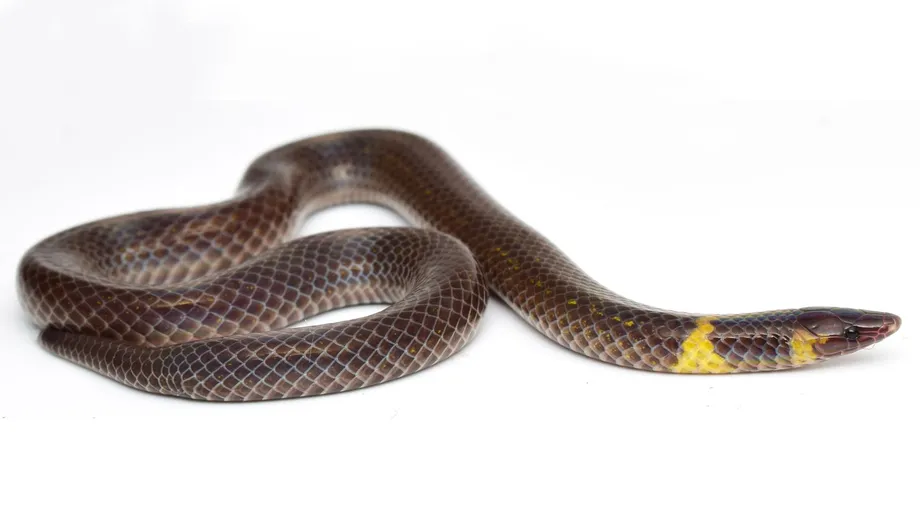
The team collected 11 P. saravacense, one P. collaris and one P. longiceps, plus the six Calamaria snakes. The animals measured about 11 to 28 centimetres long, making them easy to miss beneath forest debris.
Kojima described their habit of staying out of sight:
They always hide under the leaves,
The researchers constructed a narrow track approximately 2.2 metres long. Each snake was placed at one end and gently tapped to encourage it to move. Cameras above and beside the track recorded the response from two angles, allowing the team to follow both forward travel and changes in body position.
The comparison involved 19 snakes in total. Within the Pseudorabdion group, 11 of the 13 belonged to P. saravacense, while the other two species were represented by one animal each. That distribution matters when considering how much variation the experiment captured within each species.
What happens during a cartwheel?
A dwarf reed snake begins by curling its body into a C shape. It lifts its head and points it towards the direction it will travel. Its body then starts to straighten, moving the point of contact with the ground towards its tail.
The snake pushes off, briefly sending part of its body into the air. During this phase, it twists into an arch above its head, then swings that arch forward and down past one side of the head.
Contact with the ground starts the next rotation. By alternating which side of its body touches down, the snake can repeat the sequence and continue travelling forward. The movement combines rolling, twisting and pushing in a coordinated cycle.
Scientists call this active cartwheeling because the animal supplies the force needed to propel itself. A snake rolling downhill can gain speed from gravity; these snakes also roll on a flat surface by using their bodies to push against the ground.
The head follows a steadier course than the rotating body. Researchers think that keeping it aligned with the direction of travel helps the snake maintain its bearings while the rest of its body swings around it. They compared this feature with the way flying snakes stabilise their heads as they launch into the air.
How fast is the rolling escape?
The measured peak speeds ranged from 1.72 to 3.69 metres per second, equivalent to approximately 6 to 13 kilometres per hour, or 3.8 to 8.3 miles per hour. Those are brief maximum speeds recorded during movement along the track.
The fastest cartwheel was roughly four times the peak forward speed measured during conventional lateral undulation. Lateral undulation is the familiar movement in which a snake makes waves along its body, pushing against the surface to travel forward.
That comparison gives a concrete reason for interest in cartwheeling as an escape behaviour. A small snake exposed on the ground may have only a short distance to cover before reaching leaves, a log or another hiding place. A rapid burst could shorten the time it spends exposed.
The experiment also revealed a difference between the groups tested: all 13 Pseudorabdion snakes rolled, compared with zero of the six Calamaria snakes. The next challenge is to understand what allows the first group to perform the movement and how widely that ability occurs among its relatives.
From a road encounter to a laboratory study
The earlier formal description followed an encounter with a P. longiceps in northwest Malaysia in August 2019. Scientists conducting surveys for other species came across the snake crossing a road. After being startled, it curled up and rolled downhill away from them.
The researchers caught the animal and placed it on a flat area, where it rolled again while they recorded it. That second observation showed the snake generating its own rolling movement on level ground. The encounter was described in Biotropica in 2023, providing the first formal documentation of cartwheeling in a snake.
- August 2019: Scientists observed and filmed a dwarf reed snake rolling during fieldwork in northwest Malaysia.
- 2019: Kojima heard a colleague in Sarawak describe the unusual behaviour.
- 2023: A Biotropica study formally described the field observation.
- October 19, 2026: The Current Biology study examined the movement in detail using three Pseudorabdion species and a Calamaria comparison group.
Why roll when a snake can slither?
Dwarf reed snakes live close to the forest floor, sheltering beneath rocks, logs and leaf litter. Their small size and secretive habits help them stay concealed, but they remain vulnerable to predators, including birds and other snakes such as the striped coral snake.
Researchers suspect that rapid rolling could help a snake reach shelter while startling or confusing an approaching predator. An abrupt change from slithering to tumbling would create a very different moving target.
Another suggestion is that the movement could interrupt a scent trail. Snakes and other animals can use chemical traces to follow prey, so changing contact with the ground might affect those traces. This remains a proposed explanation awaiting testing.
Rolling escapes also occur elsewhere in the animal kingdom. The Moroccan flic-flac spider uses a rolling movement when threatened. Its example shows that very different body forms can produce rapid rotations, although a spider's legs and a snake's long body create different mechanical challenges.
The physical demands behind the spectacle
Jessica Tingle, a biologist at Brown University in Providence, Rhode Island, who was not involved in the study, highlighted the challenge of moving a long body in this way:
I find it especially amazing that an elongate animal like a snake can manage to roll, especially given that they do it in such an explosive way, which probably asks a lot of their muscles and bones.
The recordings explain the sequence of body movements, while questions remain about its energy cost, how long a snake can sustain it and how well it works across natural forest surfaces. Researchers also need to investigate whether particular features of the muscles, skeleton or nervous system make it possible.
Neural control means the signals through which the brain and nerves coordinate muscles. For a cartwheeling snake, those signals must organise a rapid push, twist and landing while keeping the head facing forwards.
Tingle framed the evolutionary question in terms of an ability that might be specialised or more widely shared:
Are their brains different in some way to let them coordinate a fast and unusual movement? Or do all snakes have the basic equipment, and they just don't use it?
What the footage changes
The new experiments connect a rare field observation with a repeatable movement recorded across three species. Cameras show how the snakes generate forward motion, link one rotation to the next and stabilise their heads during a fast escape.
The combination of field observations and laboratory measurements gives future work a specific task: examine when snakes choose to cartwheel, what happens when a predator approaches and how leaves, branches and uneven ground affect the movement. For these small forest reptiles, the value of the manoeuvre ultimately lies in reaching safety.
Key Points
- All 13 Pseudorabdion snakes tested cartwheeled; none of six Calamaria snakes did.
- Peak speeds reached 3.69 metres per second, about 13 kilometres per hour.
- The fastest rolling movement was roughly four times the measured peak speed of ordinary slithering.
- The snakes coordinated pushes, twists and alternating landings while keeping their heads relatively steady.
- The behaviour was formally described in 2023 after an observation in Malaysia in 2019.
- Its energy cost, endurance and performance during encounters with predators still require investigation.