A Mountain Barrier With a New Crossing
Xinjiang has started building a 393.693 km expressway that aims to keep traffic moving across the Tianshan Mountains in every season. The G3033 Kuitun to Dushanzi to Kuqa Expressway, known in Chinese as the Kuiduku Expressway, will run from Kuitun and Dushanzi in the north to Kuqa in the south. It has been approved and is listed as a major project of the national comprehensive transport network under the 15th Five-Year Plan, a Chinese five year blueprint for development. The planned price tag is more than 70 billion yuan, and completion is targeted for 2032.
Contents
- A Mountain Barrier With a New Crossing
- Why the Existing Duku Highway Closes
- What the New Expressway Will Include
- A Short Timeline of the Build
- How Engineers Are Beating the Cold
- Why the Crossing Matters to People
- From a Seasonal Drive to an All Season Route
- What Changes for Trade and Daily Life
- What Travelers Should Know Before the New Road Opens
- The Engineering Lessons Already in Use
- What to Know
The central promise is time. Project descriptions say the crossing between northern and southern Xinjiang will fall from 14 hours to four hours. Xinjiang Transportation Investment Co., Ltd. gives a wider estimate of about five hours for the completed route. Either figure points to a shift for a region where the Tianshan range has long split travel into northern and southern halves. The new road is designed for 100 to 120 km/h.
Why the Existing Duku Highway Closes
The expressway is called a sister line of the Duku Highway, a famous scenic road in China. The Duku Highway is China National Highway 217, a 561 km route from Dushanzi to Kuqa built between 1974 and 1983. During construction, 168 soldiers died. The road climbs from desert valleys to Haxilegen Pass, about 3,700 meters above sea level, with grades reaching 12 percent.
Snow and ice make that high pass hard to keep open. The Duku Highway is generally open from June to October, about five months. More detailed travel information puts the closed season from mid October to late May. Snow at Haxilegen Pass can pile up several meters deep, and winter temperatures can fall to 40 degrees Celsius below zero.
For the 2026 season, the stated window was around June 1 to around October 10, with a warning that snow after September 25 can force an early closure. Travelers can check road status through the Xinjiang Transportation Bureau hotline, 0991 2865111. The road has vehicle limits too: vehicles with more than 7 seats are kept off some sections, and tour buses and large trucks face restrictions.
What the New Expressway Will Include
G3033 starts at the Kuitun East interchange with the Lianyungang Horgos Expressway and ends at the Kuqa East interchange with the Turpan Hotan Expressway. It passes through Dushanzi, Wusu, Qiaoerma, Gongnais, Bayinbulak and the Kuqa Grand Canyon area before reaching Kuqa. The route is entirely inside Xinjiang.
The engineering load is heavy. The main line has four lanes in both directions and 147 bridges with a combined length of about 52 km. It also has 37 tunnels. Bridges and tunnels make up nearly 46 percent of the route, a measure known as the bridge tunnel ratio. That means almost half the road will be carried on structures or pass through mountains rather than sit on open ground. At more than 70 billion yuan, the project is the largest single investment among highway projects under construction in China and the most demanding technically.
Three connector roads will be built alongside the main line, totaling 27.905 km. Thirteen interchanges are planned: Kuitun East, Dushanzi East, Dushanzi South, Wusu, Jiangjunmiao, Qiaoerma, Gongnais, Lardun, Bayinbulak, Bayingolin, Ganjier, Kuqa Grand Canyon and Kuqa East. Several of those interchanges will link to the Duku Highway, giving drivers ways to join the scenic route when it is open.
A Short Timeline of the Build
The project did not move from paper to work in one step. Its construction history gives clear markers, and they show how the main crossing entered the national plan after early works had begun.
- September 20, 2025: pilot works for the Kuitun Kuqa Expressway began.
- March 2026: the project entered the transport network construction part of the 15th Five-Year Plan.
- April 14, 2026: a mobilization meeting for the main line marked the formal start of construction.
- November 20: the project had fully entered winter construction, with cold protection materials, emergency supplies and heated work areas in use.
- November 23: work continued at tunnels, including cold proof drainage tunnels being built below the main tunnels.
- 2032: the full expressway is targeted for completion.
No opening date was given for individual interchanges or connector roads. The date that was given is the full route target of 2032.
How Engineers Are Beating the Cold
Winter construction in the Tianshan is a technical problem, not a pause. On November 20, crews were using cold and frost protection supplies, emergency rescue equipment, sealed insulation systems at tunnel portals, hot air heating and heated material warehouses. These systems keep concrete and other materials workable when outside temperatures would spoil construction quality.
The most unusual measure is under the ground. At the Gongnais No. 6 tunnel, workers were building two small drainage tunnels about 7 meters below the main tunnel. Wang Jinjun, chief engineer for the third civil construction section and fourth work area of the Kuiduku Expressway under China Railway 17th Bureau Group, said the main tunnel lies in ground that is cold, high and rich in water. The left bore is 6,271 meters long and the right bore is 6,268 meters.
The small tunnels are 2.5 meters wide and 2.5 meters high. The left drainage tunnel is 682 meters long and the right one is 629 meters. They have holes that let groundwater enter, so water trapped behind the tunnel lining, the strong inner shell of the tunnel, can be led away. In simple terms, the design gives water a drain before it can turn into ice or pressure. By November 23, workers had excavated 140 meters.
Song Wenzheng, deputy general manager of Xinjiang Jiaotou Duku Expressway Investment Development Co., Ltd., said the project is adding six cold proof drainage tunnels at three locations: Gongnais No. 6 tunnel and the South Tianshan No. 1 and No. 2 tunnels. The method is being used for the first time in an expressway project in Xinjiang. It is meant to reduce water leakage, hanging ice, pooled ice and frost heave, where frozen ground expands and damages the structure.
Why the Crossing Matters to People
A road through mountains is also a road between communities. Dilnur Tursunjiang, a Xinjiang tour guide, described the purpose in terms of the people living beyond the Tianshan. Her words, translated from Chinese, put the human aim ahead of the machinery and rock.
It is not that cutting through the Tianshan is easy, but that there are people on the other side of the Tianshan.
The human focus helps explain the wider purpose. The expressway will give tourists easier access to scenery in Xinjiang and give residents a more reliable route across the range. It will also connect places along the line to markets, services and jobs. During the short open season of the Duku Highway, tourism in the mountain corridor is concentrated into a few months. A road that works in winter could spread that activity across the year.
From a Seasonal Drive to an All Season Route
The Duku Highway has become famous because it compresses dramatic changes into a single drive. The 561 km route crosses deserts, grasslands, forests, glacial valleys and snow peaks. It rises from about 500 meters to 3,700 and falls back toward 1,000 at Kuqa. It is divided into three sections: 250 km from Dushanzi to Nalati, 61 km from Nalati to Bayinbulak and 250 km from Bayinbulak to Kuqa.
The new expressway is not built as a sightseeing road. It is designed as a high speed transport corridor that can stay open when snow closes the older road. High speed in this case means a design speed of 100 to 120 km/h, far above the slow mountain climbing that shapes much of the G217 drive.
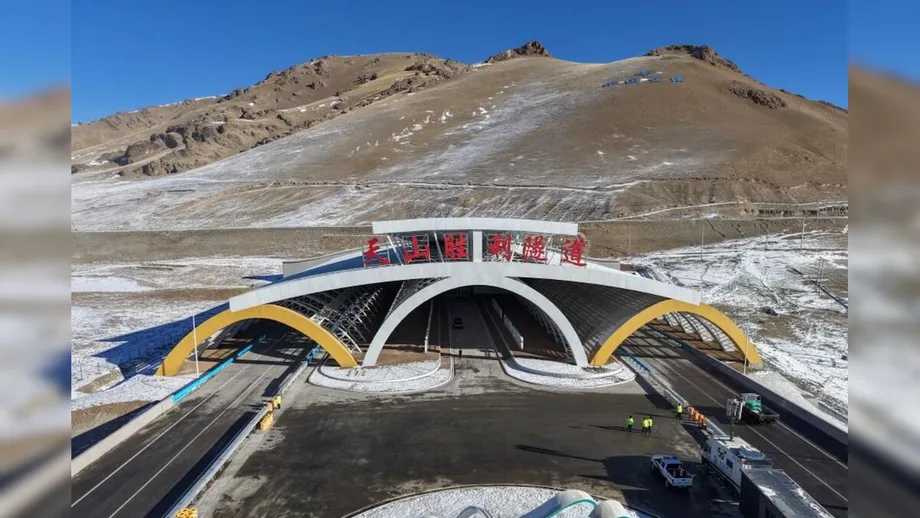
Another tunnel already shows what crossings can do. The 22.13 km Tianshan Shengri Tunnel was completed in 2024 and cut driving across the middle Tianshan from several hours to about 20 minutes. G3033 will work on a larger scale, crossing the range between north and south and linking with the existing transport network.
What Changes for Trade and Daily Life
Shorter crossings can change how people buy, sell and travel. In Xinjiang, apples picked in Aksu in the morning can reach supermarket shelves in Urumqi by evening. Yak meat from the Pamir Plateau can reach restaurants in Shanghai the next day by air freight. Faster road links across the Tianshan add another option for goods that need quick movement.
The wider transport base in Xinjiang has grown sharply. By the end of 2024, highways in Xinjiang exceeded 230,000 km, nearly 70 times the 3,361 km recorded when the People's Republic of China was founded. Laid end to end, those roads could circle the Earth almost six times. The railway network stretches over 9,557 km and covers more than 80 percent of county level areas.
Rail projects include the Lanzhou Xinjiang high speed railway, which links Urumqi to the national high speed grid. The Hotan Ruoqiang railway forms a loop around the Taklamakan Desert, and the Golmud Korla railway is the third major corridor into and out of Xinjiang. Freight figures show the scale of movement. In 2024, railway freight in Xinjiang reached 237 million metric tons, up 10.6 percent from the previous year.
Northern and southern Xinjiang are being drawn into a travel circle of about five hours. Desert edge cities, once separated from large markets by long journeys, are being pulled into a more connected industrial belt. Xinjiang covers about one sixth of the territory of China. As the core area of the Silk Road Economic Belt, it is building an open framework that links domestic and international markets and supports two way links between east and west. The railway linking China, Kyrgyzstan and Uzbekistan and the economic corridor linking China and Pakistan are also progressing.
What Travelers Should Know Before the New Road Opens
Until G3033 is finished, the Duku Highway remains a seasonal mountain route with special rules. Its steep grades and high pass mean visitors need to plan around weather, road status and permit rules. The northern section from Dushanzi to Nalati includes Dushanzi Grand Canyon, Tangbula Grassland and Haxilegen Pass. The middle section is a 61 km grassland stretch between Nalati and Bayinbulak. The southern section descends toward Kuqa through Bayinbulak wetland, Dragon Pools and the Tianshan Grand Canyon.
Foreign nationals are barred from independent self driving in Xinjiang. Travel permits for the Duku corridor take 2 to 4 weeks and are arranged through licensed agencies. A three day private car with a driver costs 3,000 to 5,000 yuan, while small group tours cost 2,500 to 4,000 yuan per person. A private guide and driver package costs 5,000 to 8,000 yuan for three days.
Those rules matter because the older road can close quickly once snow reaches the high pass. The new expressway is expected to remove the seasonal barrier, but it will not erase the need for safety rules on mountain roads. The 2032 target gives travelers a clear date to watch, while the current road still depends on the summer window.
The Engineering Lessons Already in Use
Building roads in Xinjiang has required methods for heat, cold, sand and ice. On highways crossing the Taklamakan Desert, grass planting techniques stabilize shifting dunes and keep the roadbed steady. In the Tianshan tunnels, designs must account for frost heave, the expansion of water in frozen ground that can crack concrete and distort a tunnel.
The G217 Duku Highway also uses an intelligent sentinel system to support traffic safety while the road is open. The Kuiduku Expressway adds a more direct answer to winter water: drainage tunnels placed below the main tunnels. Together, these methods show how transport work in Xinjiang has shifted from simply adding distance to solving local ground and climate problems.
What to Know
- G3033 is a 393.693 km expressway linking Kuitun and Dushanzi with Kuqa through the Tianshan.
- The project is planned for completion in 2032 and is listed under the 15th Five-Year Plan.
- Project descriptions put the crossing at four hours, down from 14; Xinjiang Transportation Investment Co., Ltd. uses about five hours.
- The route includes 147 bridges, 37 tunnels and 13 interchanges, with bridges and tunnels making up nearly 46 percent of the main line.
- Winter work includes cold proof drainage tunnels below selected tunnels, a first for expressway building in Xinjiang.
- The older Duku Highway remains seasonal and regulated until the new route opens.