Final Dress Rehearsal in the Gobi Desert
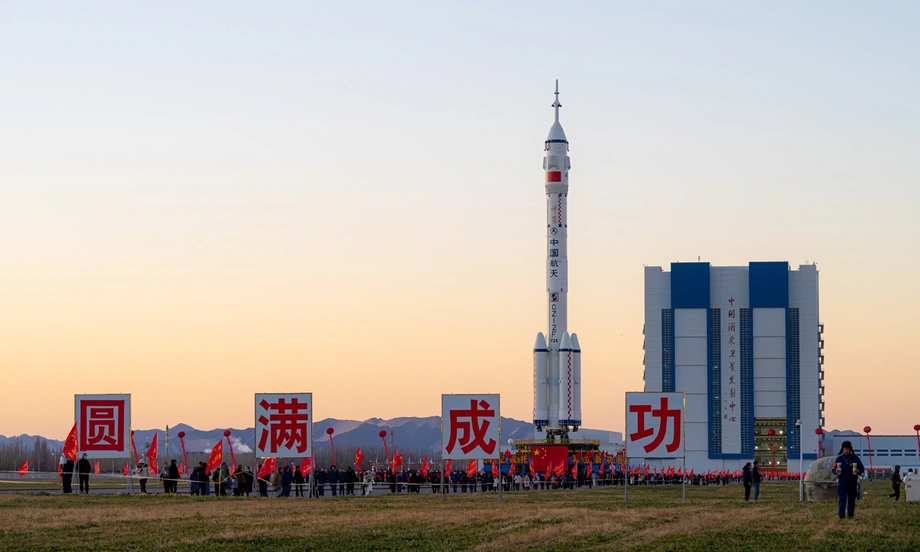
Three astronauts assigned to the Shenzhou-24 mission completed a full rehearsal on Saturday, November 21, 2026, at the Jiuquan Satellite Launch Center in northwestern China, preparing for a flight that will send the first foreign visitor to the Tiangong space station. The crew consists of two Chinese astronauts and one Pakistani payload specialist, marking the first joint flight of Chinese and foreign crew members in the history of the China Manned Space Program.
Contents
- Final Dress Rehearsal in the Gobi Desert
- Bilingual Manuals and Halal Space Food
- Two Pakistani Pilots Compete for One Seat
- How an Emergency Launch Reshaped the Timeline
- Jasmine Flowers and Map Reviews on the Mission Patch
- A Yearlong Stay and a Changed Crew Rotation
- Preparing a Six Person Dinner in Orbit
- At a Glance
The China Manned Space Agency has not yet announced the official launch time or the names of the three crew members. An airspace closure notice issued by the United States Federal Aviation Administration on the afternoon of November 20 points to a launch window on Wednesday, November 25, 2026, running from 8:08 a.m. to 8:48 a.m. Beijing time, with liftoff expected around 8:15 a.m. to 8:18 a.m. (00:18 Coordinated Universal Time). China's human spaceflight office is expected to hold a press conference on November 24 to announce the final crew roster and departure time.
Winter temperatures at the Gobi Desert launch site have dropped to between minus 3 and minus 4 degrees Celsius. Because the launch is scheduled for early morning, the three astronauts will hold their departure ceremony and board the spacecraft before dawn, during the coldest hours of the day.
Bilingual Manuals and Halal Space Food
The November 21 exercise was the final complete rehearsal before liftoff, matching the actual launch day procedures at a one to one scale. Under the unified command of the Beijing Aerospace Flight Control Center, the Jiuquan Satellite Launch Center, the Xi'an Satellite Control Center, and tracking stations across the network tested all technical systems and data flows from prelaunch preparation through flight.
The astronaut support system carried out medical checks, departure ceremony drills, cabin configuration checks, and boarding operations with the three crew members. To accommodate the international crew, engineers compiled dual language operating manuals in Chinese and English and prepared Halal space food matching the dietary customs of the Pakistani astronaut. Following the rehearsal, mission teams shifted their focus to medical supervision to keep the astronauts in peak physical and psychological condition.
According to the mission overview, Shenzhou-24 is the 24th flight of the Shenzhou spacecraft series, the 18th crewed flight, and the 41st mission overall in China's human spaceflight program. It is also the final crewed launch on China's 2026 spaceflight calendar.
Two Pakistani Pilots Compete for One Seat
One of two Pakistani military pilots, Muhammad Zeeshan Ali or Khurram Daud, will occupy the payload specialist seat on Shenzhou-24, while the other serves as the backup. A payload specialist focuses on operating scientific experiments and research equipment in orbit rather than flying the spacecraft. After a February 2025 cooperation agreement signed in Islamabad by the China Manned Space Agency and Pakistan's Space and Upper Atmosphere Research Commission (SUPARCO), the two candidates were chosen from a group of about 20 finalists in April 2026.
Muhammad Yousaf Khan, chairman of SUPARCO, explained that the Pakistani candidates trained alongside Chinese astronauts in China so that one would be selected to join a flight crew as early as October. Both candidates arrived at the Astronaut Center of China in Beijing on April 24, 2026, after completing Chinese language studies at the Islamabad Confucius Institute to prepare for technical commands and daily operations aboard the station.
During their training in Beijing, Chinese institutions selected four biotechnology experiments from more than 300 proposals submitted by Pakistani universities. Those experiments focus on microgravity research related to food security and climate change, examining how biological systems, fluids, and materials behave in near weightlessness.
Chinese Foreign Ministry spokesperson Guo Jiakun addressed the wider significance of the bilateral program during a press conference on April 24, 2026, when the two trainees arrived in Beijing. He pushed back against treating orbital research as a geopolitical contest and stated China's diplomatic position on international participation.
Space is not an "arena" of major-power rivalry, and China will continue to work with all parties to build an open "friend circle" in space and advance the common cause of mankind's exploration of outer space.
How an Emergency Launch Reshaped the Timeline
The path to the Shenzhou-24 launch pad involved an unexpected schedule adjustment late last year. When the China Manned Space Agency opened its public contest for 2026 mission patch designs on November 1, 2025, this flight was designated Shenzhou-23. Following the emergency launch of the Shenzhou-22 spacecraft on November 25, 2025, space officials renumbered the late 2026 mission as Shenzhou-24, accelerated spacecraft production for factory delivery in the summer of 2026, and reopened the emblem contest through December 30, 2025.
China follows a rolling backup strategy in which one rocket and spacecraft stand ready on the ground in case an emergency rescue is needed in orbit. The buildup for Shenzhou-24 proceeded through several steps over the past year:
- November 1 to December 30, 2025: The China Manned Space Agency solicited mission emblem designs, extending the deadline after renumbering the mission from Shenzhou-23 to Shenzhou-24 on November 26.
- January 30 to February 6, 2026: Ten candidate emblem designs were put to an online public vote.
- April 2026: The Long March-2F Y24 carrier rocket arrived at the Jiuquan Satellite Launch Center, and Pakistan announced the selection of Muhammad Zeeshan Ali and Khurram Daud.
- May 2026: Engineers completed vertical assembly and testing of the Shenzhou-24 spacecraft and rocket combination so it could serve as the ground emergency backup during the Shenzhou-23 launch.
- November 7, 2026: Officials unveiled the official mission emblem and confirmed the spacecraft assignment for the Pakistani astronaut.
- November 17, 2026: The combined Shenzhou-24 spacecraft and Long March-2F Y24 rocket rolled out vertically to the launch pad between 5:30 p.m. and 7:00 p.m. Beijing time.
- November 21, 2026: Ground systems and the three crew members completed the final launch site dress rehearsal.
- November 23, 2026: The Beijing Aerospace Flight Control Center adjusted the orbital attitude of the Tiangong space station in preparation for docking at the forward port of the Tianhe core module.
Jasmine Flowers and Map Reviews on the Mission Patch
Unlike previous years when all annual mission emblems were released together early in the year, the Shenzhou-24 patch was held back until November 7, 2026. Because an earlier Shenzhou-23 mission emblem had contained a map error, officials submitted the Shenzhou-24 design to China's Ministry of Natural Resources for cartographic review before publication, establishing a new inspection rule from this mission onward.
The chosen symmetrical emblem shows an overhead view of the Shenzhou spacecraft approaching the forward docking port of the Tianhe core module in blue and red tones. In the background, a full view of Earth places China and Pakistan at the center. The outer ring features ancient Chinese dragon patterned jade ornaments called huang alongside the white jasmine flower, Pakistan's national floral symbol, marking the joint crew composition.
A Yearlong Stay and a Changed Crew Rotation
The short visit by the Pakistani payload specialist will alter the standard six month handover pattern aboard Tiangong. After docking at the Tianhe core module's forward port, the Pakistani astronaut will remain in orbit for roughly one week to ten days before returning to Earth aboard the Shenzhou-23 spacecraft.
To balance the three seats on each spacecraft, two members of the current Shenzhou-23 crew, which consists of astronauts Zhu Yangzhu, Zhang Zhiyuan, and Li Jiaying, will return to Earth alongside the Pakistani visitor. The remaining Shenzhou-23 astronaut will stay aboard Tiangong to carry out a long duration residency test lasting more than one year, eventually returning to Earth in May 2027 with the two Chinese astronauts launched on Shenzhou-24. Officials have not yet announced whether Zhu, Zhang, or Li will undertake the yearlong stay; that assignment will be disclosed at the prelaunch press conference. Astronauts selected from Hong Kong and Macau are also considered candidates for one of the Chinese seats on Shenzhou-24.
Preparing a Six Person Dinner in Orbit
Aboard the Tiangong space station, the Shenzhou-23 crew is nearing the six month mark since arriving in orbit on May 24, 2026. Video footage released by the China Manned Space Agency on Tiangong TV shows Zhu Yangzhu, Zhang Zhiyuan, and Li Jiaying shifting from scientific research to station housekeeping as they prepare to double the station's population from three people to six, a doubling that requires twice the daily supply of oxygen, drinking water, and living space.
Doubling the crew places an immediate load on the station's closed loop environmental systems, which recycle cabin air, sweat, and wastewater to reduce the need for cargo resupply flights from Earth. Over the past week, the Shenzhou-23 astronauts adjusted the parameters of the regenerative life support system, checked the waste collection units in the space lavatory, configured lighting in the sleeping quarters, and stowed floating cargo bags to clear movement corridors.
The orbital crew also inspected and serviced the space kitchen appliances to prepare a joint welcome dinner for the incoming Chinese and Pakistani astronauts. Alongside their housekeeping duties, the three astronauts completed routine checks of the extravehicular spacesuits, replaced samples in the high temperature materials cabinet, recovered samples from the variable gravity experiment cabinet, repaired components in an inertial particle device, and installed test samples for rapid microbial detection and protective materials.
In preparation for the departure of two crew members, the Shenzhou-23 astronauts collected cabin gas, water quality, and microbial samples to bring back to Earth. They also underwent bone density measurements and muscle ultrasound scans to track how six months of weightlessness has affected their bodies, with Li Jiaying using the onboard treadmill to counter muscle loss and bone demineralization before the return flight.
At a Glance
- Launch Window: Expected on Wednesday, November 25, 2026, between 8:08 a.m. and 8:48 a.m. Beijing time (around 00:18 UTC) from the Jiuquan Satellite Launch Center.
- Crew Composition: Two Chinese astronauts and one Pakistani payload specialist (either Muhammad Zeeshan Ali or Khurram Daud), with final names to be announced on November 24.
- Historic Firsts: The first foreign astronaut to visit the Tiangong space station, the first Pakistani national in orbit, and the first joint flight in China's human spaceflight program.
- Special Preparations: Engineers prepared dual language Chinese and English operating manuals, Halal space food, and a mission emblem verified by the Ministry of Natural Resources featuring Pakistan's national jasmine flower.
- Rotation Shift: The Pakistani astronaut will stay for seven to ten days and return on Shenzhou-23 with two Chinese astronauts, while one Shenzhou-23 crew member (Zhu Yangzhu, Zhang Zhiyuan, or Li Jiaying) stays behind for a yearlong orbital test until May 2027.