A Rust Heap That Changes the Picture
Near Xi'an in Shaanxi Province, the mausoleum of Qin Shihuang, the First Emperor of a unified China, is best known for its army of clay soldiers. Inside one of the large tombs west of the emperor's mound, archaeologists have found the remains of what was probably a real suit of iron armor. The find is described in a study published in Antiquity on November 26, 2026, by Michael Charlton of the UCL Institute of Archaeology, Wenbin Shao of the Emperor Qin Shihuang's Mausoleum Site Museum, and colleagues.
Contents
- A Rust Heap That Changes the Picture
- What Did Excavators Find in Tomb M1?
- Why Does the Heap Look Like One Suit of Armor?
- What Do the Scales Look Like, and How Were They Joined?
- What Did Red and Black Traces Reveal?
- How Did Qin Smiths Make the Iron?
- Why Does the Terracotta Army Look Different?
- What Would Such Armor Cost?
- How Early Was Iron Armor in China?
- Why Do Bronze Weapons Still Dominate the Mausoleum?
- What Comes Next for the Research Team?
- Key Points
The object may be China's earliest known complete iron scale armor corselet. A corselet is body armor covering the torso. Scale armor is made from small overlapping plates, each pierced so cord can pass through and tie it to its neighbors. The mausoleum complex was built between 248 and 208 BCE, covers about 56 square kilometers (22 square miles), and contains more than 500 tombs and burial pits. The Terracotta Army was discovered in 1974, and UNESCO inscribed the mausoleum on the World Heritage List in 1987.
That long history makes the rust heap striking. For decades, the clay army has shaped the public picture of Qin military equipment, with leather looking common and bronze weapons abundant. An iron corselet from a high status tomb adds a different material to the story. It also revives a question that cannot yet be settled: was iron armor a rare elite possession, or an early sign of a wider change in how Qin forces were equipped?
Michael Charlton and Wenbin Shao described the object as likely the earliest known Chinese example of a complete iron scale armor corselet. Their conclusion rests on the tomb, the pile of scales, and a close study of tiny pieces that were once joined into a flexible garment.
What Did Excavators Find in Tomb M1?
Tomb M1 was excavated between 2013 and 2023. It is the third of nine large tombs stretching west beyond the outer enclosure of the emperor's tomb. Its main chamber covers 1,900 square meters and lies 15.6 meters below ground. crews found two coffins, a large four wheeled wooden carriage, prestige objects, and, in three smaller side pits, horse and chariot burials.
No other Qin tomb excavated so far has produced richer material or better preservation. The occupant has not been identified. The coffins, carriage, and armor suggest a person of high rank, possibly a military commander, a senior official, or a member of the royal family. No inscription has given that person a name or title.
The tomb lies within one of the most important burial complexes in the world, but that setting also makes identification hard. A person buried beside the First Emperor had to be close to power. The armor strengthens that inference without adding a name.
Why Does the Heap Look Like One Suit of Armor?
The iron scales lay on the southern side of the main chamber. The deposit measured about 40 by 30 by 10 centimeters, a small patch for something that once covered a torso. It was lifted in three blocks of sediment so researchers could study the positions of the pieces. A ceiling had collapsed long ago, and the researchers think the scales fell from a shelf into a semi organized heap.
Corrosion has broken much of the metal into tiny fragments and iron powder, but at least 200 larger pieces survived. The team studied 81 loose scales in detail. They estimate that the original garment held 800 to 1,200 scales. A helmet of this kind would need only 80 to 90 scales, and several suits would require far more. The shape of the pieces also fits a corselet rather than a helmet, because the irregular or triangular scales typical of helmets are missing.
With an average of about 6 grams per scale, plus the cord used for lacing, the armor would have weighed about 10 kilograms (22 pounds). Leather scale corselets of the period are estimated at 4 to 5 kilograms. Other metal scale corselets can weigh 10 to 25 kilograms. The M1 garment therefore sat at the lighter end of metal body armor while being much heavier than leather.
What Do the Scales Look Like, and How Were They Joined?
The most common scale is a slightly curved rectangle, roughly 33 by 29 millimeters and 1.5 millimeters thick. It weighs about 5 grams and has 10 small holes along three sides. A larger type weighs about 8 grams and has 11 holes. A few smaller, longer pieces suggest a third form shaped like a fish scale, with five or more holes.
Those holes matter because they show how the armor worked. Cord passed through them to join each scale to its neighbors, creating a surface that could bend with the body while still blocking cuts and blows. A damaged scale could be retied, which made this kind of armor practical to repair even when it was costly to make.
What Did Red and Black Traces Reveal?
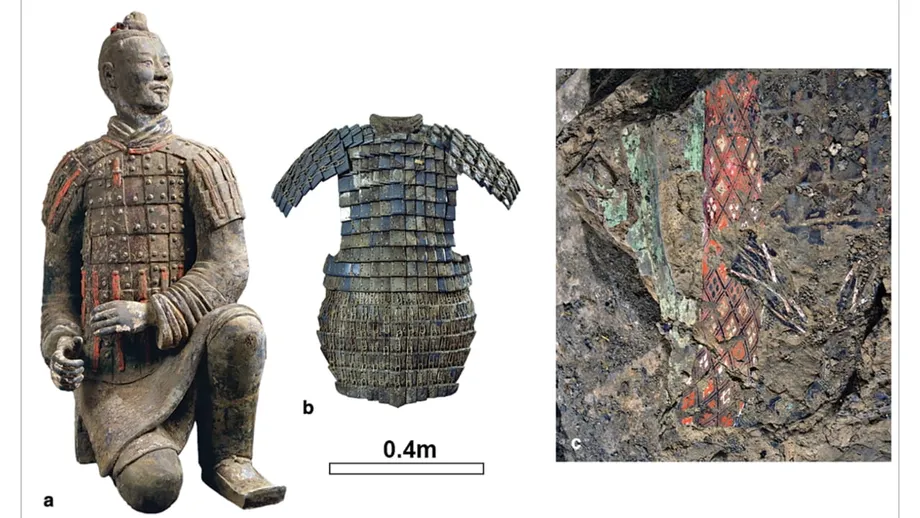
Micro X ray fluorescence, a method that maps chemical elements on a surface, found mercury and sulfur together on nearly every scale tested. The researchers identified this as cinnabar, a red mercury mineral used as a pigment in ancient China. Several scales still carried bright red traces.
Other pieces had flakes of a smooth black layer, probably lacquer, a hardened plant resin used for protection and decoration. The layer contains chromium, but its origin is uncertain. It may have come from the original recipe, or it may have seeped in from the surrounding soil. No gold or silver plating was found. That differs from a later Han Dynasty iron corselet from Linzi, which had 2,142 scales and was decorated with silver and gold.
How Did Qin Smiths Make the Iron?
Five scales were cut and examined under optical and scanning electron microscopes. A scanning electron microscope uses a focused beam of electrons to reveal very small structures. The carbon content was low, between 0.1 and 0.4 percent by weight. The metal grains measured 10 to 20 microns across, a sign of heavy hammering, and slag was scarce.
Michael Charlton of the UCL Institute of Archaeology and his coauthors gave the laboratory result in technical terms:
The microstructure and internal composition of the scales indicate the use of a mild steel forged into thin sheets.
The most likely production route began with cast iron, which is hard but brittle because it contains too much carbon. Smiths could heat it in air in a process called fining, which removes carbon and makes the metal easier to work. They then hammered the result into thin sheets and cut scales from them. Solid state smelting, in which iron forms without passing through a fully molten stage, remains possible because the sample was small and some data were limited.
The same authors explained that the smiths did not keep the carbon perfectly even:
The result was a scale with soft edges and cores of variable hardness.
Why Does the Terracotta Army Look Different?
The Terracotta Army gives researchers a comparison inside the same burial complex. Most clay scales on the warriors are brown and unpigmented, which suggests they copy leather or rawhide. Smaller gray scales on some higher ranking figures may represent iron. Pit 1 has about 1,000 warriors unearthed, and the study notes that about five times as many may still be underground.
Accessory pit K9801 tells a different story. It covers about 1.3 hectares and is the second largest known accessory pit in the complex. Only about 1 percent has been excavated, yet crews recovered 87 stone corselets, 43 stone helmets, parts of horse armor, and scales joined with flat copper wire.
The stone scales look much like the scales from Tomb M1 and are smaller than those shown on the clay figures. The researchers suggest that the clay armor copies leather while the stone armor copies iron. In that reading, the terracotta figures were not simply showing every kind of equipment used by Qin soldiers. Some details may have translated expensive materials into clay or stone for burial.
What Would Such Armor Cost?
Qin legal texts written on bamboo slips from tomb 11 at Shuihudi in Hubei Province help gauge the value of armor. Bamboo slips were strips of bamboo tied together as writing material. The texts set punishments in labor, including the making of military equipment. The study uses an equivalence of six to eight yuan per day, produced by a 2010 study, to calculate that one set of armor was worth 168 to 224 days of labor. A set of cords was worth only two or three days.
The text probably refers to a simple leather corselet for infantry. An iron corselet with 800 to 1,200 smaller scales and more holes per piece would have demanded much more work. The authors suggest it might have kept a small workshop busy for a year or more.
Other details show how organized that work could be. The state stored leather and tended lacquer tree plantations. The Zhouli, a ritual classic from around 300 BCE, mentions rhinoceros, buffalo, and wild ox hides for armor, along with lacquer. The labor question also connects with evidence from the terracotta workforce fingerprints, which assigned 45 percent of 79 prints to adult men, 32.7 percent to adult women, and 22.3 percent to juveniles under 15. Those figures describe the prints examined, not the full workshop population, but they show how buried objects can reveal the people behind production.
How Early Was Iron Armor in China?
Scale armor was already known far beyond China. Between about 500 and 300 BCE, it appeared in wealthy burials and art in Macedonian Greece, Thrace, and Crimea. It remained a constant though more minor feature of Roman armor in western Europe for centuries afterward.
The Chinese record is thinner. The earliest definitive iron scale armor previously known was a helmet from Yanxiadu in northeastern China, made of 89 scales and dated broadly to between 475 and 220 BCE. Workshop areas at the same site produced another 222 helmet pieces and 270 iron scales. Earlier candidates include 42 bronze plates from a Western Zhou tomb at Chang'an. Iron tools were used in China by the fifth century BCE, but iron weapons became widespread only in the third century BCE or later. Bronze could be cast with great precision, which helps explain why it remained important.
Why Do Bronze Weapons Still Dominate the Mausoleum?
Iron swords were found in Tomb M1, yet the mausoleum holds tens of thousands of bronze weapons. That imbalance is one of the puzzles left by the find. Researchers have suggested that some bronze weapons may have come from older military stockpiles. Old reign dates on weapons from Pit 1 support the idea that the army buried with the emperor included aging equipment. The researchers also cite historian Donald Wagner's view that the bronze was symbolic.
Work on the clay army adds detail to the production side. Xiuzhen Li, Andrew Bevan, and colleagues showed in 2014 that crossbow triggers were made in batches and used to equip groups of terracotta crossbowmen in Pit 1. A 2018 study by Bevan, Li, and colleagues found soot based ink marks on two of those triggers, offering another glimpse of marking practices behind Qin weapon production.
The M1 armor does not settle the debate. It shows that high status iron body armor existed inside the emperor's complex. It leaves open whether such equipment was reserved for elites or belonged to a broader shift from bronze to iron. For ordinary soldiers, that distinction matters because body armor affected weight, cost, repair, and survival in battle.
What Comes Next for the Research Team?
The team plans to study more iron tools and weapons from the mausoleum complex. That work could show whether the M1 corselet was isolated or part of a larger iron working tradition near the emperor's burial. No date was given for the next studies. Funding comes from the Arts and Humanities Research Council and the British Academy.
Michael Charlton of the UCL Institute of Archaeology and his coauthors ended the study with a proposal for future work:
the iron armour from tomb M1 invites more detailed investigations of its origins and the organisation of the labour that produced it.
Key Points
- Tomb M1 near Xi'an yielded the likely earliest known complete Chinese iron scale armor corselet.
- The tomb was excavated from 2013 to 2023 and is the richest and best preserved Qin tomb dug so far.
- The armor held an estimated 800 to 1,200 scales and weighed about 10 kilograms.
- Tests found low carbon steel, cinnabar pigment, possible lacquer, and no gold or silver plating.
- Stone and clay armor in the mausoleum may copy leather and iron equipment used in life.
- Qin legal texts suggest one basic armor set was worth 168 to 224 days of labor.
- The find leaves open whether iron armor was an elite item or part of a wider military shift.